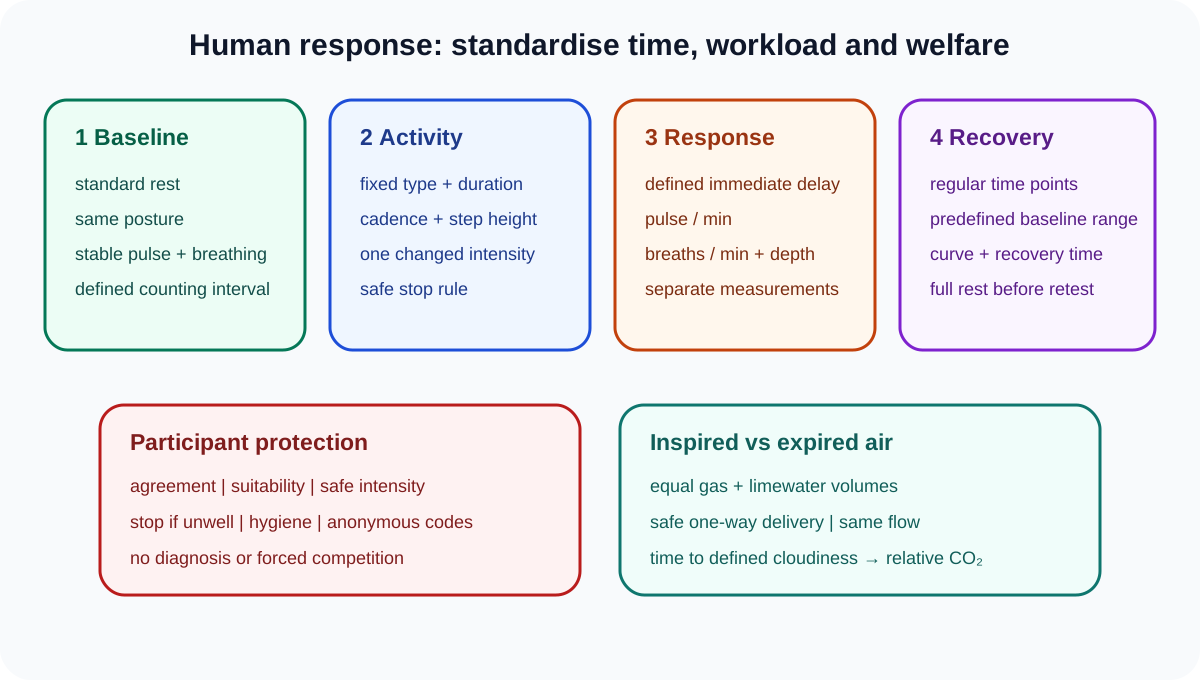
Heart rate and breathing rate are explicit Cambridge IGCSE Biology practical contexts. Topic 11 also requires investigation of physical activity effects on breathing rate and depth and comparison of inspired and expired air using limewater. Human investigations need reproducible timing, controlled activity, participant welfare and appropriately limited conclusions.
Define the measured outcome
Heart rate is beats per minute. Pulse rate is commonly used as a proxy because each heartbeat normally produces a pressure pulse in an artery.
Breathing rate is breaths per minute. Breathing depth describes the volume moved per breath, not how forcefully a participant appears to breathe. Direct depth measurement needs suitable apparatus; chest movement or another supplied measure is only a proxy.
Ventilation rate combines rate and volume per breath. Do not call breathing rate alone ventilation volume.
Recovery time is the time taken for a response to return to a defined baseline or threshold. State the criterion before analysing data.
Establish a baseline
Ask the participant to sit quietly in the same posture for a standard rest period. Measure resting pulse and breathing rate more than once until readings are reasonably stable.
Use the same counting interval for every measurement. A full minute reduces multiplication and short-interval fluctuation, while a shorter interval may be necessary immediately after exercise. If counting for 15 or 30 seconds, convert correctly to a per-minute rate.
Record room temperature, recent activity and time of measurement where relevant. An unstable baseline weakens every comparison that follows.
Measure pulse consistently
Locate a pulse at the wrist or another instructed safe site using fingertips rather than a thumb, which has its own detectable pulse. Count beats for the defined interval.
An electronic heart-rate sensor can reduce counting burden and provide continuous recovery data, but check placement and recording interval. It does not remove biological variation or the need for a stable baseline.
Manual counting can miss beats at high rates. Two observers should not press simultaneously on different sites in a way that changes the method. Use one standard protocol.
Measure breathing rate and depth
Count one complete inhale-exhale cycle as one breath. Observe discreetly because conscious attention can change breathing.
Use the same posture and interval. If breathing depth is required, use supplied spirometry, chest displacement or another defined method. A larger chest movement may indicate greater depth but is not automatically an exact volume.
Check this topic from memory
Attempt the matching topic bank before reopening the notes. Use each missed idea to decide what to review next.
Do not ask participants to hold their breath or breathe through unsuitable apparatus unless the approved procedure specifically requires it.
Standardise physical activity
Choose a safe activity such as stepping at a fixed height and pace for a fixed time. Use a metronome or timed signal to standardise pace.
Keep activity type, duration, step height or distance, cadence, posture and room conditions constant. Define the starting and stopping instructions.
Exercise intensity can be the independent variable if deliberately changed through cadence, duration or another measurable setting. Do not change pace and duration together when testing one factor.
The participant should stop if they feel unwell, dizzy, breathless beyond the approved level or otherwise unable to continue safely.
Capture the immediate response
Begin the first post-exercise measurement at a defined delay. Heart and breathing rates begin recovering quickly, so inconsistent delay creates a major systematic difference.
One approach counts for a short fixed interval immediately and converts to per minute. Another uses a sensor continuously. Apply the same approach to every trial.
Record pulse and breathing separately. Do not infer one from the other.
Construct a recovery curve
Measure at regular intervals after exercise until the value returns to the defined baseline range. Plot time after exercise on the x-axis and rate on the y-axis.
The curve can show immediate response, rate of decline and recovery time. A participant may briefly overshoot or fluctuate, so define recovery as remaining within a chosen baseline range rather than touching one value once.
Use actual time stamps if a measurement interval spans several seconds. Avoid plotting every converted value as if it were instantaneous without acknowledging the counting window.
Compare within one participant
A repeated-measures design compares the same person under different safe activity intensities. This reduces between-person variation in age, body size and fitness.
Allow full recovery between trials. Randomise or counterbalance condition order to reduce fatigue and practice effects. Repeating hard exercise without recovery changes the starting state.
Day-to-day variation from sleep, food, stress, illness and previous activity can remain. Repeat on separate occasions under similar conditions where appropriate.
Compare between participants
People differ in age, sex, body size, fitness, health, medication, sleep, stress and exercise familiarity. These may confound an observed association.
Use a suitable sample rather than one person per group. Match relevant characteristics or record them for interpretation. Keep the exercise and measurement protocol identical.
An association between faster recovery and training status does not prove training is the only cause. Qualify the conclusion and avoid diagnostic health claims.
Protect participants and data
Obtain informed agreement through the centre's approved procedure. Do not include anyone for whom the activity is unsuitable. Avoid maximal exertion and invasive measurement.
Provide a clear stop rule, safe space, stable equipment and recovery period. Clean shared sensors according to instructions.
Use anonymous participant codes rather than unnecessary names. Report grouped or de-identified results where possible.
The investigation should not pressure a participant to disclose medical information publicly or compete beyond safe intensity.
Compare inspired and expired air
Limewater turns cloudy in the presence of carbon dioxide. To compare inspired and expired air, pass equal volumes through equal limewater volumes using the approved one-way apparatus or method.
Expired air normally makes limewater cloudy more quickly because it contains more carbon dioxide than inspired air.
Do not inhale through limewater or allow liquid to reach the mouth. Use a safe apparatus with traps, one-way routing or pumping as specified. Follow centre hygiene instructions and do not share mouthpieces without approved controls.
Time to the same cloudiness is an endpoint proxy. Define cloudiness using a reference or instrument where possible and control gas volume and flow rate.
Improve measurement quality
Use a metronome for cadence, a fixed step for workload and a scripted transition to post-exercise measurement. A sensor can reduce reaction-time and counting error.
For breathing, video or a second observer may permit later checking only with consent and approved privacy handling. Discreet observation reduces conscious breathing changes.
Increase independent participants to improve representativeness and repeat trials to assess within-person reliability. These solve different limitations.
Interpret biological patterns
Physical activity commonly raises heart rate so blood transports more oxygen and glucose and removes carbon dioxide more rapidly. Breathing rate and depth increase to support gas exchange and respond to increased carbon dioxide.
After activity, rates remain elevated during recovery. Interpret the observed duration and magnitude rather than assuming every participant follows one curve.
A higher immediate rate may reflect workload, baseline, fitness or measurement timing. Conclusions need the controlled design and quoted evidence.
Evaluate limitations
Manual counting error is larger at high rates. Inconsistent post-exercise delay can dominate results. Unstandardised step pace changes workload, and incomplete recovery contaminates later trials.
Participant motivation and technique may vary even with a metronome. A sensor improves measurement but not activity standardisation.
Small samples limit generalisation. Repeating one person many times improves within-person reliability but not population representation.
For limewater, unequal gas volume, flow rate, limewater volume or subjective cloudiness invalidates comparison. Standardise each and use a defined endpoint.
Worked application: compare two recovery trials
One participant has a resting pulse of 72 beats/min. After two minutes of stepping at 20 steps/min, pulse is 108 immediately, 88 after two minutes and 74 after four minutes. At 30 steps/min, values are 132, 104 and 82 beats/min. The faster cadence produced a larger response and slower recovery in this participant under these trials. It does not prove the effect for everyone. The order should be randomised, full baseline recovery confirmed, step height and immediate-measurement delay controlled, and trials repeated before comparing mean curves.
Common misconceptions and corrections
Calling pulse rate blood pressure. They are different measurements.
Using the thumb to feel a pulse. Its own pulse can interfere.
Counting for different intervals without conversion. Standardise or convert to per minute.
Multiplying a 15-second count by two. Multiply by four.
Calling one inhale one complete breath. Count the full cycle.
Saying breathing rate is breathing depth. Rate and volume per breath differ.
Calling breathing rate alone ventilation volume. Depth also matters.
Skipping the rest period. Baseline may be unstable.
Using one baseline reading after recent movement. Confirm stability.
Changing exercise pace and duration together. Isolate the factor.
Letting participants choose their own step height. Workload differs.
Starting measurement after an undefined delay. Recovery begins immediately.
Comparing manual and sensor methods as identical. Their sampling differs.
Inferring breathing rate from pulse. Measure each response.
Stopping recovery measurement at one baseline touch. Define a stable criterion.
Starting a second trial before full recovery. The baseline differs.
Always testing the hardest condition last. Order effects can bias results.
Calling one participant representative. A population needs independent participants.
Saying many repeats on one person enlarge population sample. They do not.
Claiming fitness is the sole cause of recovery difference. Confounders remain.
Making a medical diagnosis from classroom data. The investigation is not diagnostic.
Ignoring consent because the activity is familiar. Human research still needs agreement.
Encouraging maximal effort. Use safe approved intensity.
Sharing mouthpieces without hygiene control. Follow approved procedures.
Breathing limewater into the mouth. Use safe one-way apparatus.
Calling cloudy limewater oxygen evidence. It indicates carbon dioxide.
Using unequal gas volumes in the air comparison. Standardise delivery.
Defining cloudiness differently between trials. Use one endpoint rule.
Saying sensors fix exercise inconsistency. They improve measurement only.
Generalising a correlation as causation. Qualify the inference.
Assessment guidance
Define baseline, activity workload, measurement interval and immediate post-exercise delay. Keep pace, duration, step height, posture and environment constant, then record pulse and breathing separately through recovery. Human-investigation answers need consent, suitability, safe intensity, a stop rule and de-identified handling. Distinguish repeats within one person from independent participants. Conclusions should quote rates and remain within the tested people and conditions. Inspired-expired air comparisons need safe one-way handling, equal gas and limewater quantities and a defined cloudiness endpoint. Target improvements to counting, delay, workload, recovery, sampling or endpoint limitations.
Retrieval practice
Design a safe step-test protocol with baseline criteria, workload, post-exercise timing and a recovery graph. Compare within-person and between-person designs and list confounders for each. Practise rate conversion from 15, 20 and 30-second counts. Design a safe limewater comparison, then diagnose inconsistent delay, incomplete recovery, unstandardised cadence, small samples and subjective cloudiness.
Theory and practical ownership
This practical note owns human response measurements, activity control, recovery analysis, participant safety and inspired-expired air comparison. Transport, gas-exchange and respiration theory notes own circulatory and ventilatory mechanisms. Practical 2 owns general planning vocabulary.