Cambridge IGCSE Biology Notes 3: Movement Into and Out of Cells
Cambridge IGCSE Biology Notes 3: Movement Into and Out of Cells
Study guide/
Cambridge IGCSE Biology 0610 and 0970 notes on diffusion, osmosis, active transport, water potential, plant-cell responses, transport proteins and factors affecting diffusion.
Topic 3 of Cambridge IGCSE Biology 0610 and 0970 distinguishes diffusion, osmosis and active transport by the particles moved, gradient direction, membrane requirement and energy source. Core candidates also study the biological importance and investigation of diffusion and osmosis. Extended candidates add water potential, detailed plant-cell responses, protein carriers and the importance of active transport.
3.1 Diffusion
Definition and particle model
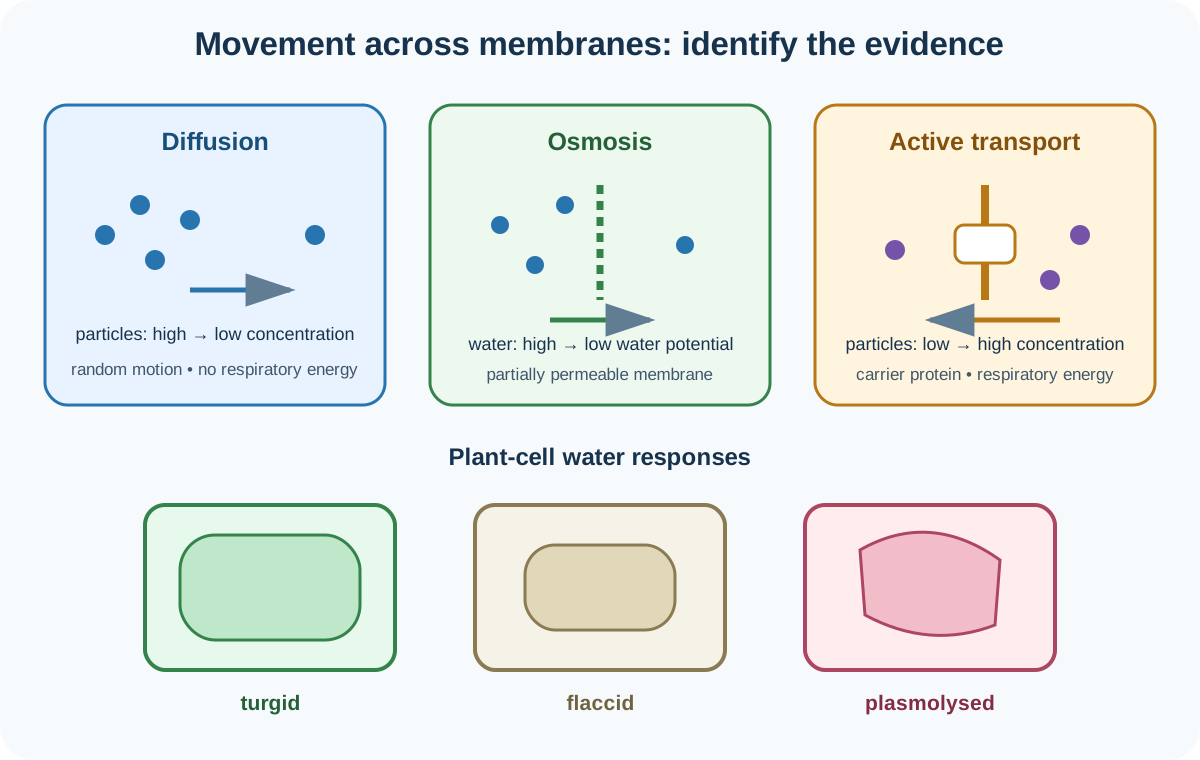
Diffusion is the net movement of particles from a region of higher concentration to a region of lower concentration, down a concentration gradient, as a result of their random movement.
All particles continue moving randomly. "Net movement" means that more particles cross in the down-gradient direction per unit time than cross in the opposite direction. At equilibrium, movement continues in both directions but there is no net change in concentration.
The energy for diffusion comes from the kinetic energy of the randomly moving molecules and ions. It does not require energy released by respiration.
Diffusion through cell membranes
Some substances move into and out of cells by diffusion through the cell membrane. Oxygen can diffuse from a higher concentration in alveolar air into blood, then from blood into respiring cells. Carbon dioxide can diffuse in the reverse overall direction. Digested soluble nutrients can diffuse when their concentration gradient and membrane properties allow.
The membrane is not required for the definition of diffusion itself. Diffusion also occurs through gases and liquids without a membrane. Whether a substance crosses a cell membrane depends on its properties and the membrane.
Factors affecting diffusion rate
The official investigation factors are surface area, temperature, concentration gradient and distance.
Larger surface area: more particles can cross simultaneously, increasing total transfer per unit time.
Higher temperature: particles have greater average kinetic energy, move faster and spread more rapidly.
Steeper concentration gradient: a larger concentration difference produces a greater net movement per unit time.
Shorter distance: particles have less distance to travel, so diffusion is faster.
When comparing biological exchange surfaces, state which factor changes. A thin alveolar wall provides a short diffusion distance; many alveoli provide a large surface area; ventilation and blood flow help maintain concentration gradients.
Check this topic from memory
Attempt the matching topic bank before reopening the notes. Use each missed idea to decide what to review next.
An investigation should vary one factor while controlling the others. Agar cubes can show how size affects diffusion distance, but colour change through the cube is an indirect indicator and should not be confused with direct measurement of particle speed.
3.2 Osmosis
Water as a solvent
Water acts as a solvent in organisms. In digestion, soluble products can be transported and absorbed. In excretion, wastes such as urea are carried in solution. In transport, blood plasma and plant fluids carry dissolved substances.
Core description
Water diffuses through partially permeable membranes by osmosis. Water moves into and out of cells through the cell membrane.
A partially permeable membrane allows some particles, including water molecules, to pass while restricting others. Osmosis describes movement of water molecules, not movement of the dissolved solute or the whole solution.
Water potential: Supplement
Osmosis is the net movement of water molecules from a region of higher water potential, a more dilute solution, to a region of lower water potential, a more concentrated solution, through a partially permeable membrane.
Pure water has a higher water potential than a solution containing dissolved solute under the same conditions. Adding solute lowers water potential. Water-potential language tracks the direction of net water movement and avoids saying that concentration alone moves water without naming which concentration is meant.
Dialysis-tubing investigation
Dialysis tubing models a partially permeable membrane. A solution is placed inside, the tubing is tied and rinsed, and its mass or volume is measured before and after immersion in another solution. A mass increase indicates net water entry; a mass decrease indicates net water exit.
The tubing must be checked for leaks and blotted in a consistent way before weighing. Surface liquid left on the outside can imitate a mass gain. Use equal tubing lengths, equal times and controlled temperature when comparing treatments.
This is a model rather than a complete cell. It lacks cytoplasm, active membrane transport and a cell wall.
Plant-tissue investigation
Plant tissue pieces, such as potato cylinders, can be immersed in solutions of different concentrations. Measure initial mass or length, keep dimensions and immersion time controlled, blot consistently and calculate change or percentage change.
Percentage change in mass is
initial massfinal mass−initial mass×100%.
A positive change indicates net water entry; a negative change indicates net water loss. A concentration at which percentage change is approximately zero estimates the concentration with no net water movement for that tissue under the tested conditions. It does not mean individual water molecules stop crossing.
Plant-cell responses
When water enters a plant cell, the vacuole expands and the contents press outward against the cell wall. The cell becomes turgid. Turgor pressure supports leaves and young stems. The rigid wall limits expansion and prevents the cell from bursting under ordinary osmotic entry.
When water leaves, turgor pressure falls and the cell becomes flaccid. With further water loss, the cell membrane and cytoplasm pull away from the cell wall; this is plasmolysis. The cell wall itself does not shrink away from the membrane.
Across a tissue, loss of turgor can cause wilting. Water potential and osmosis are therefore important in uptake and loss of water by organisms, cell support and maintenance of functioning tissues.
3.3 Active transport
Core definition
Active transport is the movement of particles through a cell membrane from a region of lower concentration to a region of higher concentration, against a concentration gradient, using energy from respiration.
Unlike diffusion, active transport can build or maintain a concentration difference. It always involves a cell membrane and a metabolic energy supply.
Carrier proteins and importance: Supplement
Protein carriers in the membrane move specific molecules or ions during active transport. Energy released by respiration changes carrier activity so particles can move against their gradient.
Root hair cells can absorb mineral ions from soil solution even when the ion concentration is lower outside than inside the cell. Their membranes contain carrier proteins, and mitochondria release energy through respiration. A lack of oxygen can reduce respiration and therefore reduce active ion uptake.
Active transport can move substances into or out of a cell. The defining feature is movement against the concentration gradient using energy, not movement in one anatomical direction.
Select the process from evidence
Ask five questions:
Which particles move?
In which direction relative to their concentration or water-potential gradient?
Is a partially permeable membrane specifically required?
Is energy from respiration used?
What biological outcome follows?
Water moving down a water-potential gradient through a partially permeable membrane is osmosis. Solute moving down its concentration gradient is diffusion. Solute moving against its concentration gradient using respiratory energy is active transport.
Worked application: interpret three cell-transport observations
A potato cylinder gains 8 percent mass in dilute solution, so water entered by osmosis from higher external water potential to lower tissue water potential through cell membranes. Another cylinder loses 12 percent mass in concentrated solution, so net water movement was outward and cells lost turgor. Neither result shows that water molecules moved in only one direction. In a separate root experiment, mineral-ion uptake continues when the external ion concentration is lower than the cell concentration but falls sharply when respiration is inhibited. Uptake is therefore active transport: ions move against their concentration gradient through carrier proteins using energy from respiration. Diffusion cannot explain accumulation against the gradient.
Common misconceptions and corrections
Defining diffusion as any particle movement. It is net movement down a concentration gradient due to random motion.
Saying particles move only from high to low concentration. They move randomly in both directions; the net movement is down gradient.
Saying particles stop at equilibrium. Random movement continues with no net change.
Giving respiration as the energy source for diffusion. Diffusion uses particle kinetic energy.
Requiring a membrane for all diffusion. Diffusion can occur without one.
Saying higher temperature steepens the concentration gradient. It increases particle kinetic energy.
Calling a large surface-area-to-volume ratio the named factor. The official factor is surface area; state the actual exchange consequence.
Saying shorter distance increases concentration. It reduces the travel path.
Changing cube size and temperature together. Control non-investigated diffusion factors.
Defining osmosis as movement of solution. It is net water-molecule movement.
Saying solute crosses by osmosis. Osmosis concerns water.
Omitting the partially permeable membrane. It is part of the Extended definition.
Using high concentration without naming water or solute. Use water potential or specify the substance.
Saying concentrated solution has higher water potential. Dissolved solute lowers water potential.
Saying pure water has zero water potential as a required IGCSE rule. The syllabus requires relative higher and lower water potential, not numerical potential.
Leaving dialysis tubing wet before weighing. Surface liquid can create a false mass gain.
Calling dialysis tubing a complete cell. It is a membrane model.
Using final mass alone to compare unequal samples. Calculate change or percentage change.
Saying zero mass change means no water crosses. It means no net movement.
Saying turgor comes from the wall absorbing water. Water enters the cell and contents press on the wall.
Saying a plant cell bursts whenever water enters. The wall resists expansion.
Calling a flaccid cell plasmolysed automatically. Plasmolysis requires the contents to pull from the wall.
Saying the cell wall pulls away during plasmolysis. The membrane and cytoplasm pull inward.
Defining active transport as fast diffusion. It moves against a gradient using respiratory energy.
Saying active transport always moves particles into cells. It can move them either direction against gradient.
Omitting the membrane from active transport. Carrier proteins act in the membrane.
Saying roots absorb mineral ions by osmosis. Osmosis moves water, not mineral ions.
Saying carrier proteins supply energy. Energy is released by respiration and used in carrier action.
Choosing a process without stating gradient direction. The direction is decisive evidence.
Assessment guidance
Use exact definitions: particle type, net direction, gradient, membrane and energy source all matter. Explain diffusion-rate changes through particle movement or exchange geometry, not memorised arrows. In osmosis questions, name relative water potentials and trace water, then connect entry or loss to turgid, flaccid or plasmolysed plant cells. For investigations, identify raw measurements, controls, consistent blotting and percentage change before interpreting the zero-change point. Diagnose active transport only when movement is against a concentration gradient and linked to respiratory energy and membrane carriers.
Retrieval practice
Compare diffusion, osmosis and active transport in a table using particle, gradient, membrane and energy evidence. Predict and explain dialysis-tubing and potato-tissue changes across three solutions, calculate percentage mass change, sequence turgid-to-plasmolysed cell states, and explain how temperature, surface area, gradient and distance affect diffusion rate. Then justify root mineral-ion uptake from respiration evidence.
Theory and practical ownership
This theory note owns transport definitions, mechanisms, rate factors, water potential, plant-cell consequences and carrier-protein reasoning. The separate Biology practical hub owns dialysis-tubing and plant-tissue setup, measurement, control variables, graphing, uncertainty and evaluation.