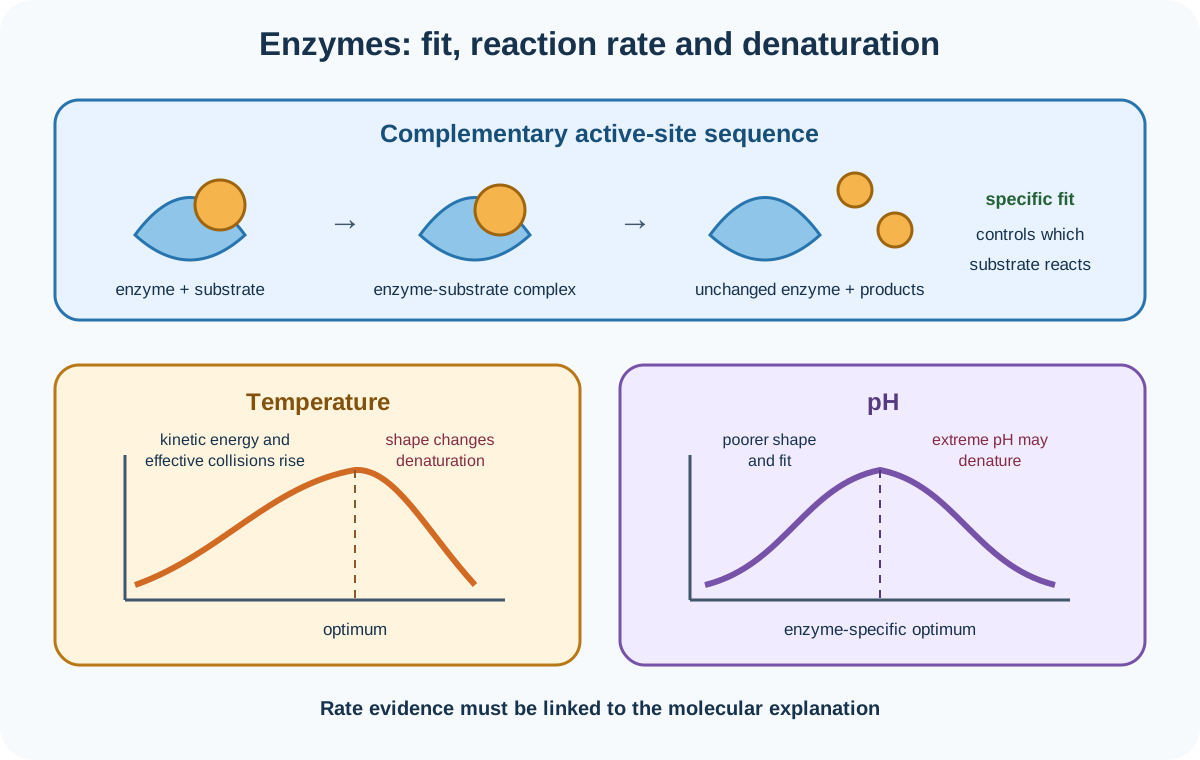
Topic 5 of Cambridge IGCSE Biology 0610 and 0970 develops enzymes as protein catalysts needed throughout metabolism. Core candidates describe catalyst behaviour, complementary active sites, product formation and the effects of temperature and pH. Supplement candidates explain specificity, enzyme-substrate complexes, effective collisions, shape and fit, and denaturation.
Catalysts and metabolic reactions
A catalyst increases the rate of a chemical reaction and is not changed by the reaction. It participates in the reaction pathway but is available again after products form. It does not become one of the products and is not steadily consumed.
Enzymes are proteins that function as biological catalysts. They are involved in all metabolic reactions. Metabolism means the chemical reactions taking place in cells and organisms, including reactions that build larger molecules and reactions that break molecules down.
Enzymes are important because uncatalysed reactions would often proceed too slowly at the temperatures compatible with life. Enzymes provide reaction rates that can sustain processes such as respiration, digestion, growth, repair and synthesis without requiring temperatures that would damage cells.
An enzyme changes reaction rate, not the identity of the reactants or products. It also does not provide the raw material for a reaction. Cells still need the correct substrate and suitable conditions.
Active-site action
The active site is a region of an enzyme with a particular three-dimensional shape. The substrate is the molecule on which the enzyme acts. For a reaction to occur, the substrate must fit the active site.
At Core level, describe the active-site shape as complementary to the substrate. Complementary means that the shapes match in a way that permits binding. The enzyme converts the bound substrate into product or products, which leave the active site. The enzyme can then act again.
At Supplement level, name the temporary enzyme-substrate complex. A complete sequence is:
Substrate molecules move and collide with the enzyme.
A substrate with the correct complementary shape fits the active site.
An enzyme-substrate complex forms.
The reaction takes place and product forms.
Product leaves because it no longer fits in the same way.
The unchanged enzyme is available for another substrate.
The active-site model is a molecular explanation, not a claim that enzymes and substrates are rigid household objects. What matters for this syllabus is complementary shape and fit.
Check this topic from memory
Attempt the matching topic bank before reopening the notes. Use each missed idea to decide what to review next.
Enzymes are specific because only a substrate with a complementary shape can fit a particular active site well enough for the reaction to occur. A differently shaped molecule may collide with the enzyme but will not form the required enzyme-substrate complex.
Specificity makes metabolism controllable. Different reactions need enzymes with different active sites. One enzyme does not catalyse every cellular reaction, even though enzymes share the broad role of biological catalyst.
Do not define specificity only by saying that an enzyme has "one job". The assessed explanation links the active site's complementary shape and fit to the substrate.
Temperature and enzyme activity
At low temperature, enzyme and substrate particles have less kinetic energy. They move more slowly, so collisions occur less frequently. Fewer collisions have the conditions needed to form enzyme-substrate complexes each second, and reaction rate is low.
As temperature rises, particles gain kinetic energy. They move faster, collision frequency increases and effective collisions occur more often. Reaction rate therefore rises toward an optimum temperature.
The optimum temperature is the temperature at which the measured enzyme activity is greatest under the stated conditions. It is not one universal value for every enzyme. It depends on the enzyme and its biological setting.
Above the optimum, increasing thermal movement disrupts bonds that maintain the enzyme's three-dimensional shape. The active site changes shape, so the substrate no longer fits as well. Fewer enzyme-substrate complexes form and activity falls rapidly. If the shape change prevents normal function, the enzyme is denatured.
Denaturation is a change in protein shape and active-site fit. It is not the enzyme being killed, because enzymes are molecules rather than living organisms. A low temperature usually slows activity without denaturing the enzyme. If the enzyme is warmed back to a suitable temperature, activity may increase again, provided it has not been damaged by another condition.
pH and enzyme activity
Each enzyme has an optimum pH at which its active-site shape and fit support the greatest measured activity. Moving away from this optimum can alter the interactions that maintain the protein's shape. The active site becomes less complementary to the substrate, fewer enzyme-substrate complexes form and rate falls.
An extreme pH may denature the enzyme. The pH-rate graph is often shown as a peak, but the optimum and curve width differ between enzymes. Do not assume that every enzyme works best at pH 7 or that all acidic conditions immediately denature every enzyme.
For a temperature explanation, Cambridge explicitly requires kinetic energy and frequency of effective collisions as well as shape, fit and denaturation. For a pH explanation, focus on shape, fit and denaturation. Do not invent a temperature-style kinetic-energy change when only pH changes.
Interpret enzyme evidence
Activity may be measured through product formed per unit time, substrate removed per unit time, gas volume produced per unit time, colour change or time taken to reach a stated endpoint. Identify what the graph or table actually measures before comparing values.
If identical endpoints are used, a shorter time usually means a faster rate. A reciprocal comparison can be written as:
relative rate=time1.
This produces a relative rate unless the endpoint corresponds to a known quantity of product or substrate. State units from the supplied time, such as per second.
When temperature or pH is varied, other important conditions must remain controlled, including enzyme amount, substrate amount, total volume and measurement method. This theory note owns the expected biological pattern and molecular explanation. The practical note owns detailed apparatus, range choice, controls, safety and evaluation.
Worked application: explain a temperature pattern
An enzyme reaches the same colour endpoint in 80 s at 20 °C, 40 s at 30 °C, 25 s at 40 °C and 100 s at 60 °C. Relative rates are 0.0125, 0.025, 0.040 and 0.010 per second, so the fastest measured condition is 40 °C. From 20 °C to 40 °C, greater kinetic energy increases collision frequency and the frequency of effective collisions, so more enzyme-substrate complexes form each second. At 60 °C, disruption of the enzyme's shape changes the active site. Complementary fit is reduced, fewer complexes form and the rate falls because the enzyme is denatured.
Common misconceptions and corrections
Saying a catalyst is used up. It is not changed by the reaction and is available again.
Saying an enzyme supplies energy to a cell. It increases reaction rate; it is not an energy source.
Calling every protein an enzyme. Enzymes are proteins here, but proteins have many other roles.
Restricting enzymes to digestion. They are involved in all metabolic reactions.
Saying enzymes make impossible products. They catalyse particular reactions between appropriate substances.
Calling the substrate the enzyme. The substrate is the molecule on which the enzyme acts.
Calling the active site a separate molecule. It is a region of the enzyme.
Saying complementary means identical. It means matching shapes that permit binding.
Omitting product formation from enzyme action. Bound substrate is converted and products leave.
Saying the enzyme-substrate complex is permanent. It is temporary.
Saying product remains attached forever. Product leaves and the enzyme can act again.
Explaining specificity only as one enzyme having one job. Link substrate fit to complementary active-site shape.
Saying any molecule can fit any active site. Incorrect shape prevents the required complex.
Saying low temperature kills an enzyme. It usually lowers kinetic energy and rate.
Saying low temperature denatures an enzyme. The normal explanation is slower movement and fewer effective collisions.
Saying rising temperature always increases rate. Rate falls after the optimum as active-site shape changes.
Calling the optimum the highest survivable temperature. It is the condition with greatest measured activity.
Giving one optimum temperature for every enzyme. Optima depend on the enzyme and conditions.
Saying heat changes the substrate only. The assessed explanation includes enzyme shape and fit.
Calling an enzyme alive and therefore killed. Use denatured for the protein shape change.
Saying denaturation means the enzyme is consumed. It means its functional shape has changed.
Omitting kinetic energy from a temperature explanation. It drives faster particle movement.
Omitting effective collisions. Not every collision leads to a bound complex and reaction.
Claiming pH changes particle kinetic energy. Explain pH through enzyme shape, fit and denaturation.
Assuming every enzyme has optimum pH 7. Different enzymes have different optima.
Saying any change from optimum instantly denatures the enzyme. Activity may first decline as fit becomes less favourable.
Reading longer endpoint time as faster. For the same endpoint, longer time means slower rate.
Calling reciprocal time an exact rate without qualification. It is relative unless the endpoint quantity is known.
Ignoring controlled variables when comparing results. A valid temperature or pH inference needs comparable conditions.
Describing apparatus when asked to explain a rate curve. Use kinetic energy, collisions, shape, fit and denaturation as required.
Assessment guidance
Start definition questions with the exact catalyst contract: reaction rate increases and the catalyst is not changed. For enzyme action, name active site, complementary substrate, enzyme-substrate complex and product in a logical sequence. Explain specificity through shape and fit. On a temperature curve, separate the rising limb from the post-optimum fall: kinetic energy and effective-collision frequency explain the rise, while active-site shape, poorer fit and denaturation explain the fall. For pH, use shape, fit and denaturation. Read axes and measurement direction before identifying an optimum, and distinguish an observation, such as shorter endpoint time, from the biological explanation.
Retrieval practice
Draw the six-stage enzyme-action sequence from free enzyme and substrate to product release. Explain why an incorrectly shaped substrate fails to react. Sketch separate temperature and pH activity curves, annotate each side of the optimum and convert four endpoint times into relative rates. Finish by comparing low-temperature slowing with high-temperature denaturation.
Theory and practical ownership
This theory note owns catalyst definitions, enzyme importance, active-site action, specificity and the molecular explanation of temperature and pH patterns. The separate Biology practical hub owns enzyme-investigation apparatus, range and interval selection, temperature equilibration, buffers, controls, endpoint reliability, safety, tables, graphs and evaluation.