Topic 12 of Cambridge IGCSE Biology 0610 and 0970 distinguishes cellular respiration from breathing and gas exchange. Official sections 12.1 to 12.3 cover the uses of released energy, temperature and yeast respiration, aerobic and anaerobic equations, the smaller anaerobic energy yield and the complete lactic-acid oxygen-debt recovery pathway.
Respiration releases energy for life
Respiration describes chemical reactions in cells that break down nutrient molecules and release energy. It occurs in living cells throughout an organism. Breathing ventilates lungs; gas exchange moves oxygen and carbon dioxide; respiration is the chemical process that releases energy.
Cambridge names seven uses of energy:
muscle contraction
protein synthesis
cell division
active transport
growth
passage of nerve impulses
maintenance of a constant body temperature
Energy is transferred to cellular processes rather than created as a material substance. Carbon dioxide and water are chemical products of aerobic respiration; energy is released during the reactions.
Protein synthesis and growth are related but not identical. Energy may build amino acids into proteins, while growth is a permanent increase in size and dry mass involving many synthetic and cellular processes.
Aerobic respiration
Aerobic respiration is the chemical reactions in cells that use oxygen to break down nutrient molecules to release energy.
The Core word equation is:
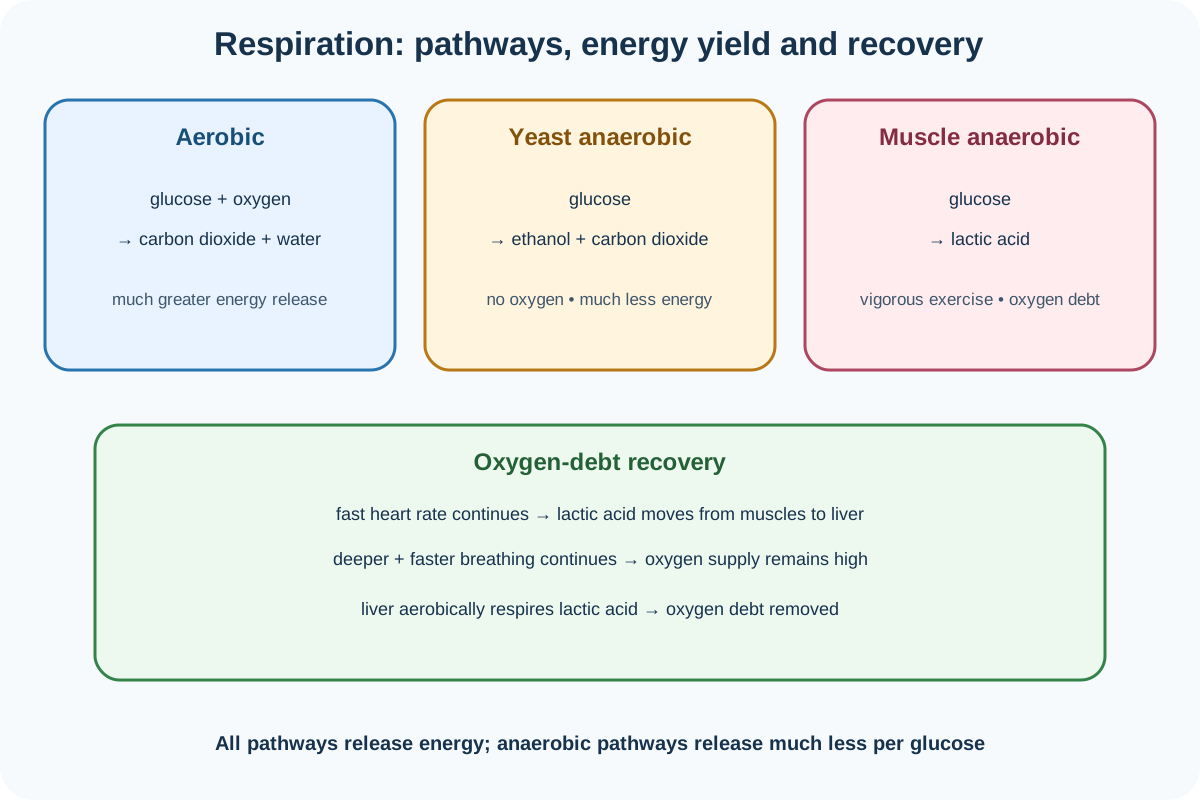
glucose+oxygen→carbon dioxide+water.
Check this topic from memory
Attempt the matching topic bank before reopening the notes. Use each missed idea to decide what to review next.
The equation balances six carbon atoms, twelve hydrogen atoms and eighteen oxygen atoms on each side. Coefficients belong before formulae; changing a subscript changes the substance.
Oxygen allows much more energy to be released per glucose molecule than anaerobic respiration. At this level, detailed biochemical stages are outside the boundary. Use the definition, equation, relative energy yield and application to cells.
Anaerobic respiration
Anaerobic respiration is the chemical reactions in cells that break down nutrient molecules to release energy without using oxygen. It releases much less energy per glucose molecule than aerobic respiration because breakdown is incomplete.
Anaerobic does not mean "without releasing energy". The process can support short-term activity or survival when oxygen supply is insufficient, but its lower yield and products have consequences.
Anaerobic respiration in yeast
The Core word equation is:
glucose→alcohol+carbon dioxide.
The alcohol is ethanol. The Supplement balanced equation is:
C6H12O6→2C2H5OH+2CO2.
Carbon dioxide production can provide evidence that yeast is respiring, but a gas result alone must be interpreted with controls. Yeast also respires aerobically when oxygen is available, so method conditions determine which pathway is supported.
Temperature and yeast respiration
At low temperature, yeast enzyme-controlled reactions proceed slowly because molecules have less kinetic energy and effective collisions occur less often. As temperature rises toward a suitable range, respiration rate can increase.
At excessive temperature, yeast enzymes denature and cells may be damaged or killed, causing rate to fall. The graph therefore may rise to an optimum and then fall rather than increasing indefinitely.
Respiration rate can be estimated using carbon dioxide volume per unit time, bubble production, mass loss or a stated indicator change. Bubble count is less reliable if bubble size varies. A fair temperature comparison controls yeast amount, substrate concentration and volume, pH, total volume and measurement time.
The theory chapter owns expected biological patterns. Apparatus, water-bath equilibration, gas collection, controls and evaluation remain in the practical hub.
Anaerobic respiration in muscles
During vigorous exercise, oxygen delivery may not meet the rate required for fully aerobic energy release. Muscle cells can respire anaerobically.
The required word equation is:
glucose→lactic acid.
Lactic acid builds up in muscles and blood during vigorous exercise and causes an oxygen debt. Do not give yeast products for human muscle or add carbon dioxide to this syllabus equation.
Anaerobic respiration provides energy rapidly but releases much less per glucose. It therefore cannot replace aerobic respiration indefinitely at the same metabolic demand.
Removing the oxygen debt
Recovery after vigorous exercise has three linked parts in the official boundary.
First, heart rate remains fast so blood transports lactic acid away from muscles to the liver. Continued circulation also supports oxygen delivery.
Second, breathing remains faster and deeper, supplying oxygen for aerobic respiration of lactic acid. Both rate and depth matter because together they increase ventilation.
Third, lactic acid is aerobically respired in the liver. The continuing oxygen use after exercise is why the recovery requirement is described as an oxygen debt.
Do not reduce oxygen debt to "needing to breathe after exercise". State the substance, transport route, organ and aerobic removal.
Compare the three pathways
Aerobic respiration uses oxygen and produces carbon dioxide and water. Yeast anaerobic respiration uses no oxygen and produces ethanol and carbon dioxide. Muscle anaerobic respiration uses no oxygen and produces lactic acid.
All release energy, but aerobic respiration releases much more per glucose. The correct equation therefore depends on organism, tissue and oxygen availability.
A question may combine the pathways. Yeast initially exposed to air may respire aerobically, then increasingly use anaerobic respiration as available oxygen becomes limited. Use the stated conditions and measured products instead of assuming that yeast always ferments.
Interpret rate and recovery evidence
Rate requires a quantity per time. If 36 cm³ of carbon dioxide is collected in six minutes, mean rate is:
6 min36 cm3=6.0 cm3 min−1.
This mean can hide changes during the interval. A time-course graph gives stronger evidence about when rate accelerates, stays constant or declines.
For recovery data, distinguish resting, exercise and recovery phases. A falling heart or breathing rate after exercise does not mean recovery is complete until it approaches the resting pattern and the oxygen debt has been addressed.
Worked application: identify pathways and calculate rate
A yeast suspension produces 48 cm³ of carbon dioxide in eight minutes without an oxygen supply, giving a mean rate of 6.0 cm³ per minute. The supported pathway is anaerobic respiration: glucose forms ethanol and carbon dioxide and releases less energy per glucose than aerobic respiration. In a runner, lactic acid builds up during vigorous exercise when oxygen delivery is insufficient. After stopping, heart rate remains elevated to transport lactic acid from muscle to liver, while deeper and faster breathing supplies oxygen. The liver aerobically respires the lactic acid, removing the oxygen debt. Yeast carbon dioxide must not be used as the muscle product.
Common misconceptions and corrections
Saying respiration occurs only in lungs. It consists of chemical reactions in cells.
Using respiration and breathing as synonyms. Breathing moves air.
Using respiration and gas exchange as synonyms. Gas exchange is diffusion of gases.
Saying energy is a chemical waste product. It is released and transferred to processes.
Omitting muscle contraction from energy uses. It is one of the seven named uses.
Omitting protein synthesis or cell division. Both require energy.
Saying active transport requires no energy. Energy from respiration supports it.
Saying nerve impulses are matter transported by respiration. Energy supports their passage.
Defining aerobic respiration only as breathing oxygen. It is cellular nutrient breakdown using oxygen.
Leaving water out of the aerobic equation. It is a product.
Putting energy as a formula in the balanced equation. Balance chemical substances; describe energy release separately.
Changing subscripts to balance an equation. Change coefficients, not substance formulae.
Saying anaerobic respiration uses a little oxygen. It occurs without using oxygen.
Saying anaerobic respiration releases no energy. It releases much less than aerobic respiration.
Saying anaerobic breakdown is complete. Its lower energy yield reflects incomplete breakdown.
Calling yeast alcohol lactic acid. Yeast forms ethanol and carbon dioxide.
Calling muscle product ethanol. Muscle forms lactic acid.
Adding carbon dioxide to the muscle word equation. It is not in the required equation.
Omitting carbon dioxide from yeast respiration. It is a named product.
Assuming yeast always respires anaerobically. Available oxygen affects the pathway.
Calling any gas bubble oxygen. Respiring yeast commonly produces carbon dioxide.
Comparing bubble counts without bubble size. Gas volume is stronger evidence.
Saying temperature always raises respiration rate. Excess heat can denature enzymes and damage cells.
Explaining low temperature as denaturation. It normally slows molecular movement and reaction rate.
Changing temperature without equilibrating samples. The biological material may not be at the stated temperature.
Comparing gas totals over different times. Convert to a rate.
Calling a total volume a rate. Rate includes time.
Saying lactic acid forms only after exercise ends. It builds up during vigorous exercise.
Calling oxygen debt a shortage of glucose. It concerns oxygen needed for lactic-acid removal.
Saying heart rate instantly returns to rest. It remains elevated during recovery.
Saying continued breathing supplies oxygen directly to muscles only. Oxygen supports aerobic respiration of lactic acid in the liver.
Omitting transport of lactic acid to the liver. Continued circulation performs this route.
Saying the liver stores all lactic acid permanently. It is aerobically respired in the required explanation.
Claiming anaerobic respiration can sustain the same output indefinitely. It releases much less energy and produces accumulating products.
Assessment guidance
Begin by separating cellular respiration from breathing and gas exchange. Give all seven named energy uses when a broad list is requested. For equations, choose the correct organism and oxygen condition, preserve formula subscripts and use coefficients to balance. Compare energy yield explicitly: anaerobic is much lower per glucose. On yeast data, calculate amount per time and explain the temperature curve through kinetic energy, enzyme action and denaturation while naming controls. For oxygen debt, write the full recovery chain: continued fast heart rate transports lactic acid from muscle to liver, deeper and faster breathing supplies oxygen, and the liver aerobically respires lactic acid.
Retrieval practice
Reconstruct all three word equations and both balanced equations from memory, then sort the seven energy uses into movement, synthesis, transport, signalling, growth and temperature control. Calculate rates from five yeast datasets, annotate a temperature curve and write the complete muscle-to-liver oxygen-debt recovery sequence without importing yeast products.
Theory and practical ownership
This theory note owns respiration definitions, equations, energy uses, expected temperature effects, pathway comparison and oxygen-debt recovery. The separate Biology practical hub owns yeast preparation, gas collection, indicator selection, temperature equilibration, controls, safe ranges, repeats, rate graphs and evaluation.