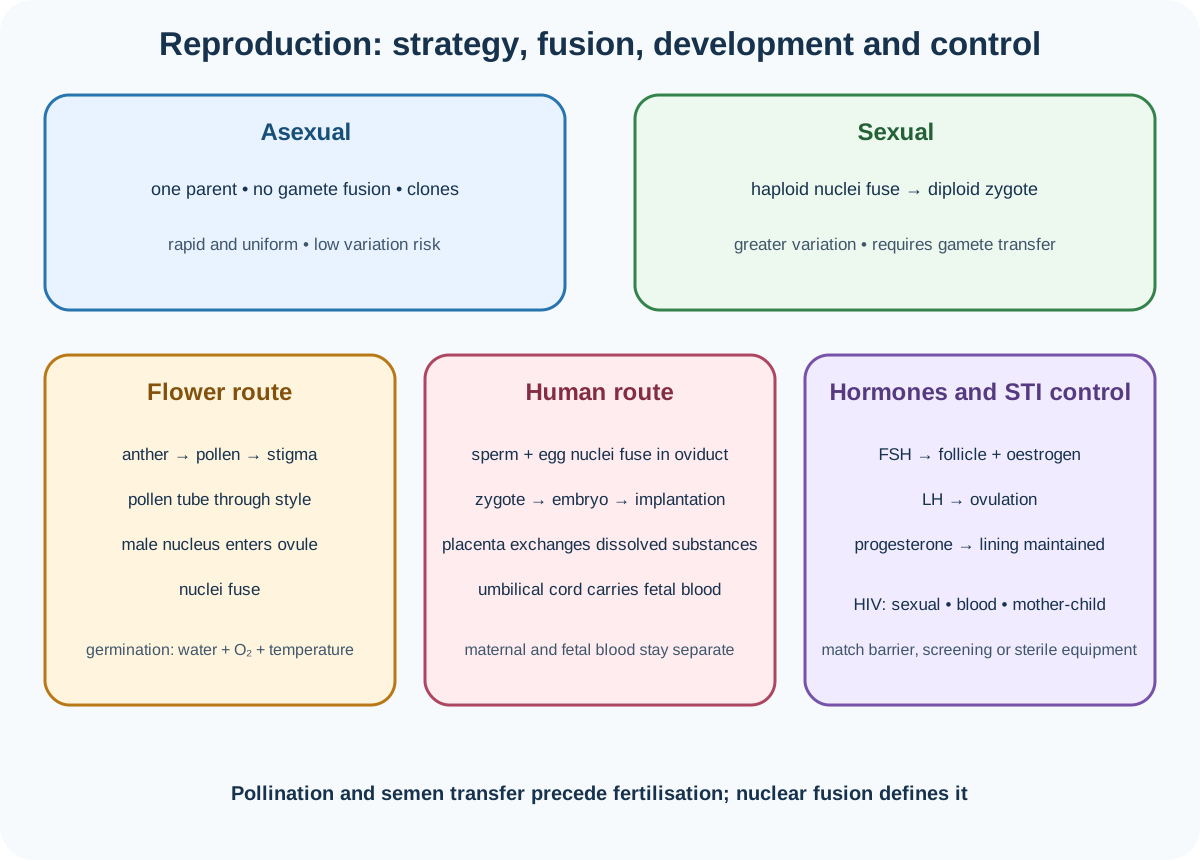
Topic 16 of Cambridge IGCSE Biology 0610 and 0970 compares asexual and sexual strategies before following reproduction in flowering plants and humans. Official sections 16.1 to 16.6 cover flower and gamete structure, pollination, germination, fertilisation, fetal exchange, menstrual hormones and sexually transmitted infections. Birth, contraception and assisted reproduction are not imported into this boundary.
Asexual reproduction
Asexual reproduction produces genetically identical offspring from one parent. There is no fusion of gamete nuclei. Genetically identical descendants are clones, although a later mutation can introduce a difference.
Examples can include binary fission in microorganisms, runners or bulbs in plants and other cases shown in diagrams or unfamiliar information. Identify the defining evidence: one parent, no gamete fusion and genetically identical offspring.
In a stable wild environment, rapid reproduction and retention of a successful genotype can increase population quickly. One organism can reproduce without finding a mate. However, low genetic variation means a new disease or environmental change may affect many individuals similarly.
In crop production, asexual propagation gives uniform plants with desired yield, quality or timing and can multiply them rapidly. Uniformity supports predictable harvests, but shared susceptibility can allow a pathogen or environmental stress to damage much of the crop.
Sexual reproduction
Sexual reproduction involves fusion of nuclei from two gametes to form a zygote and produces offspring genetically different from one another. Fertilisation is specifically the fusion of gamete nuclei.
Gamete nuclei are haploid, containing one set of chromosomes. The zygote nucleus is diploid, containing two sets after fusion.
In a wild population, genetic variation increases the chance that some individuals survive environmental change or disease. Sexual reproduction can require more time and energy, and individuals may need to find a mate or depend on pollination.
In crop production, variation provides material for selecting and breeding new combinations, including disease resistance. It can also produce less uniform offspring, and controlled crosses take more time than cloning a proven plant.
Do not describe sexual reproduction as automatically producing better individuals. Variation produces differences; whether a feature is advantageous depends on the environment.
Insect-pollinated flower structure
Sepals protect the flower when it is a bud. Petals can attract insect pollinators through colour, scent or nectar guides.
Check this topic from memory
Attempt the matching topic bank before reopening the notes. Use each missed idea to decide what to review next.
The stamens are male structures. Each has a filament supporting an anther. Anthers produce and release pollen grains containing male nuclei.
The carpel is the female structure. Its stigma receives pollen, the style holds the stigma and provides a route toward the ovary, and the ovary contains ovules. An ovule contains a female nucleus.
Drawings should show positions and connections rather than decorative shading. Label lines should touch the intended structure and should not cross unnecessarily.
Pollination and flower adaptations
Pollination is transfer of pollen grains from an anther to a stigma. It occurs before fertilisation.
Insect-pollinated flowers commonly have conspicuous petals, scent and nectar. Anthers and stigmas are held where visiting insects contact them. Pollen grains tend to be larger and sticky or spiky, so they attach to an animal and stigma.
Wind-pollinated flowers usually have small or inconspicuous petals and no need for scent or nectar. Anthers are exposed and loosely attached so wind shakes out pollen. Stigmas are large, feathery and exposed to intercept airborne grains. Pollen is produced in large quantities and tends to be small, light and smooth.
Every feature should be linked to transfer: attraction, attachment, release, transport or capture.
Self-pollination and cross-pollination
Self-pollination transfers pollen from an anther to the stigma of the same flower or another flower on the same plant. It can occur without another plant and is less reliant on pollinators, but tends to maintain lower genetic variation.
Cross-pollination transfers pollen to a flower on a different plant of the same species. It combines genetic material from different plants and tends to increase variation, which can improve a population's capacity to respond to environmental change. It relies more on wind, animals or another transfer agent and may fail if compatible plants or pollinators are unavailable.
The distinction is plant identity, not merely whether pollen moves between two flowers.
Fertilisation in flowering plants
After compatible pollen lands on a stigma, a pollen tube grows down through the style. The male nucleus travels through the tube. The tube enters an ovule, and the pollen nucleus fuses with a nucleus in the ovule. This nuclear fusion is fertilisation.
Pollination places pollen on the stigma; fertilisation occurs later in an ovule. Details of endosperm production and subsequent development are not required in this outcome.
Seed germination
Germination requires water, oxygen and a suitable temperature. Water rehydrates tissues, activates metabolism and supports enzyme action. Oxygen is needed for aerobic respiration to release energy. A suitable temperature permits enzyme-controlled reactions to proceed at an effective rate.
Light is not in the general required list for this investigation. Some particular species may respond to light, but do not replace the official three conditions.
An investigation changes one condition while keeping seed type, number, age, duration and other conditions comparable. A control must isolate the missing water, oxygen or suitable-temperature factor. Detailed setup and evaluation belong to the practical hub.
Male reproductive system
Testes produce sperm and testosterone. The scrotum holds the testes outside the abdominal cavity at a temperature suitable for sperm production. Sperm ducts carry sperm from the testes. The prostate gland adds fluid to form semen. The urethra carries semen through the penis, and the penis transfers semen into the vagina.
In diagrams, trace a continuous sperm route. Do not confuse a sperm duct with a ureter, which belongs to the urinary system.
Female reproductive system
Ovaries produce egg cells and hormones including oestrogen and progesterone. Oviducts carry egg cells and are the usual site of fertilisation. The uterus supports embryo and fetal development. The cervix is the muscular opening between uterus and vagina. The vagina receives the penis and semen and forms the passage from uterus to outside.
Fertilisation fuses the sperm nucleus with the egg-cell nucleus, normally in an oviduct. The resulting zygote divides to form an embryo, described here as a ball of cells, and the embryo implants in the uterus lining.
Gamete adaptations and comparison
A sperm cell is small and motile. Its flagellum propels it, mitochondria release energy for movement and acrosome enzymes help it penetrate the egg's outer layers.
An egg cell is large and non-motile. It contains energy stores supporting early development. Its jelly coat changes after fertilisation, preventing entry of additional sperm.
Males produce very large numbers of small sperm; females release far fewer large egg cells. Both gamete nuclei are haploid even though cell size, structure, motility and number differ.
Placenta, umbilical cord and amniotic protection
The placenta is an exchange organ between maternal and fetal blood supplies. Dissolved nutrients and oxygen pass from mother toward fetus, while carbon dioxide and urea pass from fetus toward mother for removal.
Maternal and fetal blood normally do not mix directly. Exchange occurs across a thin barrier with a large surface area and good blood supplies, maintaining gradients.
The umbilical cord connects fetus to placenta and contains blood vessels carrying fetal blood. The amniotic sac encloses the fetus, and amniotic fluid cushions it against mechanical shock and permits movement.
The placenta is not a perfect barrier. Some pathogens and toxins can cross and affect the fetus. A substance reaching maternal blood is therefore not automatically harmless to fetal development.
Puberty and sex hormones
Testosterone and oestrogen regulate development of secondary sexual characteristics during puberty. Testosterone is associated with male secondary characteristics, including deeper voice and facial hair. Oestrogen is associated with female secondary characteristics, including breast development and widening hips.
These hormones act throughout the body through target tissues. Puberty changes vary among individuals and do not occur at an identical age or rate.
The menstrual cycle
The menstrual cycle includes changes in ovaries and uterus lining. Menstruation sheds the lining near the start of a cycle. A follicle develops in an ovary, ovulation releases an egg cell and the uterine lining thickens and is maintained in preparation for implantation. If pregnancy does not occur, hormone concentrations fall and the lining breaks down.
FSH is produced by the pituitary gland. It stimulates follicle development and oestrogen secretion. Oestrogen is produced mainly by the developing follicle in the ovary. It repairs and thickens the uterine lining, inhibits FSH and stimulates LH release.
LH is produced by the pituitary gland and triggers ovulation. After ovulation, the corpus luteum in the ovary produces progesterone. Progesterone maintains the uterine lining and inhibits FSH and LH.
If hormone support falls without pregnancy, the lining is shed. During pregnancy, oestrogen and progesterone continue to support the reproductive state; the placenta becomes an important site of their production.
Hormone graphs should be read by peaks, overlaps and resulting events rather than memorised as isolated day numbers, because diagrams may use different scales.
Sexually transmitted infections and HIV
A sexually transmitted infection, or STI, is an infection transmitted through sexual contact. Human immunodeficiency virus, HIV, is a pathogen that causes an STI. HIV infection may lead to AIDS.
HIV can be transmitted through unprotected sexual contact, infected blood, shared contaminated needles and from mother to child during pregnancy, birth or breast-feeding. It is not spread by ordinary social contact such as sharing a room or touching intact skin.
STI spread is controlled by barrier protection such as condoms, reducing numbers of sexual partners, testing and treatment where available, screening blood, using sterile needles and avoiding sharing injecting equipment. Education and informed consent support safer choices.
Match each measure to a route. Condoms reduce exchange of infected body fluids during sex; screening protects transfusions; sterile single-use equipment prevents blood transfer.
Worked application: connect plant and human fertilisation
In a wind-pollinated plant, exposed anthers release many small light pollen grains and a feathery stigma intercepts them. Pollination ends when pollen reaches the stigma. A pollen tube then grows through the style into an ovule, where a pollen nucleus fuses with the ovule nucleus, completing fertilisation. In humans, a sperm's flagellum supports movement and acrosome enzymes help penetration; its haploid nucleus fuses with the egg's haploid nucleus in an oviduct. The diploid zygote divides into an embryo and implants in the uterus lining. Both examples require nuclear fusion, but pollen transfer itself and semen transfer itself are not fertilisation.
Common misconceptions and corrections
Saying asexual reproduction uses two parents. It uses one parent.
Saying asexual offspring can never differ. Mutation can introduce variation later.
Calling any rapid population sexual reproduction. Look for gamete-nucleus fusion.
Saying clone uniformity is always advantageous. Shared susceptibility is a major risk.
Defining sexual reproduction without a zygote. Gamete nuclei fuse to form one.
Saying sexual offspring are genetically identical. They are genetically different from one another.
Calling a gamete nucleus diploid. It is haploid.
Calling a zygote haploid. Its nucleus is diploid.
Saying variation guarantees survival. It changes the probability that some individuals suit conditions.
Calling a filament the pollen-producing part. The anther produces pollen.
Calling the stigma the ovule container. The ovary contains ovules.
Calling petals the fertilisation site. They commonly attract pollinators.
Defining pollination as nuclear fusion. It is pollen transfer from anther to stigma.
Calling fertilisation pollen transfer. It is fusion of nuclei in an ovule.
Saying wind-pollinated flowers need large scented petals. Wind does not require attraction.
Saying wind pollen is large and sticky. It is generally small, light and smooth.
Saying insect pollen is produced mainly to float. It is sticky or spiky for attachment.
Defining self-pollination as transfer between any two flowers. Both flowers may be on the same plant.
Defining cross-pollination between different species. Plants must be the same species.
Saying self-pollination maximises variation. Cross-pollination generally increases it.
Saying cross-pollination never relies on a vector. Wind or animals commonly transfer pollen.
Placing fertilisation on the stigma. It occurs after pollen-tube entry into an ovule.
Adding endosperm-development detail as required. It is explicitly excluded.
Saying all seeds require light to germinate. The general required factors are water, oxygen and suitable temperature.
Saying water supplies germination energy. Respiration releases energy; water enables metabolism.
Calling the sperm duct the ureter. They carry different materials.
Saying the prostate makes sperm. Testes make sperm; prostate adds fluid.
Placing human fertilisation in the uterus. It usually occurs in an oviduct.
Calling implantation fertilisation. Implantation occurs after zygote division.
Saying sperm mitochondria perform propulsion directly. They release energy; the flagellum propels.
Saying the acrosome stores energy. It contains enzymes.
Saying the egg jelly coat never changes. It changes at fertilisation.
Saying sperm and egg are equal in size and number. They differ greatly.
Saying maternal and fetal blood mix freely. Exchange occurs across a placental barrier.
Calling the umbilical cord the exchange surface itself. It connects fetus to placenta.
Saying amniotic fluid feeds the fetus. Its named role is cushioning and support.
Saying the placenta blocks every toxin. Some toxins and pathogens cross.
Pairing testosterone with the ovaries. Testes produce it.
Pairing oestrogen only with the pituitary. It is produced by ovarian tissue and during pregnancy by placenta.
Saying LH develops the follicle. FSH stimulates follicle development.
Saying progesterone causes menstruation while high. It maintains the lining; its decline permits breakdown.
Saying oestrogen has no uterine role. It repairs and thickens the lining.
Saying HIV and AIDS are identical terms. HIV infection may lead to AIDS.
Saying HIV spreads through ordinary touch. Transmission requires relevant infected fluids or mother-child routes.
Saying condoms screen transfused blood. Match each control to its route.
Importing contraception, assisted reproduction and birth into Topic 16. They are not in the current official outcome list.
Assessment guidance
Use nuclear fusion as the boundary between sexual and asexual reproduction and discuss strategies separately for wild populations and crops. For flowers, pair every structure or adaptation with protection, attraction, release, transfer, capture or fertilisation, and keep pollination before pollen-tube growth and fertilisation. Human answers should trace organs and distinguish gamete adaptations, oviduct fertilisation, uterine implantation and placental exchange without blood mixing. On cycle questions, connect FSH, oestrogen, LH and progesterone to production site, ovarian event and uterine effect. Define HIV as a pathogen causing an STI and match each prevention measure to sexual, blood or mother-child transmission.
Retrieval practice
Compare asexual and sexual reproduction for wild populations and crop production. Draw and label insect- and wind-pollinated flowers, sequence pollination to fertilisation and design three germination controls. Then trace male and female reproductive routes, compare gametes, annotate placental exchange, reconstruct the four-hormone menstrual cycle and match HIV controls to transmission routes.
Theory and practical ownership
This theory note owns reproduction definitions, strategic comparisons, flower and human anatomy, fertilisation, germination requirements, development, hormone control and STI transmission. The separate Biology practical hub owns flower dissection and drawing, pollen observation, germination apparatus, controls, safe biological handling, measurement, tables, graphs and evaluation.