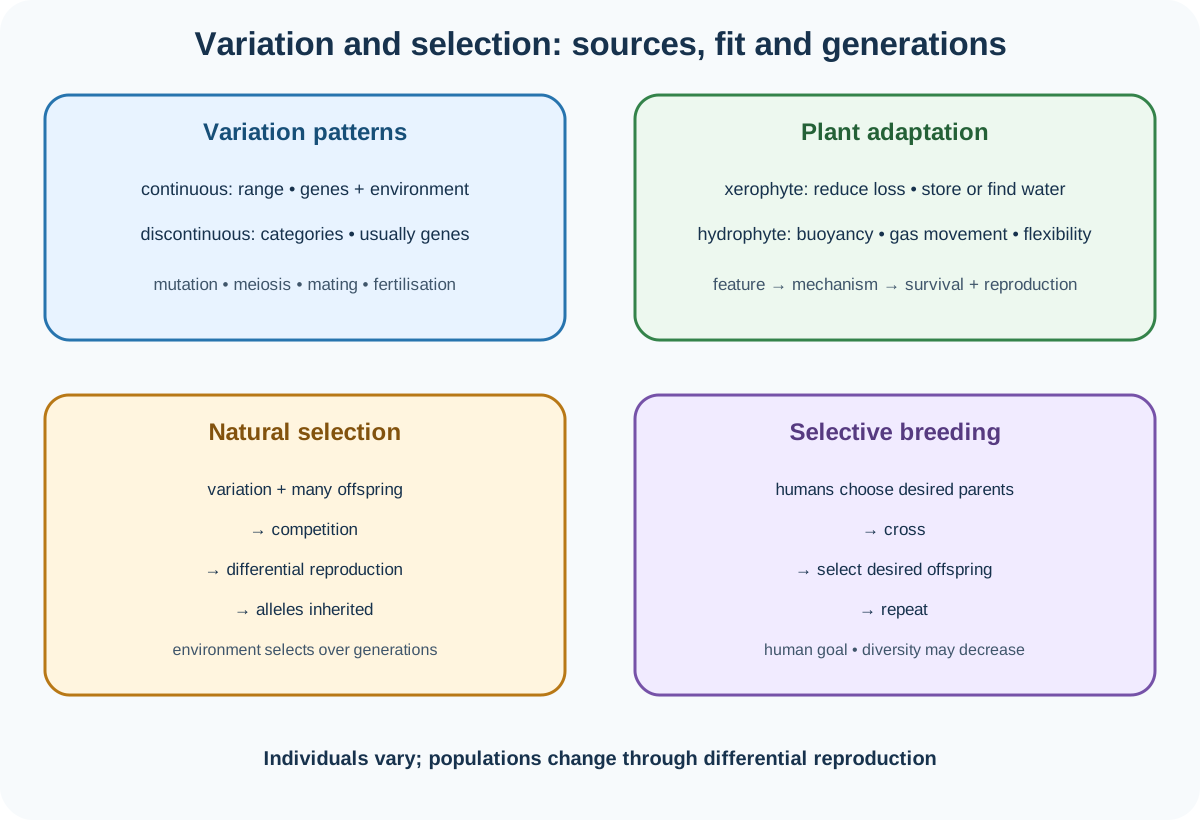
Topic 18 of Cambridge IGCSE Biology 0610 and 0970 follows differences within a species from their genetic and environmental sources to inherited adaptations and changing populations. Official sections 18.1 to 18.3 cover variation patterns, mutation, hydrophytes and xerophytes, natural selection, antibiotic resistance and selective breeding.
Variation within a species
Variation means differences between individuals of the same species. Variation can be observed in measurements, categories, physiology, behaviour or other phenotypes.
The pattern matters because it affects graph choice, explanation and how selection can act.
Continuous variation
Continuous variation produces a range of phenotypes between two extremes. Body length and body mass are named examples. Measurements can take many intermediate values and usually form a distribution rather than separate categories.
Continuous variation is caused by both genes and the environment. Many genes may contribute, while nutrition, health, activity and other environmental conditions influence the observed value.
A histogram is suitable when continuous measurements are grouped into class intervals. Adjacent bars touch because the scale is continuous. Sample size, measurement precision and representative sampling affect the distribution.
Discontinuous variation
Discontinuous variation produces a limited number of phenotypes with no intermediates. Cambridge names ABO blood groups, pea seed shape and pea seed colour.
It is usually caused by genes only in this level of model. Individuals fall into categories, so a bar chart with separated bars is appropriate.
Discontinuous does not mean that only two categories exist. ABO has four phenotypes, but no continuous intermediate between them.
Investigating variation
Define the population and sample before measuring. Use the same method and instrument for every individual, select participants or organisms without favouring particular outcomes and record units consistently.
For continuous data, measure rather than round individuals into vague labels. For discontinuous data, define each category before counting.
Differences within a sample do not automatically reveal cause. A phenotype may reflect genes, environment or both, and an observational investigation often cannot separate them completely.
Practical sampling, consent, measurement, data presentation and evaluation remain in the practical hub.
Mutation and genetic variation
A mutation is a genetic change. A gene mutation is a random change in the base sequence of DNA. Mutation can create a new allele.
Check this topic from memory
Attempt the matching topic bank before reopening the notes. Use each missed idea to decide what to review next.
Random means a mutation does not occur because an organism needs a particular feature. Its effect may be harmful, neutral or advantageous in a particular environment.
Ionising radiation and some chemicals increase mutation rate. These mutagens increase probability; they do not direct the exact useful change.
Mutation, meiosis, random mating and random fertilisation are sources of genetic variation in populations. Mutation creates new alleles. Meiosis produces genetically different gametes. Random mating combines parental genotypes, and random fertilisation combines gametes unpredictably.
Environmental effects can create phenotypic variation without creating a new allele. A suntan or increased muscle size acquired during life is not automatically inherited.
Adaptive features
An adaptive feature is an inherited feature that helps an organism survive and reproduce in its environment.
Interpret an unfamiliar organism by linking structure to a specific environmental challenge, mechanism and reproductive advantage. "It helps survival" is incomplete unless the answer explains how.
Adaptation also describes the population process resulting from natural selection, through which populations become better suited to their environment over many generations.
Individuals possess adaptive features; populations become adapted over generations.
Xerophyte adaptations
Xerophytes are plants adapted to environments where water is scarce. Their features reduce water loss, store water or increase uptake.
A thick waxy cuticle reduces evaporation from the epidermis. Reduced leaves or spines provide less surface area for transpiration. Rolled leaves and leaf hairs trap humid still air, reducing the water-vapour concentration gradient. Sunken stomata also trap humid air and shelter pores from wind.
Fewer stomata reduce diffusion routes for water vapour. Succulent tissues store water. Extensive shallow roots can absorb brief rainfall over a wide area, while deep roots can reach more persistent water, depending on the environment.
No single feature defines every xerophyte. Use the shown structure and explain its actual mechanism.
Hydrophyte adaptations
Hydrophytes are plants adapted to living in water or waterlogged conditions.
Large internal air spaces provide buoyancy and allow gas movement through submerged tissues. Floating leaves can have stomata on the upper surface, where they contact air. A thin or absent waxy cuticle is possible because preventing water loss is less important.
Flexible stems and leaves move with water currents rather than resisting them rigidly. Supporting and water-conducting tissues may be reduced because surrounding water provides support and is readily available. Broad floating leaves provide a large surface for light capture.
Again, explain each feature in the context shown. A submerged leaf and a floating leaf face different gas-exchange conditions.
Natural selection
Natural selection follows a population sequence:
Genetic variation exists within the population.
Many offspring are produced.
Individuals compete for limited resources in a struggle for survival.
Individuals with inherited features better suited to the environment have a greater chance of surviving and reproducing.
They pass their alleles to offspring.
Over many generations, advantageous alleles become more common and the population becomes better adapted.
Selection acts on phenotype, but inheritance changes allele frequencies. An individual does not genetically transform because it tries harder. Differences in survival and reproduction alter the next generations.
The environment determines which features are advantageous. If conditions change, a previously favourable allele may become neutral or harmful.
Antibiotic-resistant bacteria
A bacterial population may contain genetic variation for antibiotic resistance. Antibiotic exposure kills susceptible bacteria, while resistant bacteria are more likely to survive.
Survivors reproduce and pass resistance alleles or genetic information to descendants. The resistant proportion rises, and the antibiotic becomes less effective.
The antibiotic is a selection pressure, not a substance that teaches each bacterium to adapt. Using antibiotics only when essential reduces unnecessary selection opportunities, as developed in Topic 15.
Rapid bacterial reproduction allows population change to be observed over a relatively short time, but the logic remains variation, selection, differential reproduction and inheritance.
Selective breeding
Selective breeding, or artificial selection, uses human choice:
Identify individuals with desired inherited features.
Cross selected individuals.
Examine offspring.
Select offspring showing the desired features.
Breed those selected offspring.
Repeat over many generations.
Crop examples include improved yield, disease resistance, size, flavour or harvest timing. Domesticated-animal examples include milk yield, growth rate, temperament or disease resistance.
Selection must involve heritable variation. Choosing a well-fed animal solely for an environmentally caused large mass does not guarantee offspring inherit that mass.
Artificial selection can increase the frequency of desired alleles but reduce genetic diversity. A narrow gene pool can increase susceptibility to disease or inherited disorders.
Natural versus artificial selection
Both processes require inherited variation, differential reproduction and changes over generations.
In natural selection, environmental conditions determine which phenotypes reproduce more successfully. There is no planned target. In artificial selection, humans choose breeders to increase desired features.
Natural selection tends to improve suitability to the current environment. Artificial selection increases suitability to human aims, which may reduce survival without human care.
Avoid saying that artificial selection produces an individual instantly. Repeated crossing and selection alter a population over generations.
Worked application: connect variation to selection
A bacterial population contains susceptible and resistant variants before treatment. Antibiotic exposure kills most susceptible cells, while resistant cells survive and reproduce. Their descendants inherit resistance, so the resistant proportion rises over generations. The drug did not cause bacteria to mutate because they needed survival; it selected existing genetic variation. In a crop programme, growers instead choose plants with inherited disease resistance, cross them, select resistant offspring and repeat this process over many generations. Both processes change inherited composition through differential reproduction, but the antibiotic environment drives natural selection while humans choose parents in artificial selection.
Common misconceptions and corrections
Defining variation as differences between species. It concerns individuals of the same species here.
Saying continuous variation has no intermediate values. It forms a range.
Calling ABO blood group continuous. It has discrete categories.
Saying discontinuous variation must have two categories. It can have several.
Saying continuous variation is caused only by genes. Genes and environment contribute.
Saying discontinuous variation is usually environmental only. It is usually genetic only.
Using a separated bar chart for grouped continuous data. Histogram bars touch.
Using a histogram for named categories. A separated bar chart is clearer.
Measuring different individuals with different methods. Standardise the method.
Claiming an observational pattern proves genetic cause. Environment may contribute.
Defining mutation as any visible difference. It is genetic change.
Saying gene mutation is a directed useful change. It is random base-sequence change.
Saying organisms mutate because they need to adapt. Need does not direct mutation.
Saying every mutation is harmful. Effects can be harmful, neutral or advantageous.
Saying mutagens guarantee a particular mutation. They increase mutation rate.
Saying environmental change always creates a new allele. It can alter phenotype without changing DNA.
Omitting meiosis from variation sources. It produces genetically different gametes.
Saying random fertilisation reduces variation. It combines gametes in different ways.
Defining an adaptive feature without inheritance. It must be inherited.
Saying any helpful acquired behaviour is an adaptive feature genetically. Apply the inherited-feature definition.
Saying individuals evolve during their lifetimes. Population composition changes over generations.
Saying xerophytes live in water. They are adapted to water scarcity.
Saying a thick cuticle increases evaporation. It reduces water loss.
Saying sunken stomata expose pores to wind. They shelter pores and trap humidity.
Saying rolled leaves steepen the vapour gradient. Trapped humid air reduces it.
Saying all xerophytes must have identical roots. Root adaptation depends on water distribution.
Saying hydrophytes require a thick cuticle to save water. Water conservation is less limiting.
Saying air spaces only make a leaf heavier. They aid buoyancy and gas movement.
Putting stomata under a floating leaf as the main air route. Upper-surface stomata contact air.
Starting natural selection without genetic variation. Selection needs inherited differences.
Saying all offspring survive. Overproduction contributes to competition.
Saying the best-adapted individual is always strongest. Suitability depends on the environment.
Saying survival alone changes a population. Reproduction and allele transmission matter.
Saying antibiotics create resistance deliberately. They select resistant variants.
Saying a person becomes antibiotic-resistant. Bacterial populations do.
Saying selective breeding and natural selection have the same selector. Humans choose in artificial selection.
Choosing a non-heritable feature for breeding. Only inherited differences respond predictably.
Stopping selective breeding after one cross. It is repeated over generations.
Saying selective breeding always increases diversity. It can narrow the gene pool.
Saying artificial selection always improves wild survival. It serves human aims.
Assessment guidance
Classify variation from the phenotype pattern before naming causes or graph type. For mutation, distinguish random genetic change from mutagen-driven rate increase and list mutation, meiosis, random mating and random fertilisation as genetic sources. Adaptive-feature answers need inheritance, a mechanism, the environmental challenge and a survival or reproductive benefit. Natural-selection answers must include variation, overproduction, competition, differential reproduction, allele transmission and change over generations. Apply that full chain to antibiotic resistance. Selective-breeding answers require human choice, crossing, offspring selection and repetition, then compare the selector and goal with natural selection rather than merely saying one is faster.
Retrieval practice
Classify ten datasets as continuous or discontinuous and choose appropriate graphs. Trace four sources of genetic variation, explain unfamiliar xerophyte and hydrophyte images, reconstruct natural selection in a changed environment and antibiotic treatment, then design a six-generation selective-breeding plan while identifying likely diversity trade-offs.
Theory and practical ownership
This theory note owns variation patterns and causes, mutation, adaptive mechanisms, selection and breeding logic. The separate Biology practical hub owns representative sampling, ethical measurement, histogram and category presentation, image observation, controls, safe model investigations and evaluation.