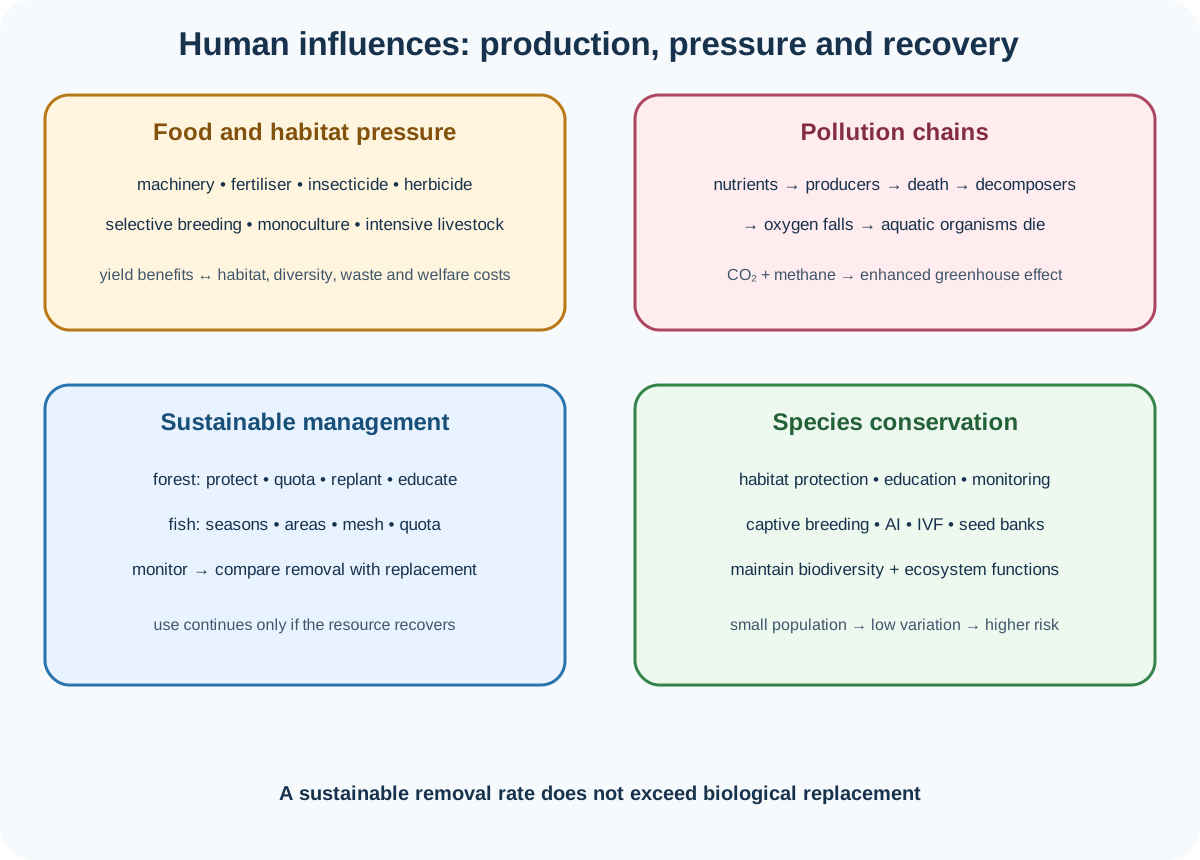
Topic 20 of Cambridge IGCSE Biology 0610 and 0970 evaluates human changes to food production, habitats, pollution and biological resources. Official sections 20.1 to 20.4 require causal chains and trade-offs from machinery and monoculture to eutrophication, climate change, sustainable forest and fish management, endangered-species programmes and low-population genetic risk.
Increasing food production
Agricultural machinery allows larger areas to be cultivated and harvested efficiently with fewer workers and more predictable timing. It can increase output but requires energy and capital, can compact soil and enables expansion into habitats.
Chemical fertilisers supply mineral ions such as nitrates, improving plant growth and yield when ions are limiting. Excess fertiliser can wash into water and cause eutrophication.
Insecticides kill insect pests, improving crop quality and yield. They may also harm non-target species, reduce food for predators and select resistant pest populations.
Herbicides kill weeds, reducing competition with crops for light, water and mineral ions. Reduced weed diversity can remove food and habitat for other organisms.
Selective breeding increases production by choosing crop plants or livestock with desired inherited features and breeding selected offspring over generations. It can improve yield or disease resistance but may reduce genetic variation.
Large-scale monoculture
A monoculture grows one crop type over a large area. Uniform planting supports mechanised sowing, treatment and harvesting. Management is simpler and a high-yield variety can produce a large predictable harvest.
Low species and genetic diversity creates risk. A pathogen or pest suited to the crop can spread rapidly. Repeated use of the same soil resources can require fertiliser replacement, and broad insecticide or herbicide use can damage non-target food webs.
An advantage in efficiency does not cancel ecological disadvantages. A discussion should identify stakeholder and timescale rather than label monoculture simply good or bad.
Intensive livestock production
Intensive systems keep many animals in controlled conditions, allowing feeding, breeding, temperature and disease monitoring to increase output per unit area and make production reliable.
High density can allow disease to spread rapidly. Waste can concentrate and pollute water or air. Restricted movement and housing raise animal-welfare concerns, while feed production uses land and energy.
Management can reduce some harms through hygiene, ventilation, suitable space, veterinary care and waste treatment, but these measures have costs. Evaluate the described system rather than assuming every farm has identical conditions.
Check this topic from memory
Attempt the matching topic bank before reopening the notes. Use each missed idea to decide what to review next.
Biodiversity is the number of different species living in an area in this syllabus definition.
Habitats are destroyed to provide housing and land for crop or livestock production, to extract natural resources and through freshwater or marine pollution.
Changing a habitat alters food chains and webs. Removing producers, prey, breeding sites or shelter can reduce populations beyond the species directly displaced. Fragmentation can isolate remaining populations.
Deforestation chain
Deforestation removes forest habitat, reducing biodiversity and causing local extinction. If a species exists only in the cleared area, global extinction can follow.
Roots and vegetation protect soil. Removal increases erosion and loss of fertile topsoil. With less canopy interception and root uptake, more water runs over the surface, increasing flood risk.
Fewer trees remove less carbon dioxide through photosynthesis. Burning or decomposition of cleared biomass releases carbon dioxide, increasing atmospheric concentration and contributing to the enhanced greenhouse effect.
Keep these mechanisms distinct: soil loss follows reduced protection, flooding follows changed interception and runoff, and atmospheric carbon dioxide changes through reduced uptake and release.
Sewage, fertiliser and eutrophication
Untreated sewage adds organic matter, microorganisms and nutrients to aquatic ecosystems. Excess fertiliser adds nitrate and other ions.
The required eutrophication sequence is:
Nitrate and other mineral-ion availability increases.
Producers, often algae, grow rapidly.
Producers die and more organic material is available for decomposition.
Decomposers increase aerobic respiration.
Dissolved oxygen concentration falls.
Organisms requiring dissolved oxygen die.
Dense producer growth can also reduce light reaching submerged plants, increasing death and decomposition. Fertiliser does not directly remove oxygen; decomposer respiration after increased growth and death causes the main fall.
Non-biodegradable plastics
Non-biodegradable plastics persist because decomposers cannot break them down rapidly. They accumulate in aquatic and terrestrial ecosystems.
Animals can become entangled, reducing movement, feeding or breathing. They may ingest plastic, causing blockage, false fullness or injury. Plastic can fragment into smaller pieces that remain in food webs and habitats.
Litter can cover soil or aquatic surfaces and damage habitats. Persistence means impacts continue long after disposal, so reducing use, collecting waste and recycling where effective can lower entry.
Methane, carbon dioxide and climate change
Carbon dioxide sources include fossil-fuel combustion, deforestation and other combustion. Methane sources include livestock digestion, decomposition in landfill and anaerobic conditions such as rice fields.
Both gases contribute to the enhanced greenhouse effect by increasing retention of outgoing thermal energy in the atmosphere. This raises global temperatures and drives climate change.
Climate change can alter rainfall, sea level, habitat distribution, migration timing, food availability and extinction risk. Do not confuse this mechanism with ozone-layer depletion.
Source and effect should be linked. Cattle are associated particularly with methane; fossil-fuel combustion with carbon dioxide.
Sustainable resources
A sustainable resource is produced as rapidly as it is removed from the environment so it does not run out.
Sustainability permits managed use. It does not require banning all harvesting. Removal rate, reproduction, habitat quality and monitoring determine whether the stock can recover.
Forests and fish stocks are the named managed resources.
Conserving forests
Education can build support for responsible use. Protected areas limit clearing. Quotas restrict the amount removed. Replanting replaces harvested trees and can restore future production and habitat.
Replanting must match removal rate and ecological needs. A single-species plantation does not necessarily restore the biodiversity of a natural forest.
Conserving fish stocks
Education supports compliance and informed consumption. Closed seasons protect breeding periods. Protected areas provide refuges. Controlled net types and mesh sizes reduce capture of non-target or immature fish.
Quotas limit total harvest. Monitoring provides evidence about population size, age structure and whether controls work. If data show decline, quotas or closures may need adjustment.
One control alone may be evaded or insufficient. Effective management combines rules, enforcement, monitoring and habitat protection.
Endangerment, extinction and conservation programmes
Species become endangered or extinct through climate change, habitat destruction, hunting, overharvesting, pollution and introduced species.
Conservation includes monitoring and protecting species and habitats, education, captive breeding and seed banks. Monitoring detects trends. Habitat protection preserves living requirements. Education changes behaviour and support. Captive breeding increases numbers, while seed banks preserve plant genetic material.
Artificial insemination places sperm into the female reproductive system without mating. In vitro fertilisation combines gametes outside the body before embryos are transferred. These techniques can help captive programmes use separated individuals and manage breeding.
Conservation programmes maintain or increase biodiversity, reduce extinction, protect vulnerable ecosystems and maintain ecosystem functions. Named functions include nutrient cycling and provision of food, drugs, fuel and genes.
Risk of small populations
When population size falls, genetic variation can decrease. Fewer potential mates and alleles increase inbreeding risk and reduce the chance that some individuals possess features suited to a new disease or environmental change.
Low variation therefore raises extinction risk. Detailed genetic drift is not required. State the variation and response-capacity mechanism.
Captive programmes should manage parent choice to retain as much variation as possible and avoid repeatedly breeding close relatives.
Worked application: trace pollution and choose management
Fertiliser runoff raises nitrate concentration in a lake. Producers grow rapidly, then die; decomposers aerobically respire while breaking down the extra organic material, dissolved oxygen falls and fish die. The fertiliser did not remove oxygen directly. If the affected fish stock is also harvested, managers can introduce a closed breeding season, protected areas, larger mesh sizes, quotas and monitoring. Monitoring tests whether recruitment and stock size recover, while mesh rules allow immature fish to escape. A sustainable catch cannot exceed replacement. If numbers become very small, reduced genetic variation further limits the population's capacity to respond to disease or climate change.
Common misconceptions and corrections
Saying machinery increases food by photosynthesis itself. It improves land use and efficiency.
Saying fertiliser is food for plants. It supplies mineral ions.
Calling AI artificial intelligence in this context. It means artificial insemination.
Saying IVF always occurs inside the female body. Gametes are combined outside before transfer.
Saying conservation only benefits tourism. It protects biodiversity and ecosystem functions.
Saying a small population has more genetic variation automatically. Variation usually falls.
Adding detailed genetic drift as required. It is explicitly excluded.
Assessment guidance
Evaluate food-production methods through a named mechanism, benefit and ecological, economic or welfare cost. For habitat questions, trace food-web effects and keep each deforestation consequence causal. Eutrophication answers must include ions, producer growth, death, decomposition, aerobic respiration, dissolved-oxygen decline and organism death. Pair methane and carbon dioxide with sources and the enhanced greenhouse effect, not ozone depletion. Define sustainability through replacement rate, then link each forest or fish control to reproduction, harvest or monitoring. Conservation answers should include biodiversity, extinction, ecosystem vulnerability and resource functions, while small-population answers must connect reduced genetic variation to lower capacity for environmental response.
Retrieval practice
Build trade-off tables for the five food-production methods, monoculture and intensive livestock. Reconstruct deforestation and eutrophication chains, match greenhouse gases to sources and predict climate effects. Design combined forest, fish and endangered-species programmes, then explain how monitoring, breeding technology and genetic-variation management test whether each programme is sustainable.
Theory and practical ownership
This theory note owns production trade-offs, habitat and pollution mechanisms, sustainability, conservation and genetic-risk explanations. The separate Biology practical hub owns water-quality and ecological sampling, quadrats and transects, controlled model investigations, field safety, representative data, tables, graphs and evaluation.