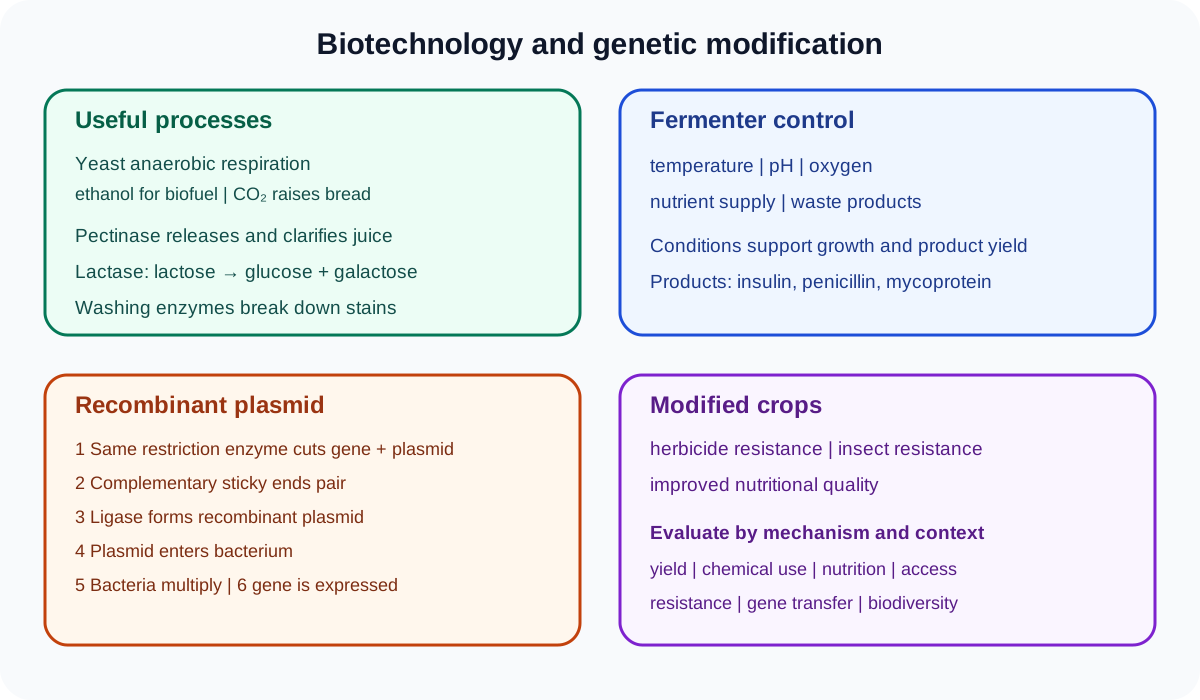
Topic 21 of Cambridge IGCSE Biology 0610 and 0970 connects useful biological processes to industrial production and deliberate gene transfer. Official sections 21.1 to 21.3 require yeast and enzyme applications, controlled fermenters, a precise recombinant-plasmid sequence and balanced evaluation of genetically modified crops.
Why bacteria are useful
Bacteria reproduce rapidly, so a small starting population can produce many cells in a short time. If every transformed bacterium contains the desired gene, population growth creates many gene copies and many protein-producing cells.
Bacteria can make complex molecules, including proteins. Their biochemical machinery can express an inserted human gene and assemble the corresponding human protein.
There are few ethical concerns over manipulating and growing bacteria compared with experiments involving animals or humans. This does not remove the need for safety, containment or ethical assessment of the resulting product.
Bacteria also contain plasmids. These small circular DNA molecules can be removed, cut, joined to a desired gene and returned to bacterial cells. A plasmid therefore acts as a vector carrying genetic material into a bacterium.
Yeast in biofuel and bread production
Yeast respires anaerobically when oxygen is unavailable. Glucose is converted to ethanol and carbon dioxide, releasing less energy than aerobic respiration.
In biofuel production, the useful product is ethanol. Plant material provides sugars, yeast ferments them, and ethanol can be separated for use as a fuel. The biological role of yeast is anaerobic respiration, not photosynthesis.
In bread-making, carbon dioxide is the useful product. Gas becomes trapped within dough and expands, causing the dough to rise. Ethanol is also formed but evaporates during baking. Yeast does not create air spaces by aerobic respiration alone in the required explanation.
Pectinase in fruit juice production
Pectin is a substance in plant cell walls and the middle lamella between cells. Pectinase breaks it down, helping separate cells and release juice.
Using pectinase can increase juice yield and improve clarity because less suspended pectin remains. Enzyme conditions matter: an unsuitable temperature or pH changes activity, while excessive heat can denature the enzyme and alter its active site.
The enzyme is a catalyst, so it is not used as a nutrient by the fruit. The practical series owns controlled comparisons of treated and untreated fruit pulp, measurement of juice volume or clarity and evaluation of repeats.
Biological washing powders
Check this topic from memory
Attempt the matching topic bank before reopening the notes. Use each missed idea to decide what to review next.
Biological washing powders contain enzymes that break large stain molecules into smaller, more soluble products. Proteases act on protein stains, while lipases act on fats. Other formulations may contain enzymes suited to carbohydrates.
Enzymes allow effective cleaning at moderate temperatures, potentially reducing energy use. Very high temperatures can denature them. A fair comparison keeps fabric, stain, powder amount, water volume, washing time and agitation constant while changing the intended variable.
Official theory requires describing and investigating this use. Experimental design, hazard control, quantitative stain comparison and evaluation belong to the practical hub, while this note owns the enzyme mechanism.
Lactase and lactose-free milk
Lactase catalyses the breakdown of lactose into the simpler sugars glucose and galactose. Passing milk over immobilised lactase, or otherwise contacting it with the enzyme under suitable conditions, reduces its lactose concentration.
The product can be consumed by people who produce insufficient lactase and therefore have difficulty digesting lactose. Immobilising an enzyme can make separation and reuse easier, but the syllabus outcome centres on using lactase to produce lactose-free milk.
Lactase does not remove every sugar from milk. It converts one named substrate into two named products.
Large-scale production in fermenters
A fermenter is a vessel in which microorganisms are grown under controlled conditions to make useful products. Bacteria or fungi can produce insulin, penicillin and mycoprotein at large scale.
Insulin is a protein that can be made by genetically modified bacteria. Penicillin is an antibiotic made by a fungus. Mycoprotein is protein-rich fungal biomass used as food. The useful material may therefore be a secreted molecule or the microbial biomass itself.
Temperature is controlled because enzymes and growth have an optimum range. Low temperature slows reactions; excessive temperature can denature enzymes and kill cells. Respiration also releases heat, so cooling may be required.
pH is controlled because enzyme activity and membrane processes depend on it. Metabolic products can change pH, so sensors and additions of acid or alkali may maintain the selected value.
Oxygen supply is controlled when aerobic respiration is needed. Air provides oxygen for energy release and growth. The required oxygen level depends on the organism and product, so it should not be assumed that every process is anaerobic.
Nutrients provide raw materials and energy sources for growth and product synthesis. Their supply must support production without creating uncontrolled conditions.
Waste products are controlled because accumulation can inhibit growth, alter pH or contaminate the desired product. Monitoring and removal maintain favourable conditions.
Sterile equipment and uncontaminated inputs prevent unwanted microorganisms from competing for nutrients, producing harmful substances or changing yield. Sterility supports the process even though it is not one of the five conditions named in the official control list.
Meaning and examples of genetic modification
Genetic modification means changing the genetic material of an organism by removing, changing or inserting individual genes.
Examples include inserting human genes into bacteria so they make human proteins, and inserting genes into crop plants to confer herbicide resistance, confer insect-pest resistance or improve nutritional qualities.
Genetic modification directly changes selected DNA. Selective breeding instead chooses parents with desired inherited features and combines existing alleles through reproduction over generations. The two processes are not interchangeable.
Recombinant plasmid sequence
The bacterial production of a human protein follows this required sequence:
A restriction enzyme isolates the DNA that makes up the human gene, forming sticky ends.
The same restriction enzyme cuts bacterial plasmid DNA, forming complementary sticky ends.
The matching ends allow the human DNA to be inserted, and DNA ligase joins the DNA backbone to form a recombinant plasmid.
Recombinant plasmids are inserted into bacteria. Specific insertion details are not required.
Bacteria containing the recombinant plasmids multiply.
The human gene is expressed in the bacteria, producing the human protein.
Using the same restriction enzyme matters because it creates complementary sticky ends on the gene and plasmid. Restriction enzymes cut DNA; ligase joins DNA. Neither enzyme manufactures the human gene.
A recombinant plasmid contains DNA from different sources. Bacterial multiplication copies the plasmid and increases the number of producing cells. Gene expression, not bacterial identity alone, produces the protein.
Evaluating genetically modified crops
Herbicide-resistant soya or maize allows a herbicide to kill weeds while leaving the crop alive. Reduced weed competition can increase yield and simplify management. Heavy reliance on one herbicide can select resistant weeds, increase chemical use or affect non-target organisms.
Insect-resistant maize can suffer less pest damage, increasing yield and potentially reducing insecticide spraying. The inserted feature may affect non-target organisms, and selection can increase the frequency of resistant pests unless resistance is managed.
Nutritionally improved rice can provide more of a needed nutrient and may help populations whose diets are limited. Its value depends on access, consumption, nutrient amount and whether the crop grows successfully in local conditions.
Possible advantages across modified crops include higher or more reliable yield, reduced crop loss, less use of some pesticides, improved nutritional quality and support for food security.
Possible disadvantages include gene transfer to wild relatives, effects on biodiversity or non-target species, evolution of resistant weeds or pests, dependence on purchased seed, unequal access and uncertainty about long-term ecological effects.
Evaluation must stay modification-specific. Herbicide resistance, insect resistance and improved nutrition have different mechanisms, benefits and risks. A possible harm is not automatically inevitable, and a potential benefit does not prove that every setting gains equally.
Worked application: human protein and crop decision
A manufacturer cuts a human gene and a bacterial plasmid with the same restriction enzyme, creating complementary sticky ends. DNA ligase joins them into a recombinant plasmid, which enters bacteria. The bacteria multiply and express the gene, producing the human protein. For a proposed insect-resistant maize, a balanced decision compares reduced pest damage, yield and possible insecticide reduction with non-target effects and selection for resistant pests. Field monitoring should test both yield and ecological outcomes. This reasoning cannot be transferred unchanged to nutrient-enriched rice because its intended benefit and relevant evidence differ.
Common misconceptions and corrections
Saying bacteria are useful only because they are small. Rapid reproduction, complex-molecule production, few ethical concerns and plasmids are the named reasons.
Calling a plasmid the bacterial nucleus. Bacteria have no nucleus.
Saying yeast makes ethanol by photosynthesis. It uses anaerobic respiration.
Saying ethanol makes dough rise. Carbon dioxide inflates the dough.
Saying bread-making produces no ethanol. Ethanol forms and later evaporates.
Saying pectinase breaks down protein. It breaks down pectin.
Saying pectinase always lowers juice yield. It helps release juice and can increase yield.
Saying biological powder contains living bacteria. It contains biological enzymes.
Assuming hotter washing always works better. Excess heat can denature enzymes.
Changing several variables in a washing-powder comparison. A fair test isolates the intended variable.
Saying lactase removes all sugar. It converts lactose to glucose and galactose.
Saying lactose-free milk contains no carbohydrate. Other sugars remain, including lactase products.
Calling every fermenter process anaerobic. Oxygen needs depend on the organism and product.
Saying fermenter temperature never changes. Microbial respiration releases heat.
Ignoring pH change during growth. Metabolism can alter the medium.
Saying nutrients are supplied only once in every process. Supply is controlled for the production method.
Saying waste cannot affect microorganisms. Accumulation may inhibit growth or alter pH.
Calling insulin a fungal biomass. Insulin is a protein; mycoprotein is fungal biomass.
Calling penicillin a nutrient. It is an antibiotic made by a fungus.
Defining genetic modification as choosing parents. That describes selective breeding.
Saying genetic modification must insert a whole organism. Individual genes are removed, changed or inserted.
Saying ligase cuts the human gene. Restriction enzymes cut DNA.
Saying restriction enzymes join the plasmid. DNA ligase joins DNA.
Using different enzymes without complementary ends. The same restriction enzyme makes matching sticky ends.
Saying sticky ends are whole plasmids. They are exposed DNA ends with complementary bases.
Saying the plasmid becomes a human cell. It remains a bacterial DNA vector carrying a human gene.
Adding detailed plasmid-insertion mechanisms. Specific insertion details are not required.
Stopping the sequence after plasmid formation. Insertion, bacterial multiplication and expression follow.
Saying bacterial multiplication itself is gene expression. Multiplication increases cells; expression makes protein.
Saying every modified crop resists both insects and herbicides. Each inserted gene has a particular effect.
Saying herbicide resistance kills insects. It lets the crop survive a herbicide targeting weeds.
Saying insect resistance guarantees no resistant pests. Selection can favour resistant variants.
Saying nutritional modification automatically ends deficiency. Access, diet and nutrient delivery still matter.
Presenting all gene transfer as certain. It is a risk whose likelihood depends on context.
Presenting all genetically modified food as risk-free. Benefits and disadvantages require evidence.
Using one crop argument for every modification. Soya, maize and rice examples may have different purposes.
Assessment guidance
For biotechnology uses, name the organism or enzyme, its substrate or process and the useful product. Fermenter answers should connect each named control to enzyme activity, respiration, growth or inhibition rather than list conditions without mechanisms. Reproduce recombinant-plasmid steps in order and assign cutting to restriction enzymes, joining to ligase, transfer to the plasmid and protein production to gene expression. Crop discussions need modification-specific advantages and disadvantages, preferably with a causal link and a qualified judgement. Do not treat every possible outcome as certain or merge selective breeding with direct gene modification.
Retrieval practice
Match yeast, pectinase, washing-powder enzymes and lactase to their substrates, processes and products. Rebuild the five fermenter controls from memory and explain each. Draw the six-step human-gene-to-bacterial-protein sequence, then compare herbicide-resistant soya, insect-resistant maize and nutritionally improved rice using distinct benefit, risk and evidence columns.
Theory and practical ownership
This theory note owns application mechanisms, fermenter control, recombinant DNA and genetic-modification evaluation. The separate Biology practical hub owns washing-powder and enzyme investigations, variables, safety, quantitative measurements, graphs, repeats, limitations and improvements.