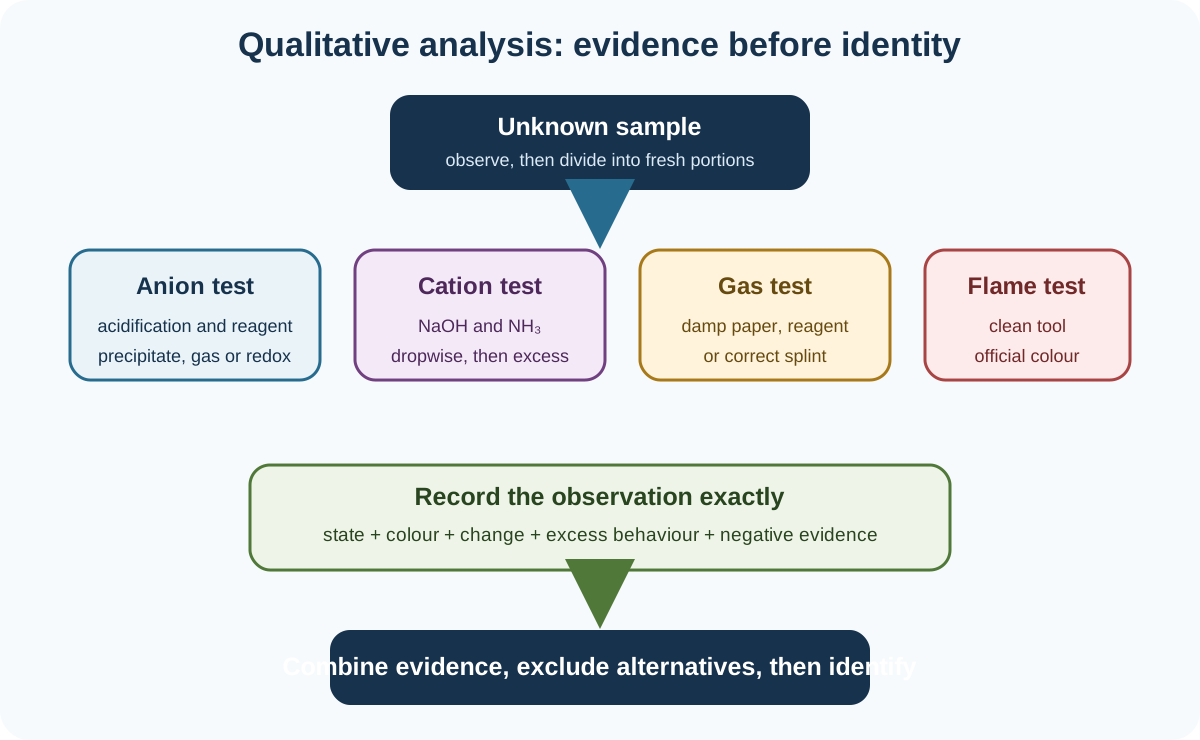
Practical Skill 3 develops identification from chemical evidence for Cambridge IGCSE Chemistry Papers 5 and 6. Official section 12.5 and the supplied Notes for use in qualitative analysis define the complete test boundary for anions, aqueous cations, gases and flame colours. Reliable work keeps reagent, procedure, observation and inference separate.
Use the evidence sequence
For every test, write four distinct parts:
Reagent: the chemical used.
Procedure: what is added, whether warming or excess is required and how gas is tested.
Observation: colour, precipitate, dissolution, gas-test result or flame colour.
Inference: the ion or gas supported by that evidence.
Use a fresh portion of unknown for each independent test unless the procedure explicitly continues on the same mixture. Reusing a treated portion can introduce chloride, nitrate, sodium, ammonia or other ions and create ambiguous results.
Anion tests
Anion
Required test
Positive observation
carbonate, CO₃²⁻
add dilute acid, then test gas for CO₂
effervescence; gas turns limewater milky
chloride, Cl⁻
acidify with dilute nitric acid, then add aqueous silver nitrate
white precipitate
bromide, Br⁻
acidify with dilute nitric acid, then add aqueous silver nitrate
cream precipitate
Check this topic from memory
Attempt the matching topic bank before reopening the notes. Use each missed idea to decide what to review next.
acidify with dilute nitric acid, then add aqueous silver nitrate
yellow precipitate
nitrate, NO₃⁻
add aqueous sodium hydroxide and aluminium foil; warm carefully
ammonia produced
sulfate, SO₄²⁻
acidify with dilute nitric acid, then add aqueous barium nitrate
white precipitate
sulfite, SO₃²⁻
add a small volume of acidified aqueous potassium manganate(VII)
purple solution becomes colourless
The acidifying reagent matters. Hydrochloric acid introduces chloride and could produce silver chloride in a halide test. Sulfuric acid introduces sulfate and could produce barium sulfate. Dilute nitric acid avoids those false positives.
For nitrate, confirm produced ammonia with damp red litmus paper turning blue. Warm carefully and point the tube away from people.
Carbonate and sulfite are different
Both can react under acidic conditions, but the required evidence differs. Carbonate produces carbon dioxide, confirmed with limewater. Sulfite decolourises acidified potassium manganate(VII) because sulfur dioxide or sulfite acts as a reducing agent.
Effervescence alone cannot identify carbonate. A named gas test or the specified redox observation is required.
Cation test method
Place separate portions of the unknown solution in clean test tubes. Add aqueous sodium hydroxide dropwise, record any precipitate, then add excess and record whether it dissolves. Repeat on a fresh portion with aqueous ammonia.
“Soluble in excess” means the precipitate disappears to give a solution after more reagent is added. It does not mean the original sample was soluble.
Aqueous-cation observations
Cation
With aqueous sodium hydroxide
With aqueous ammonia
Al³⁺
white precipitate; soluble in excess to colourless solution
white precipitate; insoluble in excess
NH₄⁺
ammonia on warming
not required
Ca²⁺
white precipitate; insoluble in excess
no precipitate or very slight white precipitate
Cr³⁺
green precipitate; soluble in excess
green precipitate; insoluble in excess
Cu²⁺
light blue precipitate; insoluble in excess
light blue precipitate; soluble in excess to dark blue solution
Fe²⁺
green precipitate; insoluble in excess; turns brown near surface on standing
same pattern
Fe³⁺
red-brown precipitate; insoluble in excess
same pattern
Zn²⁺
white precipitate; soluble in excess to colourless solution
white precipitate; soluble in excess to colourless solution
One reagent may not distinguish all ions. Al³⁺ and Zn²⁺ both dissolve in excess sodium hydroxide, but only Zn²⁺ also dissolves in excess ammonia. Cr³⁺ and Cu²⁺ are distinguished by precipitate colour and excess behaviour.
Fe²⁺ surface browning on standing is part of the required observation. Record the initial green precipitate before later oxidation changes its appearance.
Ammonium is tested by gas release
Add aqueous sodium hydroxide and warm. Ammonium ions react to release ammonia:
NH₄⁺(aq) + OH⁻(aq) → NH₃(g) + H₂O(l)
Ammonia turns damp red litmus paper blue. Do not expect an ammonium precipitate. Keep the litmus near the tube mouth without touching the solution.
Gas tests
Gas
Test and positive result
ammonia, NH₃
turns damp red litmus paper blue
carbon dioxide, CO₂
turns limewater milky
chlorine, Cl₂
bleaches damp litmus paper
hydrogen, H₂
gives a pop with a lighted splint
oxygen, O₂
relights a glowing splint
sulfur dioxide, SO₂
turns acidified aqueous potassium manganate(VII) from purple to colourless
Litmus must be damp for ammonia and chlorine so the gas can interact with the indicator. Chlorine may first show acidic colour before bleaching; the decisive required result is bleaching.
Use only a small sample of hydrogen and keep the test vessel directed away from people. Do not smell an unknown gas directly.
Flame tests
Metal ion
Flame colour
Li⁺
red
Na⁺
yellow
K⁺
lilac
Ca²⁺
orange-red
Ba²⁺
light green
Cu²⁺
blue-green
Use a clean flame-test wire or alternative apparatus and a small sample. Clean between samples to prevent carryover. Sodium contamination can produce an intense yellow colour that masks weaker colours.
Flame colour is supporting chemical evidence. Avoid decorative terms such as crimson or apple green when the supplied Cambridge wording is red or light green.
Observation language
A precipitate is an insoluble solid formed from solution. Record its colour and whether it dissolves in excess reagent.
Prefer:
light blue precipitate forms
precipitate dissolves in excess to give a dark blue solution
effervescence occurs and the gas turns limewater milky
purple solution becomes colourless
no precipitate forms
Avoid:
positive result
solution turns clear
something forms
no reaction
“Colourless solution” is not the same as “clear solution”. A coloured solution can also be transparent and clear.
Plan an efficient unknown sequence
Begin with non-destructive observations such as state and colour. Divide into fresh portions before adding reagents.
Choose tests that distinguish the remaining candidates. For a white cation precipitate soluble in excess sodium hydroxide, use aqueous ammonia on a fresh portion to distinguish aluminium from zinc. For an unknown gas, select the specific test rather than trying every test in sequence on the same small sample.
Record negative results because they eliminate possibilities. A white precipitate with sodium hydroxide but no precipitate with ammonia supports calcium and argues against zinc.
Control contamination and ambiguity
Use clean droppers and do not return excess reagent to stock bottles. Label test tubes. Avoid touching droppers to unknown solutions.
If observations conflict, repeat with fresh samples, verify reagent labels, confirm whether excess was truly added and check flame-test cleaning. Do not edit the observation to match a memorised ion.
Where two tests generate the same colour, combine evidence. A white precipitate is not a unique identity. Its reagent, acidification, solubility in excess and confirmatory test define the inference.
Safety and disposal
Wear eye protection. Dilute acids and alkalis can irritate or damage tissue; acidified oxidising reagent requires careful handling; silver and barium reagents require controlled use and disposal; unknown gases must not be inhaled.
Warm test tubes gently and point them away from people. Keep lighted splints away from bulk flammable material. Use the smallest practical sample because microscale testing reduces exposure and waste.
Safety statements should connect hazard to action, such as “aqueous sodium hydroxide can damage eyes, so wear eye protection and rinse splashes immediately according to laboratory procedure.”
Worked application: identify two ions from combined evidence
Unknown solution X gives a light blue precipitate with aqueous sodium hydroxide that remains in excess. A fresh portion gives a light blue precipitate with aqueous ammonia, then a dark blue solution in excess. The colour and ammonia-excess result identify Cu²⁺, not merely “a transition ion”. Unknown Y gives a white precipitate soluble in excess sodium hydroxide. With aqueous ammonia, its white precipitate remains, identifying Al³⁺ rather than Zn²⁺. If ammonia had also dissolved it, Zn²⁺ would be supported. The conclusion uses both reagent pathways, precise colours and excess behaviour; a single white precipitate would not be enough.
Common misconceptions and corrections
Writing the ion name as an observation. Record visible evidence first.
Using the same portion for every test. Reagents contaminate later tests.
Calling effervescence proof of carbonate. Confirm carbon dioxide.
Acidifying a chloride test with hydrochloric acid. It introduces chloride.
Acidifying a sulfate test with sulfuric acid. It introduces sulfate.
Calling every silver-halide precipitate white. Bromide is cream and iodide yellow.
Forgetting to warm the nitrate test. Warming is required carefully.
Testing nitrate ammonia with dry litmus. Use damp red litmus.
Calling sulfite decolourisation a precipitate. Purple becomes colourless.
Adding only a few drops when excess behaviour is required. Continue with more reagent.
Calling a dissolved precipitate clear. State colourless solution where appropriate.
Identifying Al³⁺ from sodium hydroxide alone. Zn²⁺ shares that pattern.
Saying Cu²⁺ dissolves in excess sodium hydroxide. It remains insoluble.
Missing the dark blue copper-ammonia solution. It is diagnostic.
Calling Fe²⁺ precipitate permanently green. Its surface turns brown on standing.
Expecting NH₄⁺ to form a precipitate. It releases ammonia on warming.
Calling chlorine's result a red litmus change only. The required result is bleaching.
Using a burning splint for oxygen. Use a glowing splint.
Using a glowing splint for hydrogen. Use a lighted splint and listen for a pop.
Calling carbon dioxide limewater colourless. It turns milky.
Smelling unknown gas directly. Use the specified chemical test.
Calling potassium flame red. It is lilac.
Calling calcium flame yellow. It is orange-red.
Ignoring sodium contamination. It can mask other flame colours.
Saying “no reaction” when no precipitate is visible. Record no visible precipitate.
Assuming one white precipitate uniquely identifies an ion. Combine reagent and solubility evidence.
Assessment guidance
Qualitative-analysis answers should follow reagent, procedure, observation and inference in that order. Include acidification reagent, warming, damp paper and excess reagent whenever required. Tables and narrative observations must use the official colour distinctions, especially white, cream, yellow, light blue, dark blue, green and red-brown. When identifying an unknown, cite every supporting result and explain how a second test removes an alternative. Negative observations are evidence and should be stated precisely. Safety and evaluation answers must name contamination routes, gas hazards or reagent risks and propose a specific prevention rather than generic carefulness.
Retrieval practice
Reconstruct the seven anion, eight cation, six gas and six flame-test outcomes without prompts. Practise each table in both directions: target to test and observation to candidate. Solve ten unknown sequences that require two pieces of evidence, including aluminium versus zinc and calcium versus other white precipitates. Rewrite vague observations, identify contamination risks and design a fresh-portion test plan with safety controls.
Theory and practical ownership
This practical note owns reagents, procedures, observations, test sequencing, contamination control, gas handling and evidence-based identification. The Chemistry theory hub owns ionic equations, solubility, redox mechanisms and electronic explanations behind the tests.