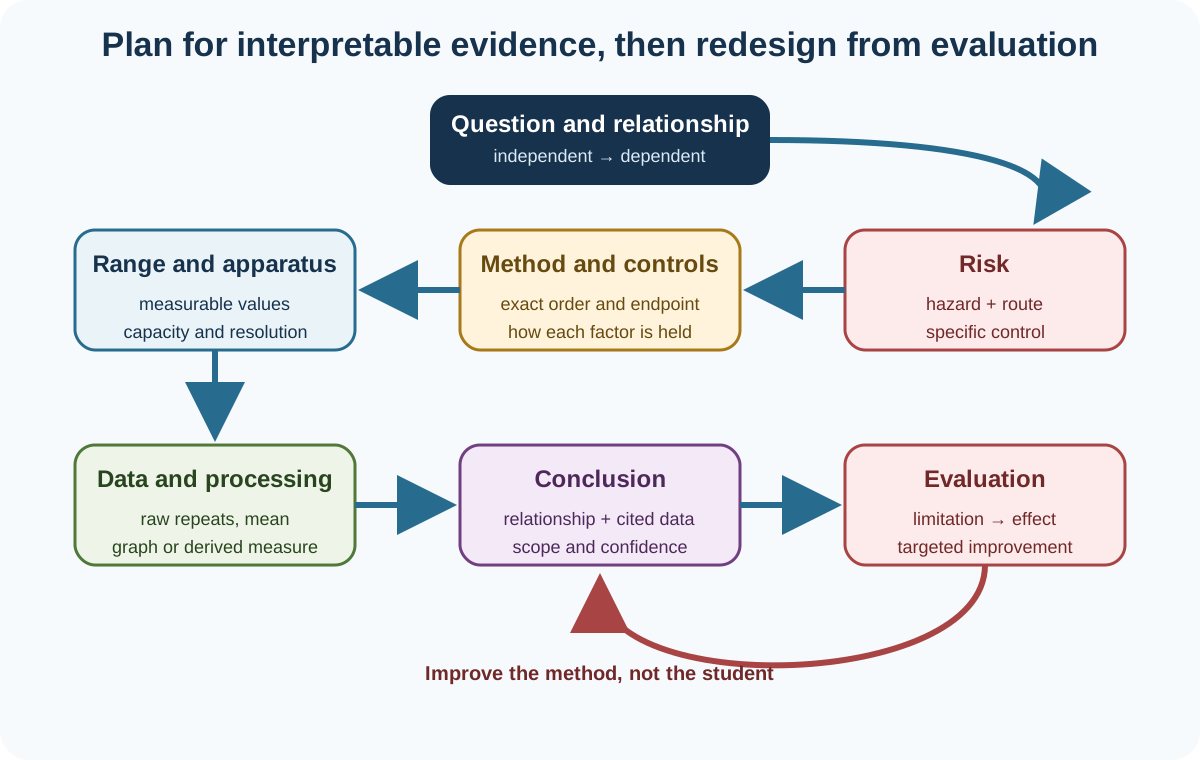
Practical Skill 4 owns the complete planning and evaluation process shared by Cambridge IGCSE Chemistry Papers 5 and 6. The official AO3 contract requires variables, range, apparatus justification, reproducible procedure, risk control, recording, processing, prediction, conclusion, anomaly handling, source-of-error analysis and targeted improvement.
Turn the question into variables
Write the aim as a relationship: how changing the independent variable affects the dependent variable.
Independent variable: deliberately changed.
Dependent variable: measured response.
Control variable: relevant factor held constant.
Operational definitions matter. “Rate” is too broad until defined as initial gas-volume gradient, mass lost per second, time to a fixed endpoint or another measurable proxy.
For acid concentration against reaction rate, specify concentration values and a dependent measure. Keep acid volume, solid mass, particle size, temperature, apparatus and mixing method constant where relevant.
Choose a useful range and intervals
Use enough independent-variable values to reveal a trend, commonly at least five where resources and context permit. Spread them sensibly across a safe, measurable range.
Two values permit only a comparison, not a well-defined trend. Closely clustered values may produce changes smaller than instrument resolution. An extreme value that reacts before the apparatus is sealed is also unhelpful.
Pilot evidence can refine a range. If every endpoint is under two seconds, reduce concentration or temperature. If change is barely detectable, increase the range or select a more sensitive dependent measure.
Do not claim one universal number of repeats or values. Justify the choice from pattern definition, time, safety and measurement resolution.
Select apparatus and justify it
Name capacity or resolution where it affects quality. A gas syringe is preferable to bubble counting when gas-volume rate is required because bubble sizes vary. A burette measures a changing delivered volume more precisely than a measuring cylinder. An insulated cup with lid reduces energy transfer in temperature-change work.
Apparatus must fit the predicted range. A 100 cm³ gas syringe cannot record 150 cm³ without stopping or losing gas. A thermometer must cover the expected temperatures.
“Use accurate apparatus” is incomplete. State the instrument and why its range or resolution suits the measurement.
Write a reproducible procedure
A reader should be able to repeat the investigation without guessing.
Check this topic from memory
Attempt the matching topic bank before reopening the notes. Use each missed idea to decide what to review next.
exact reactant identities, amounts and concentrations
apparatus setup and seal checks
how the independent variable is changed
how each control variable is maintained
when measurement starts and stops
reading interval or endpoint rule
repeat and cleaning strategy
recording and processing plan
Order matters. For a gas-rate experiment, assemble the sealed collection path before mixing reactants, or explain a method that starts the reaction after sealing. Otherwise early gas escapes.
Avoid shorthand such as “repeat for all temperatures” until the method states how each temperature is established and checked.
Control variables by method
Naming a control variable is not enough. Explain how it remains constant.
Keep solid mass constant by weighing 2.00 g each time.
Keep surface area comparable by using the same particle-size range.
Keep solution volume constant with the same volumetric apparatus.
Maintain temperature using a water bath and allow reagents to equilibrate before mixing.
Keep total volume constant when making concentrations by adding solvent to the same final volume.
Some factors cannot be perfectly controlled, but a plan can standardise them. Swirl every flask in the same way or use the same stirring schedule.
Repeats and replication
Repeat each condition to expose random variation and calculate a representative mean. Do not repeat only the easiest condition.
Independent repeats require resetting the experiment with fresh reactants. Reading the same endpoint several times is not an independent repeat.
If one repeat differs, inspect raw data and procedure, then repeat that condition. A justified anomaly may be excluded, but the original reading should remain visible.
Repeats do not remove systematic bias. A leaking gas apparatus can give consistently low volumes in every run.
Plan recording before collection
Design the raw-data table first. Put the independent variable in the first column, then repeat dependent readings, then calculated mean or derived quantity. Use quantity-unit headings and appropriate precision.
Choose processing that answers the aim:
difference for temperature change
volume divided by time or gradient for rate
mean for repeated readings
percentage change for relative comparison
graph for continuous trends
State which variable goes on each graph axis and how a conclusion will be extracted. A best-fit curve may show a plateau that two endpoint values would miss.
Make a reasoned prediction
A prediction needs direction and chemical reasoning. “The reaction gets faster” is incomplete.
For increasing acid concentration: more reacting particles occupy each unit volume, collisions occur more frequently, so successful collisions per second and measured rate increase.
The prediction should match the defined dependent variable. If rate is measured as time to a fixed gas volume, faster rate means shorter time, not a larger time value.
Risk assessment
Separate hazard from risk. A hazard is the potential source of harm. Risk considers likelihood and severity in the planned conditions.
Use a three-part chain:
Hazard and route: corrosive acid may splash into eyes.
Control: wear eye protection and use small volumes with a stable rack.
Response or disposal where relevant: follow laboratory rinsing and disposal procedure.
Possible controls include a water bath instead of flame for flammable liquids, tongs for hot apparatus, ventilation for harmful gases, dilute reagents, small quantities and keeping ignition sources away.
Do not list every laboratory precaution. Select controls for the actual substances and operations.
Draw a conclusion from evidence
State the observed relationship and support it with data, not merely the expected theory.
Example: increasing concentration from 0.50 to 1.50 mol/dm³ increased mean initial gradient from 0.8 to 2.3 cm³/s, so rate increased over the tested range.
Scope the conclusion. Do not claim all concentrations behave the same beyond the measured range. If scatter or overlap weakens confidence, say so.
Distinguish correlation from mechanism. Data show the pattern; collision theory explains it.
Evaluate data quality
Accuracy is closeness to the accepted value. Precision concerns spread and resolution. Reliability concerns consistent support from sufficient evidence. Validity concerns whether the method tests the intended relationship without uncontrolled alternatives.
Random variation creates scatter and can be assessed with repeats. Systematic error shifts results in one direction, such as a balance zero offset or continuous heat loss.
An anomaly is identified relative to repeat consistency or the overall trend. It should be checked and repeated, not removed because it weakens the hypothesis.
Link limitation, effect and improvement
Strong evaluation follows:
specific limitation → directional or uncertainty effect → targeted improvement
Heat escapes from an open cup, so the measured maximum temperature rise is too low; use an insulated cup with a lid and temperature-probe hole.
Gas escapes while the bung is fitted, so early volume and initial rate are underestimated; use a setup that allows reactants to mix after sealing.
A visual endpoint depends on observer judgement, increasing random timing variation; use a sensor-based threshold or the same observer and a standard viewing background where suitable.
“Use better equipment” and “be more careful” do not identify either mechanism or solution.
Worked application: plan and evaluate a temperature investigation
To test temperature against sodium-thiosulfate reaction rate, use water baths at 20, 30, 40, 50 and 60 °C. Equilibrate equal measured volumes of thiosulfate and acid separately, verify temperature, then mix above the same marked cross and start timing immediately. Stop when the cross is no longer visible from a fixed viewing position. Keep concentrations, total volume, flask, cross, depth and observer constant. Repeat each temperature three times and calculate mean reciprocal time as a rate proxy. Sulfur dioxide may form, so use small quantities and suitable ventilation. Subjective disappearance causes random variation; a light sensor would provide a reproducible threshold.
Common misconceptions and corrections
Calling the factor measured the independent variable. It is usually dependent.
Naming variables without measurable definitions. State values and response method.
Changing concentration by changing reactant volume alone. Total volume may become a confounder.
Using only two independent-variable values. They do not define a trend well.
Choosing values outside apparatus range. Predict capacity before running.
Saying “use a gas syringe” without justification. Link it to direct volume measurement.
Leaving the method in an impossible order. Assemble before starting the reaction.
Saying “control temperature” without a method. Use and verify a water bath.
Calling repeated readings of one run independent repeats. Reset with fresh materials.
Repeating only an anomalous condition and discarding the rest. Keep a consistent repeat design.
Saying repeats remove systematic error. They mainly reveal random variation.
Averaging an unexplained anomaly automatically. Investigate and repeat.
Putting processed values in place of raw data. Preserve both.
Predicting a larger time for a faster fixed-endpoint reaction. Faster means shorter time.
Listing a hazard without a route of harm. Connect substance, exposure and injury.
Writing “wear gloves” for every plan. Choose relevant controls.
Calling the conclusion proven theory. State what data support over the tested range.
Using one datum as a trend conclusion. Compare the complete evidence.
Equating precision with accuracy. Tight repeats can still be biased.
Calling every outlier human error. Identify a plausible mechanism.
Suggesting “more accurate results” as an improvement. Name the change and benefit.
Proposing an improvement that changes the independent variable. Preserve the investigation aim.
Assessment guidance
Planning answers should be executable, not lists of principles. State variables operationally, give a useful range and intervals, justify apparatus, explain every important control, define start and stop rules, include independent repeats and pre-plan processing. Risk statements need hazard, route and relevant control. Predictions must match the direction of the recorded dependent variable. Conclusions should quote data and stay within the tested range. Evaluation should distinguish random and systematic effects and write each improvement against a named limitation. If an unfamiliar method is supplied, apply the same contract rather than forcing a memorised experiment onto it.
Retrieval practice
Turn eight broad questions into operational variable statements. Design ranges and controls for rate, solubility, temperature-change and corrosion contexts. Write four complete methods with recording tables, repeat plans and risk chains. Given flawed data, distinguish anomaly, random scatter and systematic bias. Produce ten limitation-effect-improvement chains and rewrite conclusions so each cites evidence and respects the tested range.
Theory and practical ownership
This practical note owns method design, variables, range, apparatus justification, risk, recording, processing, conclusion and evaluation. The Chemistry theory hub owns the reaction models and equations used to justify predictions and interpret chemical mechanisms.