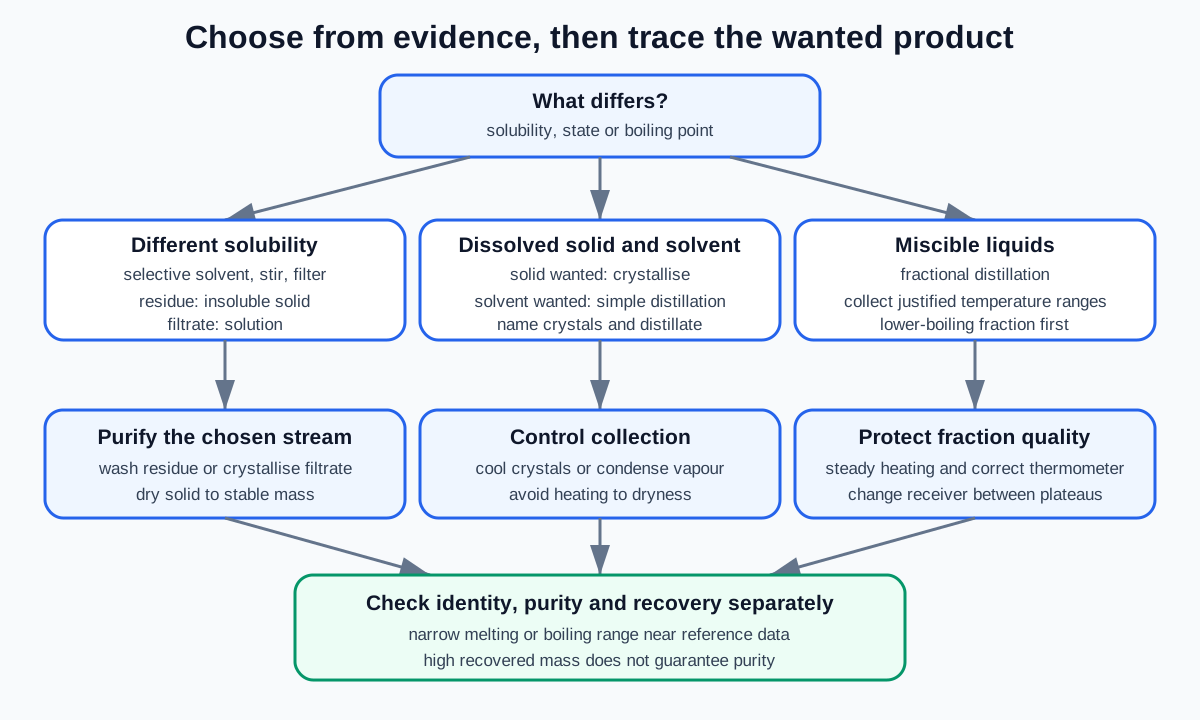
Practical Skill 6 develops the separation and purification decisions required by Cambridge IGCSE Chemistry section 12.4. The correct method follows from physical-property evidence: solubility, state, particle behaviour and boiling point. Start by deciding which component must be recovered, because the same mixture can require a different route when the desired product changes.
Describe every product precisely
A solvent dissolves a solute. A solute is dissolved in a solvent, and the resulting homogeneous mixture is a solution. A saturated solution contains the maximum concentration that can dissolve at a specified temperature.
A residue remains after a separation process. During filtration, it is the solid retained by the paper. The filtrate is the liquid or solution that passes through the filter. A distillate is the condensed liquid collected during distillation.
These labels identify streams, not permanent substances. In one stage a wanted substance may be in the filtrate; after crystallisation it becomes the solid product.
Begin with a property-and-product table
For each component, record:
physical state at the working temperature
solubility in the proposed solvent
boiling point or boiling range where relevant
whether it decomposes on strong heating
whether it is the wanted product or an impurity
Then state the useful difference. “Filter the mixture” is incomplete reasoning. “Solid sand is insoluble in water while sodium chloride dissolves, so add water and filter” links the operation to evidence.
Use a suitable solvent selectively
Solvent extraction is useful when one component dissolves but another does not. Add enough suitable solvent, stir to increase contact and allow the soluble component to enter solution. Filter to separate the insoluble material.
If the insoluble solid is wanted, wash its residue with a small amount of clean solvent to remove solution trapped between particles, then dry it. If the dissolved solid is wanted, retain the filtrate and recover the solute by crystallisation.
The solvent should dissolve the wanted component selectively, be safe enough for the stated method and be removable afterwards. More solvent can improve extraction, but an excessive volume leaves more solvent to evaporate and may reduce the fraction crystallised on cooling.
Check this topic from memory
Attempt the matching topic bank before reopening the notes. Use each missed idea to decide what to review next.
Repeated extraction with smaller portions can be more effective than one poorly mixed addition, but only claim this when the method permits the portions to be combined.
Filter an insoluble solid from a liquid
Fold and seat filter paper in a funnel, then support the funnel above a receiving vessel. Pour the mixture carefully, using a glass rod if supplied. Keep the liquid below the top edge of the paper so it cannot bypass the filter.
Filtration separates by particle behaviour, not by boiling point. Dissolved solute particles pass through with the solvent, while sufficiently large insoluble particles remain.
Choose the product stream deliberately:
wanted insoluble solid: collect, wash and dry the residue
wanted dissolved solute: retain the filtrate for further treatment
unwanted insoluble impurity: remove the residue and keep the filtrate
A cloudy filtrate may indicate torn paper, overflow, particles too fine for the paper or disturbance during transfer. Refilter through intact paper rather than merely repeating the same faulty setup.
Crystallise a soluble solid
Crystallisation recovers a dissolved solid without heating the solution completely to dryness.
Heat the solution gently to evaporate some solvent.
Stop when the solution is concentrated or near saturation. A small drop forming crystals on a cool surface can be used when the question supplies that test.
Leave the hot concentrated solution to cool so solubility decreases and crystals form.
Filter the crystals from the remaining solution.
Wash them with a small quantity of cold solvent.
Dry them between filter papers or by the stated safe method.
Cold wash solvent removes adhering solution while limiting redissolution. A large volume or warm solvent can dissolve significant product.
Heating to dryness can cause spitting, decomposition or loss of water of crystallisation. It can also leave soluble impurities mixed with the solid. Controlled concentration followed by cooling is therefore the purification route.
The liquid remaining after crystals form is the mother liquor. It still contains dissolved solute, so a lower crystal yield does not automatically mean the chemical reaction failed.
Use simple distillation to collect a solvent
Simple distillation separates a volatile liquid from a dissolved solid or from a liquid whose boiling point is much higher.
Heat the mixture in a distillation flask. The more volatile component vaporises, travels into the condenser, loses energy to the cooling water and condenses. Collect this liquid as the distillate. Non-volatile material remains in the flask.
The thermometer bulb should measure vapour entering the condenser rather than touch the liquid or sit far above the side arm. Cooling water enters at the lower condenser connection and leaves at the upper connection, keeping the water jacket full.
The system must remain open to the atmosphere. Sealing a heated apparatus can cause dangerous pressure buildup. Add anti-bumping granules before heating when instructed, never to a hot liquid.
Do not distil to complete dryness. Stop safely before the residue overheats or the apparatus becomes dry.
Use fractional distillation for miscible liquids
Fractional distillation separates miscible liquids with different boiling points, especially when their boiling points are too close for clean separation by one vaporisation-condensation step.
The fractionating column provides repeated condensation and vaporisation. Rising vapour becomes richer in the more volatile, lower-boiling component. The first collected fraction is therefore enriched in that component.
Monitor the thermometer. A relatively steady temperature near one component's boiling point supports collection of that fraction. When temperature changes between plateaus, change the receiver if separate fractions are required.
The technique does not create perfectly pure liquids automatically. Close boiling points, rapid heating, a short column or collecting across a changing temperature range can cause contamination.
Select methods from mixture evidence
Insoluble solid plus liquid: filter. Wash and dry the residue if the solid is wanted.
Soluble solid plus solvent, solid wanted: concentrate and crystallise, then filter, wash and dry.
Soluble solid plus solvent, solvent wanted: use simple distillation and collect the distillate.
Two immiscible liquids: use separation by layers if suitable apparatus is supplied; do not claim filtration separates two liquid phases.
Two miscible liquids with different boiling points: use fractional distillation, using boiling data to identify fractions.
Two solids with different solubilities: dissolve one selectively, filter, then recover the dissolved component if required.
A multi-component mixture may need a sequence. Name what occupies the residue, filtrate, distillate and crystals after every stage.
Assess purity with melting and boiling data
A pure substance has a characteristic melting point or boiling point at a stated pressure. Compare the measured value with reliable reference data.
A pure solid usually melts over a narrow range. Impurities commonly lower and broaden a solid's melting range. A liquid collected over a narrow, steady boiling range near the reference value supports purity.
Do not claim that any high melting point means pure or that boiling alone removes every impurity. Identity and purity require agreement with the expected value and attention to the measurement range and conditions.
A heating curve plateau supports a change of state at nearly constant temperature. Poor insulation, rapid heating, thermometer placement and pressure differences can shift or blur the observed result.
Record yield and quality separately
Record starting amount, product amount, appearance, melting or boiling range and the identity of every process stream. Percentage recovery compares recovered amount with the starting amount of that component.
A high recovery is not the same as high purity. Wet crystals or retained impurity can raise measured mass. Conversely, careful washing can improve purity while decreasing recovery because some product dissolves.
Use a balance consistently, allow hot material to cool before final mass measurement and repeat masses until stable when the method requires dryness.
Safety and apparatus control
Wear eye protection and heat gently on a heatproof mat. Secure distillation glassware with appropriate clamps, check joints, keep the delivery path open and never heat a sealed system. Keep flammable solvents away from naked flames and use the specified heating source.
Avoid handling hot glass directly because it can look identical to cool glass. Prevent a condenser from running dry, and turn off heat before dismantling apparatus. Hazard statements should connect a named material or operation to a specific control.
Evaluate losses and contamination
Product remaining on glassware causes transfer loss; rinse quantitatively into the correct stream when extra solvent will not damage the method.
Crystals left in mother liquor reduce recovery; concentrate appropriately or cool for longer, while recognising that excessive evaporation may reduce purity.
Warm or excessive wash solvent dissolves crystals; use a small cold portion.
Wet crystals give an artificially high mass; dry to stable mass.
Vapour leaks reduce distillate recovery and may expose users; secure sound joints without sealing the outlet.
Fast heating can carry droplets into the condenser or merge fractions; heat steadily and collect within justified temperature ranges.
Worked application: recover both salt and water
A mixture contains sand, sodium chloride and water. Sand is insoluble, so filter first. The sand is the residue; wash it with a little water and dry it if pure sand is required. The filtrate contains sodium chloride solution. To recover water, use simple distillation: water vaporises, condenses and is collected as distillate while salt remains. To recover purified salt instead, concentrate a separate portion of filtrate, cool it to crystallise, filter, wash the crystals with a little cold water and dry them. Heating that portion completely to dryness risks spitting and gives poorer control of crystal quality. Each recovered substance therefore requires a deliberately chosen stream.
Common misconceptions and corrections
Filtering a solution to remove dissolved salt. Dissolved solute passes through the paper.
Assuming the residue is always unwanted. It depends on the recovery aim.
Assuming the filtrate is pure solvent. It may be a solution.
Filling above the filter-paper edge. Liquid can bypass the paper.
Using any solvent. Selection must follow solubility and safety evidence.
Using unlimited extraction solvent. Excess solvent can hinder later recovery.
Evaporating every solution to dryness. Crystallise when the solid may decompose or purity matters.
Calling evaporation and crystallisation identical. Crystallisation includes concentration and controlled cooling.
Washing crystals with much hot solvent. This dissolves product.
Weighing wet crystals as final yield. Retained solvent inflates mass.
Calling mother liquor waste with no solute. It still contains dissolved material.
Using distillation when the solid is the only desired product. Crystallisation is normally more direct.
Placing the thermometer bulb in the boiling liquid. It should measure vapour entering the condenser.
Sending cooling water into the condenser top. Feed from the bottom to fill the jacket.
Sealing the distillation apparatus. Heating can create dangerous pressure.
Distilling to dryness. Residue can overheat or decompose.
Using simple distillation for close-boiling miscible liquids. Use a fractionating column.
Saying a fractionating column only cools vapour once. It enables repeated condensation and vaporisation.
Equating maximum recovery with maximum purity. Wet or contaminated product can have high mass.
Calling any sharp melting point proof of identity. It must agree with expected reference data.
Saying impurities always raise melting point. They commonly lower and broaden a solid's range.
Ignoring pressure in boiling-point comparison. Boiling point depends on pressure.
Assessment guidance
Selection answers should name the wanted component, cite the useful property difference and trace the product through each stream. Method descriptions need apparatus position and an observable stopping rule, not only a list of equipment. For distillation, show an open pathway, correct thermometer position and lower-to-upper condenser water flow. Purity answers should compare a narrow measured range with reference data and avoid absolute claims. Evaluation marks require limitation, consequence and targeted improvement, such as wet crystals increasing measured mass followed by drying to stable mass. Distinguish recovery from purity whenever both are assessed.
Retrieval practice
Classify twenty mixtures by state, solubility and boiling data. Draw and label filtration, crystallisation, simple-distillation and fractional-distillation setups. Trace wanted substances through residue, filtrate, crystals and distillate. Diagnose twelve apparatus errors. Interpret melting and boiling ranges for identity and purity, then write limitation-effect-improvement chains for washing, transfer, drying, heating rate, thermometer position and vapour leakage.
Theory and practical ownership
This practical note owns separation choice, apparatus, process streams, collection, purity measurement, safety and evaluation. The Chemistry theory hub owns particle, solubility, change-of-state and intermolecular explanations. Chromatography remains in Practical 5, while reaction-specific salt preparation remains in Practical 11.