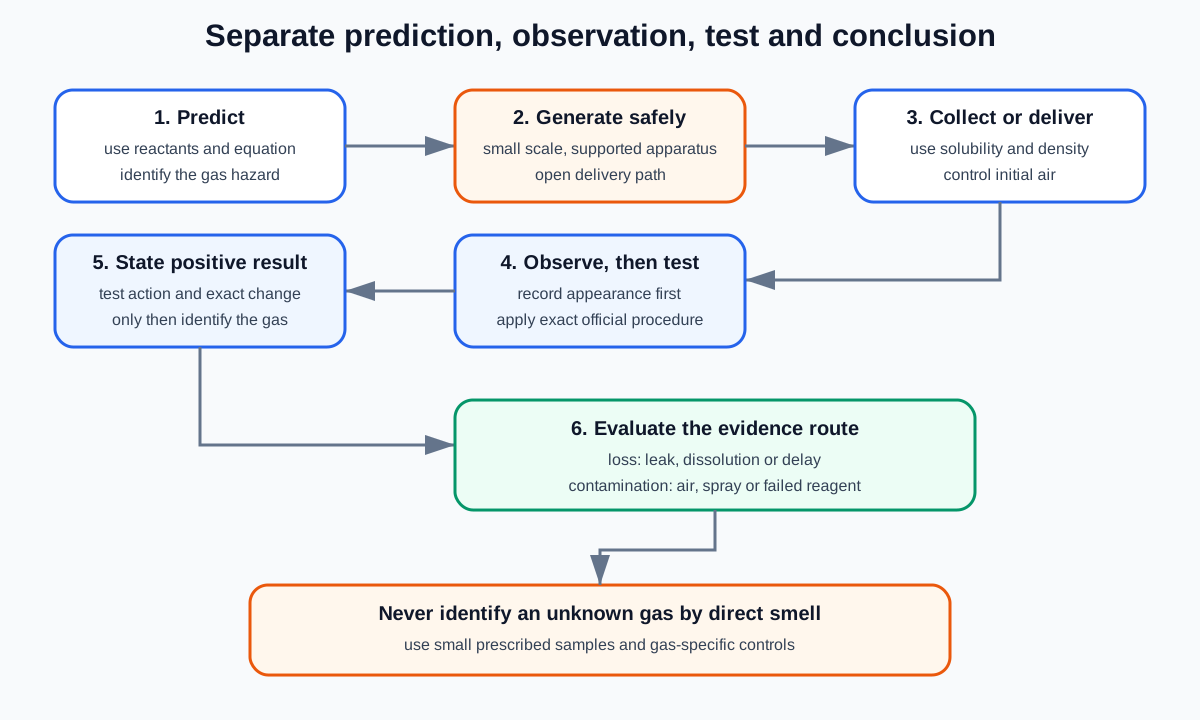
Practical Skill 10 develops the gas work required by Cambridge IGCSE Chemistry section 12.5 and the shared practical contexts. It separates four stages that exam answers often blur: generate a gas safely, collect or deliver it appropriately, record its physical observations, then apply a confirmatory test and exact positive result.
Q: What gas tests must Cambridge IGCSE Chemistry students know? A: Ammonia turns damp red litmus blue; carbon dioxide turns limewater milky; chlorine bleaches damp litmus; hydrogen gives a squeaky pop with a lighted splint; oxygen relights a glowing splint; and sulfur dioxide turns acidified aqueous potassium manganate(VII) from purple to colourless.
Predict before assembling
Use the reactants to predict the likely gas and write a balanced equation when requested. Prediction helps select apparatus and safety controls, but it is not experimental identification.
Common generation patterns include:
acid plus carbonate producing carbon dioxide
reactive metal plus suitable dilute acid producing hydrogen
decomposition of hydrogen peroxide with a catalyst producing oxygen
warming an ammonium compound with aqueous alkali producing ammonia
sulfite plus dilute acid producing sulfur dioxide
electrolysis producing gases at specified electrodes
Follow the reagents and quantities supplied. Do not invent chlorine or sulfur-dioxide preparations because both gases need controlled small-scale handling.
Build an open, controlled generator
A typical setup uses a reaction vessel, a bung with delivery tube and a collection or test vessel. Assemble and support it before the final reagent is added.
The delivery tube must remain open. A blocked outlet in a gas-generating system causes pressure buildup. Check that tubing is not kinked and that the end is not pressed against a vessel base.
Where a thistle funnel or dropping funnel is supplied, its stem position and tap allow controlled reagent addition. Do not remove a bung from a reacting vessel unnecessarily.
Use small quantities. Rapid bubbling can push liquid into the delivery tube, cause spray or exceed collection capacity. Adjust concentration, particle size or addition rate only as the question permits.
Choose a collection route from properties
Gas syringe
A gas syringe measures volume directly and avoids collecting over water. It is useful for gases with suitable chemical compatibility, but joints must be airtight and the plunger must move freely.
Check this topic from memory
Attempt the matching topic bank before reopening the notes. Use each missed idea to decide what to review next.
Secure the syringe and never clamp its plunger. Stop before its capacity is exceeded.
Collection over water
Water displacement is suitable when the gas is sufficiently insoluble and does not react significantly with water. Fill the receiving vessel completely, invert it in a water trough and deliver gas into it.
This method is unsuitable for very soluble gases such as ammonia and sulfur dioxide. Dissolution makes collected volume too low and may alter the solution.
Displacement of air
Deliver a gas into a dry vessel when water collection is unsuitable. A denser-than-air gas is often delivered into an upright vessel; a less-dense gas can be delivered into an inverted vessel. The exact arrangement must keep the delivery point and outlet safe.
Density alone does not guarantee a pure sample because gases mix by diffusion. Allow appropriate displacement time when the procedure requires it.
Direct delivery to a test reagent
Some gases are bubbled through a small quantity of test solution, such as limewater or acidified aqueous potassium manganate(VII). Use a trap if the supplied apparatus prevents suck-back.
Never immerse a delivery tube after heating stops without considering pressure change. Cooling gas can contract and draw liquid back into a hot vessel.
Control initial air
The apparatus contains air before the reaction begins. The first gas leaving is therefore a mixture of air and product.
When a pure sample is required, allow a safe, specified flushing period before collecting. Do not release a hazardous gas into the room merely to remove air; follow the centre's capture or ventilation arrangement.
Initial air can weaken positive tests, distort gas-volume ratios and create an unsafe hydrogen-air mixture. Keep flame away from the generator and test only a small collected sample after the prescribed procedure.
Observe before identifying
Record whether the gas is colourless or coloured, whether it forms rapidly or slowly and whether it has any visible effect on the apparatus. Never smell an unknown gas directly.
Then record the test action and positive result. “The gas is carbon dioxide” is a conclusion. “The gas turns limewater milky” is evidence.
Use a fresh portion for a second test when reagents could interfere. A negative result may reflect too little gas, contamination, leakage, dissolution or expired test material rather than definite absence.
Official test 1: ammonia
Hold damp red litmus paper in the gas. Ammonia turns it blue.
The paper must be damp so ammonia dissolves and produces the alkaline response. Dry paper can give a weak or delayed result. Do not place litmus in the reaction mixture when the task is to test the evolved gas.
When ammonia is produced by warming an ammonium ion sample with aqueous sodium hydroxide, warm gently and keep the test paper near the mouth without touching splashes.
Official test 2: carbon dioxide
Bubble the gas through limewater. Carbon dioxide turns limewater milky because a white precipitate forms.
Do not report “limewater turns cloudy” without stating that gas was passed through it. Very prolonged bubbling can alter the appearance under some conditions, so record the first clear positive result.
Carbon dioxide does not relight a glowing splint, but extinguishing a flame is not the official identifying test because several gases do that.
Official test 3: chlorine
Expose damp litmus paper to the gas. Chlorine bleaches the paper.
The paper may show an initial acidic colour change before bleaching, but the identifying result is bleaching. Dry litmus is inappropriate because moisture is needed.
Chlorine is toxic and irritating. Use only the supplied small-scale, ventilated procedure and do not inhale it or release it deliberately.
Official test 4: hydrogen
Bring a lighted splint to a small collected sample. Hydrogen produces a pop.
Keep the sample small and separate from the generator. Initial air can change the sound and creates a flammable mixture. Do not insert a flame into a vessel that is actively producing an unknown gas.
“Burns” alone is incomplete because other gases or vapours can burn. Record the characteristic pop with the stated test.
Official test 5: oxygen
Insert a glowing splint into a collected sample. Oxygen relights it.
The splint must glow rather than carry a full flame. If it has gone out completely, failure to relight is not reliable evidence against oxygen.
Oxygen supports combustion but is not itself described as flammable. Keep it away from fuels and uncontrolled flames.
Official test 6: sulfur dioxide
Pass the gas through acidified aqueous potassium manganate(VII). Sulfur dioxide changes it from purple to colourless.
State both initial and final colours. The result depends on the reagent being acidified. Use a fresh, small quantity and prevent suck-back.
Sulfur dioxide is toxic and irritating. It must be handled in the prescribed small-scale ventilated setup without direct smelling.
Quantify gas production
For a volume-time investigation, begin from a known syringe reading and record at fixed intervals. Use headings with units and continue to a plateau or specified time.
Correctly read syringe scale direction. Some scales increase away from the barrel while others are presented differently in diagrams. Read the position indicated by the piston edge specified in the question.
Control reagent amount, concentration, temperature, particle size, catalyst condition, apparatus volume and collection duration. Gas volume depends on temperature and pressure, so comparisons need the same conditions.
At room temperature and pressure, supplied stoichiometric questions may use 24 dm3 per mole. Convert cubic centimetres and cubic decimetres consistently. Compare theoretical with collected volume only after identifying the limiting reactant.
Dry or purify a gas only when specified
A generated gas may contain water vapour, acid spray or another gas. A wash bottle or drying tube can remove a stated impurity if the reagent does not react with the desired gas.
Do not assume that passing a gas through any solution purifies it. The reagent must selectively remove the impurity. A drying agent must remove water without consuming the product gas.
The practical boundary is apparatus reasoning, not memorising unlisted drying agents. Use the substances supplied in the question.
Evaluate by tracing gas loss and contamination
A loose joint lets product escape, making collected volume too low. Leak-test the assembled apparatus before adding reagents.
Delay while fitting a bung loses early gas, especially in a fast reaction. Assemble first and start through a reproducible addition method.
Initial air contaminates the first sample. Flush safely as directed before collection.
Gas dissolving in collection water lowers measured volume. Use a compatible gas syringe or displacement-of-air method.
Spray entering the delivery tube contaminates the gas and may block flow. Reduce reaction rate, use a larger vessel or add a suitable trap when supplied.
Suck-back can crack hot glass or contaminate the reaction. Remove the delivery tube from liquid before stopping heat where the procedure requires it, or use an appropriate trap.
Temperature change alters gas volume. Compare only after returning to the same conditions or record conditions explicitly.
Safety
Wear eye protection, point vessel openings away from people and use small quantities. Never seal a gas-generating setup. Clamp glassware securely without overtightening and inspect tubing for blockage.
Hydrogen is flammable, oxygen intensifies combustion, and chlorine, ammonia and sulfur dioxide are irritating or toxic. Use flame only for the prescribed small hydrogen test and keep it away from the generator. Use ventilation and capture arrangements for hazardous gases. Never identify a gas by direct smell.
Worked application: identify an unknown gas reliably
Dilute acid is added to a white solid and a colourless gas forms. The gas is passed through limewater, which changes from colourless to milky. This positive result identifies carbon dioxide and supports the solid containing carbonate. A separate collected sample does not relight a glowing splint, but that negative test is only supporting evidence because a failed splint could be too cool. If the first bubbles were tested immediately, air in the apparatus could weaken the result. A controlled repeat should use airtight joints, a small safe flushing period and fresh limewater. The observation, test and conclusion must remain separate.
Common misconceptions and corrections
Naming a gas without reporting the test result. Give action, observation and conclusion.
Choosing a test before considering hazards. Plan safe scale and collection first.
Sealing the gas generator. Pressure can build dangerously.
Using a blocked delivery tube. Confirm a clear outlet before starting.
Assuming the first collected gas is pure product. Apparatus initially contains air.
Flushing hazardous gas into the room. Use the specified capture or ventilation route.
Collecting every gas over water. Soluble gases may be lost.
Assuming displacement of air gives immediate purity. Diffusion causes mixing.
Ignoring syringe capacity. Stop before the plunger reaches its limit.
Clamping a gas-syringe plunger. Pressure can rise.
Identifying a gas by smell. Never smell an unknown directly.
Using dry red litmus for ammonia. The paper must be damp.
Saying carbon dioxide makes limewater colourless. It turns limewater milky.
Using flame extinction as the official carbon-dioxide test. Use limewater.
Saying chlorine only turns litmus red. The identifying result is bleaching damp litmus.
Testing hydrogen in the generating flask. Test a small separate sample.
Using a lighted splint for oxygen. Use a glowing splint.
Calling oxygen flammable. It supports combustion.
Omitting the initial purple colour in the sulfur-dioxide test. State purple to colourless.
Using unacidified manganate reagent for the official result. It must be acidified.
Treating a negative test as absolute proof. Sample and reagent failures are possible.
Assuming all missing volume is a chemical-yield loss. Leakage and dissolution matter.
Ignoring temperature and pressure in volume comparison. Gas volume depends on both.
Stopping heating before preventing suck-back. Cooling can draw liquid into hot apparatus.
Calling any drying reagent suitable. It must not react with the product gas.
Assessment guidance
Apparatus answers should show an open delivery route, stable support, safe collection position and a method suited to gas solubility and density. Identification answers need the exact official test and positive observation, not merely a gas name. Planning should control reactant amount, temperature and collection interval and address initial air. Quantitative work needs correct syringe reading, units, gas-volume conversions and limiting-reactant logic when supplied. Evaluation should trace whether a flaw causes gas loss, contamination or unsafe pressure, then propose a targeted correction. Hazard points must name the gas and matching control rather than say only “work carefully.”
Retrieval practice
Match the six official gases to tests and exact positive results. Draw gas-syringe, water-displacement and air-displacement setups, then diagnose twelve faults. Select collection methods from solubility and density data. Plan volume-time measurements and process supplied molar-volume data. Write observation-test-conclusion chains and limitation-effect-improvement chains for initial air, leakage, dissolution, spray, suck-back, temperature change and unsafe flame use.
Theory and practical ownership
This practical note owns safe generation, collection selection, observations, official gas tests, quantitative collection, contamination control and evaluation. The Chemistry theory hub owns the reaction patterns and equations that predict each gas. Ion-specific wet tests remain in Practical 3.