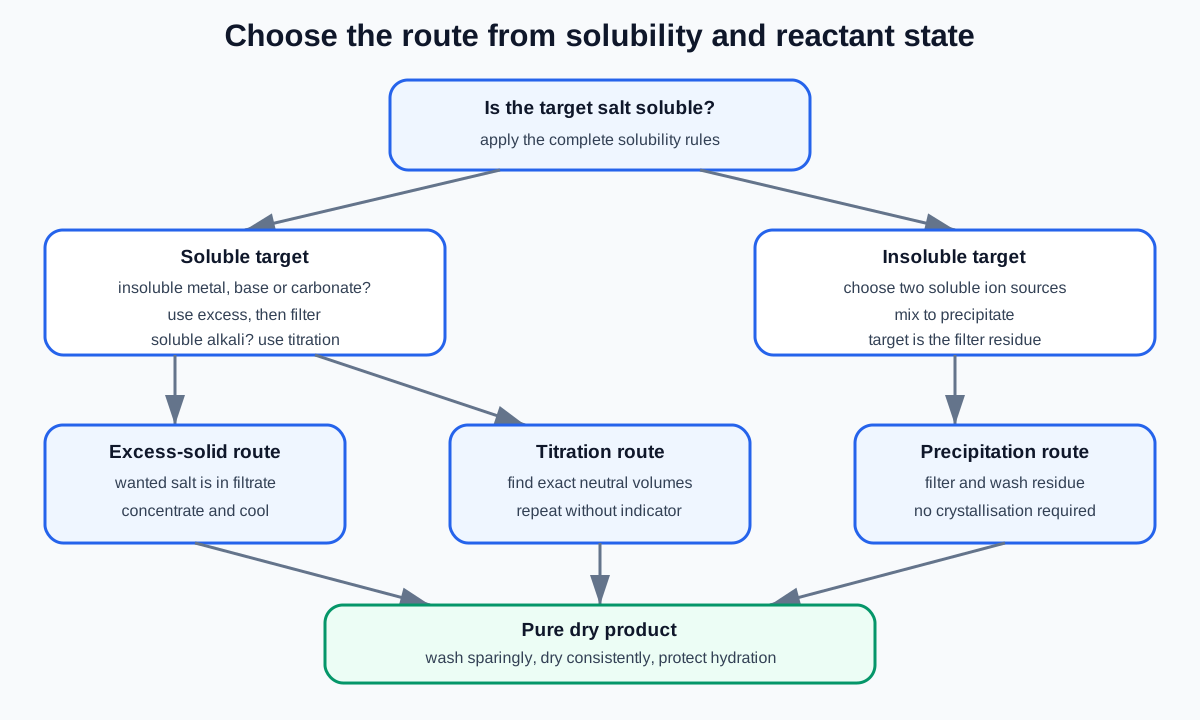
Practical Skill 11 develops Cambridge IGCSE Chemistry section 7.3 and the shared salt-preparation context. A successful answer chooses the route from the target salt's solubility and the reactants' physical states, then traces impurities through reaction, separation, crystallisation, washing and drying to obtain a pure dry product.
Q: Can aqueous sodium sulfate and hydrochloric acid be used to prepare pure sodium chloride? A: No. All four ions remain in solution, so there is no precipitate, gas or water formation to drive a reaction or separate pure sodium chloride. Choose a route that forms a removable excess solid, an exact neutralisation mixture or an insoluble precipitate.
Name the target salt first
Identify its positive ion and negative ion. The acid normally supplies the negative ion for a soluble-salt preparation:
hydrochloric acid gives chlorides
sulfuric acid gives sulfates
nitric acid gives nitrates
The metal, base, alkali or carbonate supplies the positive ion. Use the target formula to write a balanced equation and check that no unwanted ion is introduced.
Do not begin by memorising a method. First decide whether the target salt is soluble in water and whether the reacting base or metal can be removed physically if added in excess.
Apply the complete solubility rules
Cambridge requires these general rules:
all sodium, potassium and ammonium salts are soluble
all nitrates are soluble
chlorides are soluble except lead and silver chlorides
sulfates are soluble except barium, calcium and lead sulfates
carbonates are insoluble except sodium, potassium and ammonium carbonates
hydroxides are insoluble except sodium, potassium and ammonium hydroxides, with calcium hydroxide partially soluble
Use these rules to classify the target and to choose soluble reactants for precipitation. Treat them as syllabus-level generalisations; follow any specific data supplied in a question.
Route A: acid plus excess insoluble solid
Use this route for a soluble salt when the second reactant is an excess metal, insoluble base or insoluble carbonate.
Place a measured volume of the correct dilute acid in a beaker.
Warm gently if appropriate to increase reaction rate, without boiling.
Check this topic from memory
Attempt the matching topic bank before reopening the notes. Use each missed idea to decide what to review next.
Continue until some solid remains and no further reaction is observed.
Filter to remove the unreacted excess solid.
Retain the salt solution in the filtrate.
Concentrate it gently, cool to crystallise, filter the crystals, wash and dry.
The excess solid ensures all acid is consumed. Because the excess is insoluble, filtration removes it. This logic does not work for a soluble alkali: excess alkali passes through the filter and contaminates the product.
For a metal, stop adding when reaction ceases and solid remains, while respecting the reactivity and safety information supplied. For a carbonate, cessation of fizzing supports completion, but visible excess solid is stronger evidence that acid is no longer limiting.
Route B: acid plus alkali by titration
Use titration when both reactants are soluble, particularly for sodium, potassium or ammonium salts. Since excess soluble reactant cannot be filtered off, determine the exact neutralising volumes.
Pipette a fixed alkali volume into a conical flask.
Add a suitable indicator.
Titrate with the correct acid to the endpoint.
Repeat to obtain concordant titres and calculate the mean of concordant accurate values.
Pipette a fresh equal alkali volume.
Add the mean acid volume without indicator.
Transfer the neutral salt solution for crystallisation.
The indicator is used to find proportions, then omitted from the preparative repeat because it would contaminate the crystals. Do not attempt to remove dissolved indicator by filtration.
If the question supplies a different burette arrangement, follow it consistently. The core reasoning is exact soluble-reactant proportions followed by an indicator-free preparation.
Route C: precipitation of an insoluble salt
Use precipitation when the target salt is insoluble.
Choose two soluble salts whose ions provide the target cation and anion.
Prepare or use their aqueous solutions.
Mix them with stirring to form the precipitate.
Filter to collect the insoluble target as residue.
Wash the residue with small portions of distilled water.
Dry the solid to stable conditions.
The unwanted spectator ions remain dissolved and pass into the filtrate. Washing removes solution trapped between precipitate particles.
Choose reactants with solubility rules, often using nitrates or sodium, potassium and ammonium salts to keep starting materials soluble. Do not choose an insoluble starting salt that cannot provide enough ions in solution.
Precipitation does not normally require crystallisation because the desired solid forms directly.
Concentrate without heating to dryness
For a soluble-salt solution, transfer the filtrate or indicator-free neutral solution to an evaporating basin. Heat gently to remove some water.
Stop at a concentrated or near-saturated solution. A question may supply a test in which a drop crystallises on a cool surface. Do not wait until all liquid disappears.
Heating to dryness can cause spitting, decomposition or loss of water of crystallisation. It also gives less control over crystal formation and may leave soluble impurities mixed with product.
Allow the concentrated solution to cool undisturbed. Solubility usually decreases, so crystals form while some salt remains dissolved in the mother liquor.
Filter, wash and dry crystals
Filter the crystals from the mother liquor. Use a small quantity of cold distilled water to wash away adhering solution while minimising product dissolution.
Dry between clean filter papers or by the method stated. Do not heat hydrated crystals strongly unless the question specifically requires removing water, because heating can change their composition.
A hydrated substance contains water chemically combined in its crystals. Water of crystallisation forms part of the hydrated crystal formula, such as copper(II) sulfate pentahydrate. It is not merely surface moisture.
An anhydrous substance contains no water. Drying the surface of a hydrated crystal does not make it anhydrous.
Track every process stream
In the excess-solid route, the filter residue is excess reactant and the filtrate contains wanted soluble salt.
After crystallisation, the filter residue is wanted crystals and the filtrate is mother liquor containing remaining dissolved salt and soluble impurities.
In precipitation, the first filter residue is the wanted insoluble salt and the filtrate contains spectator ions.
State these identities explicitly. “Filter the mixture and keep the product” is ambiguous because either stream can be wanted at different stages.
Record yield and purity evidence
Record reagent amounts, observations during addition, the point at which excess is established, filtrate appearance, crystallisation conditions, crystal colour and dry mass.
When theoretical yield is supplied or calculated, percentage yield compares actual dry product with theoretical product. Values above 100 percent indicate wet or contaminated product, measurement error or an incorrect theoretical basis.
A lower yield can arise from incomplete reaction, transfer loss, crystals remaining in mother liquor, product dissolving during washing or loss through filter paper. These mechanisms affect recovery differently from impurity.
Purity can be assessed using appropriate melting-point or composition evidence when provided. Appearance alone does not prove purity.
Balance purity and recovery
Using more wash water removes more adhering solution but dissolves more product. Use a small cold portion.
Evaporating more water can increase crystallised mass but may trap impurities, cause premature crust formation or damage hydrated product. Controlled concentration and slow cooling often improve crystal quality.
Cooling longer or in a cooler environment can increase recovery, but crystals should not be claimed pure solely because they are large.
Dry to consistent conditions. Wet product gives high apparent yield, while overheating a hydrate can reduce mass by removing water of crystallisation and change the substance being measured.
Evaluate each route directionally
Too little excess solid leaves acid in the filtrate and contaminates crystals. Add portions until solid remains and reaction ceases, then filter.
Adding a huge excess wastes reactant and can trap solution. Add small portions near completion.
Failure to filter before crystallisation leaves solid reactant mixed with crystals. Filter the warm mixture while excess remains insoluble.
An endpoint overshoot leaves excess soluble acid or alkali. Use dropwise addition near the endpoint and concordant titres.
Leaving indicator in the preparative mixture contaminates crystals. Repeat with the measured neutral volumes and no indicator.
Insufficient washing leaves soluble spectator ions on a precipitate. Wash with small portions of distilled water.
Excessive washing dissolves product and lowers yield. Use a minimal cold volume.
Wet product inflates final mass. Dry to stable conditions before weighing.
Safety
Wear eye protection and use the specified dilute acids and alkalis. Add solids gradually to control fizzing, splashing and heat release. Warm solutions gently on a heatproof mat and do not boil an acid mixture.
Corrosive reagents can damage skin and eyes, reactive metals can produce flammable hydrogen, and carbonate additions can foam. Keep ignition sources away, use small quantities and point vessels away from people. Allow hot basins and solutions to cool before handling or filtering.
Worked application: choose a route for copper(II) sulfate
Copper(II) sulfate is soluble, while copper(II) oxide is an insoluble base. Warm dilute sulfuric acid and add copper(II) oxide in small portions until black solid remains, showing excess oxide and supporting complete acid use. Filter: the black excess oxide is the residue and blue copper(II) sulfate solution is the filtrate. Concentrate the filtrate gently, stop before dryness and cool it to form hydrated blue crystals. Filter, wash with a little cold water and dry the surfaces. Using sodium hydroxide instead would be unsuitable for this excess-solid route because excess alkali is soluble and cannot be removed by filtration.
Common misconceptions and corrections
Choosing a method before checking target solubility. Solubility determines the route.
Using the wrong acid for the target anion. Match acid to chloride, sulfate or nitrate.
Calling every salt soluble. Apply the complete rules and exceptions.
Forgetting that all nitrates are soluble. This helps select precipitation reactants.
Using excess soluble alkali and then filtering. Dissolved excess passes through.
Adding only an exact guessed amount of insoluble base. Use visible excess to consume acid.
Treating fizzing cessation alone as guaranteed excess carbonate. Confirm with remaining solid where appropriate.
Keeping the excess-solid residue as the salt. The soluble salt is in the filtrate.
Using indicator in the final preparative titration. It contaminates the crystals.
Filtering indicator from solution. Dissolved indicator passes through.
Averaging a rough titre with accurate titres. Use concordant accurate values.
Choosing an insoluble reactant for precipitation. Both ion sources should be soluble.
Keeping the precipitation filtrate as target. The insoluble salt is the residue.
Equating maximum yield with maximum purity. Washing and recrystallisation can trade recovery for purity.
Giving filtration as a universal purification method. It separates insoluble material, not dissolved impurities.
Ignoring which stream is wanted at each filter step. Name residue and filtrate contents.
Assessment guidance
Route-selection answers should state target solubility, reactant states and why excess can or cannot be removed. Excess-solid methods need gradual addition, a clear completion sign, filtration and correct stream identity. Titration preparations require concordant proportions followed by an indicator-free repeat. Precipitation requires two soluble ion sources, filtration, washing and drying. Crystallisation answers must concentrate, cool, filter, wash sparingly and dry without heating blindly to dryness. Evaluation should distinguish contamination from product loss and predict error direction. Yield answers require dry mass and a correct theoretical basis; hydration statements must separate surface moisture from water of crystallisation.
Retrieval practice
Apply the six solubility rules to forty salts. Choose excess-solid, titration or precipitation routes and justify each. Write balanced equations and trace residue, filtrate, crystals and mother liquor. Sequence complete methods from shuffled steps. Calculate supplied yields, diagnose values above 100 percent and write limitation-effect-improvement chains for incomplete neutralisation, endpoint overshoot, insufficient washing, redissolution, over-evaporation, transfer loss, wet product and hydrate damage.
Theory and practical ownership
This practical note owns route choice, apparatus, separation, crystallisation, washing, drying, yield evidence, safety and evaluation. The Chemistry theory hub owns acid-base definitions, general solubility knowledge and ionic-equation development. Practical 2 owns burette technique, while Practical 6 owns general separation apparatus.