

IGCSE Chemistry (0620): Study Plan and Paper Strategy (Singapore)
Singapore-focused Cambridge IGCSE Chemistry (0620) study plan with syllabus mapping, past-paper workflow, and a downloadable checklist.
Use this as a weekly plan for 0620 and track progress with timed practice and corrections.
Last reviewed: 18 July 2026 against the official Cambridge IGCSE Chemistry 0620 syllabus for 2026 to 2028.
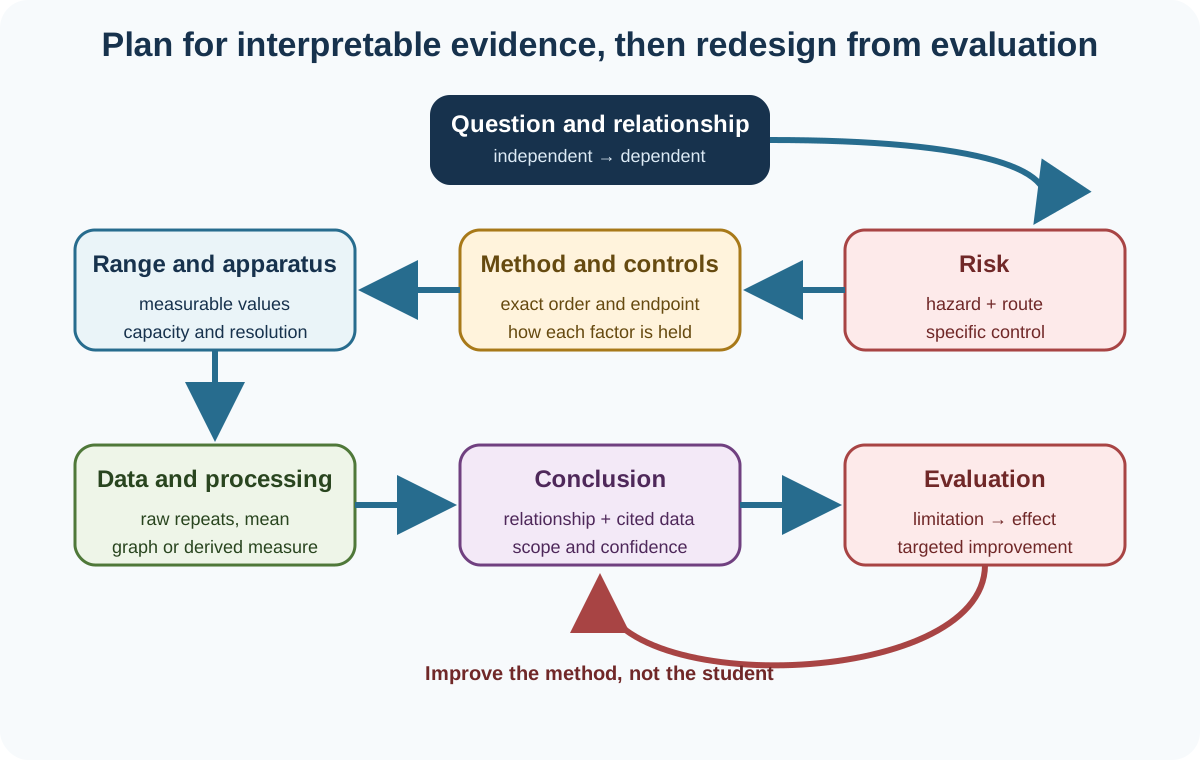
Quick Chemistry 0620 Map
The core idea is simple: Study Chemistry 0620 by topic, paper type, and error pattern.
Use it as a working check: Rotate between syllabus mapping, timed papers, mark-scheme corrections, and practical-data questions every week.
Then go one layer deeper: The biggest gains usually come from cleaner chemical language, fewer equation setup errors, and better use of observations in qualitative analysis.
Syllabus mapping for 0620
/* prettier-ignore */| Official 0620 topic | Weekly practice focus | Evidence of readiness |
|---|---|---|
| States of matter | Particle-model explanations and state changes | Uses particle language consistently |
| Atoms, elements and compounds | Structure-property explanations and symbolic accuracy | Correct use of chemical terms and representations |
| Stoichiometry | Mole calculations, equations, concentrations, and yields | Fewer setup errors before calculator work |
| Electrochemistry | Electrolysis products and redox reasoning | Can justify products and electrode changes |
| Chemical energetics | Energy-transfer diagrams and bond-energy calculations | Sign, units, and system boundaries are clear |
| Chemical reactions | Rates, equilibrium, and redox reasoning | Explains trends using the relevant model |
| Acids, bases and salts | Indicators, pH, salt preparation, and ionic reasoning | Selects an appropriate preparation method |
| The Periodic Table | Group trends and structure-property links | Supports trends with particle-level reasoning |
| Metals | Reactivity, extraction, corrosion, and alloys | Connects observations to the reactivity series |
| Chemistry of the environment | Air, water, resources, and environmental chemistry | Distinguishes evidence from a general claim |
| Organic chemistry | Formulae, reactions, polymers, and functional groups | Recognises and applies the required reaction patterns |
| Experimental techniques and chemical analysis | Planning, separation, tests, observations, and data | Uses precise observations and valid conclusions |
Current paper structure
All candidates take three components. Core candidates take Paper 1, Paper 3, and either Paper 5 or Paper 6. Extended candidates take Paper 2, Paper 4, and either Paper 5 or Paper 6. For both routes, the multiple-choice paper is 45 minutes and worth 30 %, the theory paper is 1 hour 15 minutes and worth 50 %, and the practical component is worth 20 %. Paper 5 is 1 hour 15 minutes, while Paper 6 is 1 hour.[1]
Past-paper workflow for chemistry
- Attempt a timed paper under exam conditions.
- Mark strictly against official mark schemes.
- Label each miss as concept, equation setup, data interpretation, language, or careless.
- Rewrite wrong answers in concise mark-scheme style.
- Build a personal list of equations and definitions you keep getting wrong.
- Re-test similar question families one week later.
Practical and data analysis focus
- Practise qualitative-analysis answer format regularly. If you are taking the written ATP route, use the IGCSE Chemistry Paper 6 (Alternative to Practical) guide: https://eclatinstitute.sg/blog/igcse-chemistry-experiments/IGCSE-Chemistry-Paper-6-Alternative-to-Practical-Guide
- If your school enters you for the hands-on practical, use the IGCSE Chemistry Paper 5 Practical Test guide: https://eclatinstitute.sg/blog/igcse-chemistry-experiments/IGCSE-Chemistry-Paper-5-Practical-Test-Guide
- Practise data interpretation with clear trend-comment-conclusion structure.
- Check units, state symbols, and equation balancing before final submission.
Worked example: turn one paper into a weekly repair plan
A student scores 48 out of 80 and finds twelve lost marks in stoichiometry, six in qualitative analysis, five in organic chemistry and the rest across isolated slips. The next week should not repeat another full paper immediately. First, the student reworks every stoichiometry setup without the mark scheme, then completes a short mixed set on moles, concentration and gas volume. Qualitative errors are rewritten as reagent, observation and inference chains. Organic reactions are organised by reactant, condition and product. At the end of the week, parallel questions test whether each error pattern has changed. The original score is evidence for prioritisation, not a prediction of the final grade.
Common misconceptions and corrections
- Counting completed papers instead of corrected errors. A paper is useful only when its mistakes generate targeted practice and later retesting.
- Memorising observations without reagents or inferences. Learn the complete evidence chain and use fresh portions where tests may interfere.
- Treating every calculation error as careless. Separate equation choice, unit conversion, substitution and rounding so the actual weakness is repaired.
- Revising theory while postponing practical reasoning. Include planning, observations, tables, graphs and evaluation every week.
Assessment guidance
Match practice to the entered Core or Extended route and the selected Paper 5 or Paper 6 component. Definitions need exact chemical language, calculations need balanced equations and visible working, and explanations need particle or reaction reasoning applied to the named context. In practical questions, record observations before conclusions and distinguish accuracy, precision and validity. Use official mark schemes to identify acceptable detail, but do not memorise one answer so rigidly that it cannot be adapted. Keep unrounded calculator values until the final line and include units, charges and state symbols whenever the question requires them.
Retrieval practice
Rebuild the twelve-topic map from memory, then assign one calculation, one explanation and one practical-data task to each topic. Review a recent paper and classify every lost mark. Write a seven-day repair schedule, including delayed retesting, and explain what evidence would show that each recurring error has actually reduced.
Downloadable checklist
Download the 0620 past-paper checklist: https://eclatinstitute.sg/downloads/igcse-chemistry-0620-past-paper-checklist-sg-v1.txt
Related pages in this cluster
- Hub: https://eclatinstitute.sg/blog/igcse-cie-singapore
- Complete guide: https://eclatinstitute.sg/blog/igcse-cie-singapore/igcse-cie-singapore-complete-guide-for-parents-and-students
- Private-candidate operations: https://eclatinstitute.sg/blog/igcse-cie-singapore/igcse-cie-exam-registration-dates-and-private-candidate-guide-singapore
- 0580 Maths strategy: https://eclatinstitute.sg/blog/igcse-mathematics-notes/igcse-maths-0580-study-plan-and-paper-strategy-singapore
- 0625 Physics strategy: https://eclatinstitute.sg/blog/igcse-physics-notes/igcse-physics-0625-study-plan-and-paper-strategy-singapore
- 0620 Chemistry Paper 5 Practical Test guide: https://eclatinstitute.sg/blog/igcse-chemistry-experiments/IGCSE-Chemistry-Paper-5-Practical-Test-Guide
- 0620 Chemistry Paper 6 ATP guide: https://eclatinstitute.sg/blog/igcse-chemistry-experiments/IGCSE-Chemistry-Paper-6-Alternative-to-Practical-Guide
- Schools shortlist guide: https://eclatinstitute.sg/blog/igcse-cie-singapore/igcse-schools-in-singapore-neutral-shortlist-guide
- IGCSE vs O-Level decision guide: https://eclatinstitute.sg/blog/igcse-cie-singapore/igcse-vs-singapore-o-level-which-route-fits-your-child
Frequently Asked Questions
What is the biggest score killer in 0620?
Many students lose marks through setup and language precision errors, not just content gaps. Tight answer phrasing and equation discipline are essential.
Should I memorise model answers for chemistry explanations?
Memorising patterns can help, but you should understand the logic behind each mark point so you can adapt to unfamiliar question framing.
How should parents support 0620 revision at home?
Track consistency of timed practice, completion of correction logs, and whether recurring error categories are shrinking week by week.
Check this topic from memory
Attempt the matching topic bank before reopening the notes. Use each missed idea to decide what to review next.
Start the topic quiz