

IGCSE Physics (0625): Study Plan and Paper Strategy (Singapore)
Singapore-focused Cambridge IGCSE Physics (0625) study plan with syllabus mapping, past-paper workflow, and a downloadable checklist.
Use this as a weekly plan for 0625, so revision stays consistent from week to week.
Last reviewed: 18 July 2026 against the official Cambridge IGCSE Physics 0625 syllabus for 2026 to 2028.
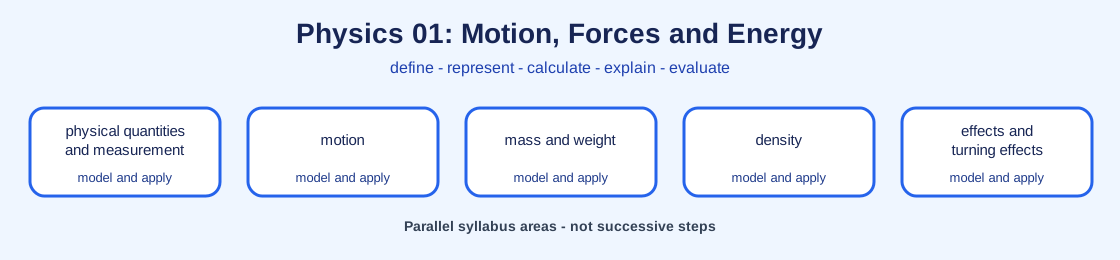
Quick Physics 0625 Map
The core idea is simple: Physics 0625 needs concept, equation, graph, and practical-data practice together.
Use it as a working check: Each week, pair one syllabus block with timed questions and one practical-data task.
Then go one layer deeper: Do not revise equations as isolated formulas. Link each one to units, assumptions, graph shapes, and measurement uncertainty.
Syllabus mapping for 0625
/* prettier-ignore */| Official 0625 topic | Weekly practice focus | Evidence of readiness |
|---|---|---|
| Motion, forces and energy | Equation selection, diagrams, and unit discipline | Fewer formula-selection errors across timed sets |
| Thermal physics | Particle-model explanations and thermal calculations | Clear cause-and-effect explanations before numerical work |
| Waves | Wave behaviour, light, sound, and diagram interpretation | Can connect a diagram or graph to the relevant quantities |
| Electricity and magnetism | Circuit, field, and electromagnetic reasoning | Correct conventions, units, and direction rules |
| Nuclear physics | Atomic, radioactive, and safety questions | Uses precise particle and radiation language |
| Space physics | Orbital, stellar, and cosmological reasoning within the syllabus | Can distinguish observation, model, and calculation |
| Practical skills | Graphing, method evaluation, and data interpretation | Can evaluate data quality and propose improvements clearly |
Current paper structure
All candidates take three components. Core candidates take Paper 1, Paper 3, and either Paper 5 or Paper 6. Extended candidates take Paper 2, Paper 4, and either Paper 5 or Paper 6. For both routes, the multiple-choice paper is 45 minutes and worth 30 %, the theory paper is 1 hour 15 minutes and worth 50 %, and the practical component is worth 20 %. Paper 5 is 1 hour 15 minutes, while Paper 6 is 1 hour.[1]
Past-paper workflow for physics
- Run one timed paper block each week.
- Mark with official mark schemes and examiner expectations.
- Classify errors: concept, command-word language, calculation, graph/data, careless.
- Rewrite weak explanations in concise mark-scheme style.
- Re-attempt similar question types after 5-7 days.
- Keep a running list of your top 10 recurring errors.
Practical and data-handling routine
- Practise graph plotting and interpretation every week.
- If you are taking the written ATP route, use the IGCSE Physics Paper 6 (Alternative to Practical) guide: https://eclatinstitute.sg/blog/igcse-physics-experiments/IGCSE-Physics-Paper-6-Alternative-to-Practical-Guide
- If your school enters you for the hands-on practical, use the IGCSE Physics Paper 5 Practical Test guide: https://eclatinstitute.sg/blog/igcse-physics-experiments/IGCSE-Physics-Paper-5-Practical-Test-Guide
- Train units and significant-figure discipline together with calculations.
- For explanation items, force one sentence per mark-point idea.
Worked example: diagnose a mixed Physics paper
A student loses six marks from choosing the wrong equation, five from incomplete explanations, four from graph gradients and three from practical evaluation. The next revision block begins by matching each calculation to its defining quantities and units, then solving parallel problems without a formula list. Explanation corrections use a principle, application and consequence chain. Graph work identifies axes, units, scale and a large gradient triangle before calculation. Practical responses are rewritten as limitation, effect and feasible improvement. A new mixed set one week later shows whether the same categories shrink. The original score identifies priorities; only independent retesting shows that the reasoning has become reliable.
Common misconceptions and corrections
- Memorising equations without quantity meanings. Link every symbol to a definition, unit, graph feature and applicable physical model.
- Writing a keyword instead of an explanation. State the principle, apply it to the named system and give the consequence.
- Calling all experimental differences human error. Identify a physical or measurement cause and explain its effect on the result.
- Ignoring diagrams and graphs during revision. Practise representations as evidence-bearing parts of the answer.
Assessment guidance
Match paper practice to the entered Core or Extended route and selected practical component. Begin calculations with the relationship, convert units before substitution and keep unrounded values until the final answer. Force, field, ray and circuit diagrams require recognised conventions, labels and directions. Description questions report patterns; explanation questions supply a causal mechanism. For graphs, state what the gradient, area or intercept represents before calculating. Practical answers should name variables, apparatus range or resolution, raw readings, analysis and a specific evaluation chain. Check every final value for magnitude, direction, unit and consistency with the physical context.
Retrieval practice
Rebuild the six theory blocks and practical-skills route without notes. For each block, recall the principal quantities, one diagram or graph, two relationships and one causal explanation. Complete a mixed calculation and explanation set, then plan an experiment with variables, table headings, graph choice and one limitation-effect-improvement chain. Retest the weakest category after one week.
Downloadable checklist
Download the 0625 past-paper checklist: https://eclatinstitute.sg/downloads/igcse-physics-0625-past-paper-checklist-sg-v1.txt
Related pages in this cluster
- Hub: https://eclatinstitute.sg/blog/igcse-cie-singapore
- Complete guide: https://eclatinstitute.sg/blog/igcse-cie-singapore/igcse-cie-singapore-complete-guide-for-parents-and-students
- Private-candidate operations: https://eclatinstitute.sg/blog/igcse-cie-singapore/igcse-cie-exam-registration-dates-and-private-candidate-guide-singapore
- 0580 Maths strategy: https://eclatinstitute.sg/blog/igcse-mathematics-notes/igcse-maths-0580-study-plan-and-paper-strategy-singapore
- 0620 Chemistry strategy: https://eclatinstitute.sg/blog/igcse-chemistry-notes/igcse-chemistry-0620-study-plan-and-paper-strategy-singapore
- 0625 Physics Paper 6 ATP guide: https://eclatinstitute.sg/blog/igcse-physics-experiments/IGCSE-Physics-Paper-6-Alternative-to-Practical-Guide
- 0625 Physics Paper 5 Practical Test guide: https://eclatinstitute.sg/blog/igcse-physics-experiments/IGCSE-Physics-Paper-5-Practical-Test-Guide
- Schools shortlist guide: https://eclatinstitute.sg/blog/igcse-cie-singapore/igcse-schools-in-singapore-neutral-shortlist-guide
- IGCSE vs O-Level decision guide: https://eclatinstitute.sg/blog/igcse-cie-singapore/igcse-vs-singapore-o-level-which-route-fits-your-child
Frequently Asked Questions
Why do many students lose marks in 0625 even when they know formulas?
A common issue is weak command-word handling and incomplete explanation structure. Physics papers reward both correct calculations and clear scientific reasoning.
How should I balance calculation versus explanation practice?
Plan both every week. Calculation speed alone is not enough, and explanation-only practice without numerical fluency also caps performance.
How many full papers should I run before exams?
Use enough full papers to stabilise timing and error patterns, then spend the remaining window on targeted correction of recurring weaknesses.
Check this topic from memory
Attempt the matching topic bank before reopening the notes. Use each missed idea to decide what to review next.
Start the topic quiz