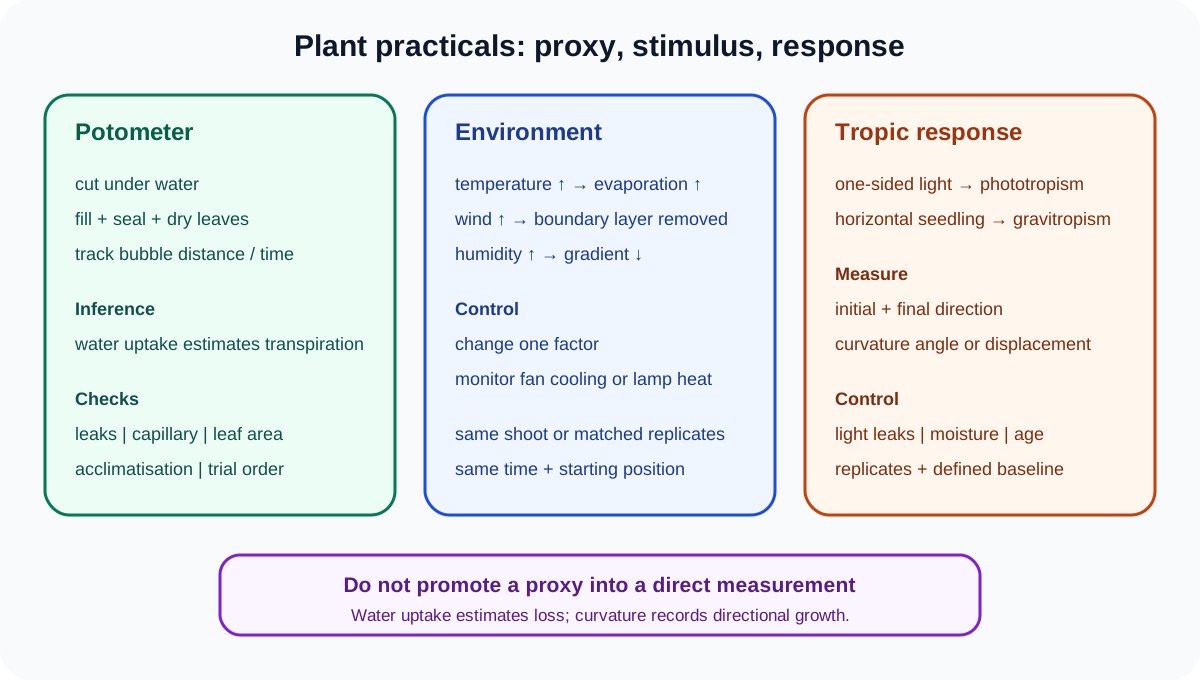
Transpiration and tropic responses are explicit Cambridge IGCSE Biology practical contexts. Topic 8 requires investigation of temperature and wind-speed effects on transpiration, while Topic 14 requires investigation of gravitropism and phototropism in shoots and roots. This note develops valid proxies, controls, measurements, safety and evaluation for both 0610 and 0970.
Know what a potometer measures
A bubble potometer measures water uptake by a cut shoot. Water uptake is used as a proxy for transpiration rate because most absorbed water is lost from leaves, but some water is used in photosynthesis, growth and maintaining cells.
Do not call the result a direct measurement of water vapour leaving stomata. State the proxy and its limitation.
Bubble movement along a capillary over time gives distance per time. If capillary cross-sectional area is known, distance can be converted to volume. Use the same measure for every trial.
Assemble the potometer
Cut a healthy leafy shoot under water to reduce entry of air into xylem. Assemble the apparatus full of water and insert the shoot while submerged or as instructed.
Seal joints with petroleum jelly where appropriate and check for leaks. Dry leaf surfaces before starting so surface water does not change local humidity or evaporate independently.
Introduce one air bubble into the capillary. Mark or record its starting position, expose the shoot to the test condition and measure movement for a fixed time. Use the reservoir or instructed method to reset the bubble.
Do not allow the bubble to enter the wider tubing or shoot. Handle glass capillary apparatus carefully and follow centre safety instructions.
Calculate water-uptake rate
For distance evidence:
rate = bubble distance moved / time
For volume evidence:
volume = capillary cross-sectional area × bubble distance
uptake rate = volume / time
State units, such as mm/min for distance rate or mm³/min for volume rate. Convert units consistently before calculation.
Use repeats at every condition and calculate a mean. Reset the bubble to the same start point and allow the shoot to acclimatise after changing conditions.
Investigate wind speed
Use a fan at defined settings or distances, with a method to make wind conditions repeatable. Keep temperature, light, humidity, shoot, leaf area, trial time and apparatus constant.
Moving air removes the humid boundary layer around leaves, maintaining a steeper water-vapour gradient and usually increasing transpiration and water uptake.
Check this topic from memory
Attempt the matching topic bank before reopening the notes. Use each missed idea to decide what to review next.
A fan may also cool the shoot. Monitor temperature so the investigation does not unintentionally change two factors.
Fan distance is a proxy, not a direct wind-speed value. If a meter is supplied, measure actual speed at the shoot position.
Investigate temperature
Place the leafy shoot in a controlled chamber or vary surrounding temperature safely while keeping the potometer water and seals stable. Allow equilibration and monitor actual air temperature near the leaves.
Keep wind speed, light, humidity, leaf area and time constant. Increasing temperature gives water molecules more kinetic energy and can increase evaporation and diffusion, raising transpiration over a suitable range.
Avoid excessive temperatures that damage the shoot or alter stomatal behaviour. Do not place electrical apparatus unsafely near water.
Humidity and light as related contexts
Although the named Topic 8 investigation focuses on temperature and wind speed, practical questions may use the wider transpiration context. Higher humidity reduces the water-vapour gradient and usually lowers transpiration. A transparent enclosure with controlled humidity can be used if temperature and air movement are held constant.
Light can affect stomatal opening. A lamp can also heat leaves, so a light comparison requires temperature monitoring or a heat shield. Do not attribute a result to light alone if temperature changed.
Use mass loss as another proxy
A potted plant or leafy shoot can be placed on a balance and mass recorded over time. Cover soil or exposed water to reduce direct evaporation, so mass loss more closely represents water loss from the plant.
Mass change per time provides a transpiration proxy. An unplanted covered pot can act as a control for non-plant evaporation.
Air currents can disturb balance readings, and growth or other mass changes may contribute over long periods. Keep the interval suitable and the setup stable.
Investigate leaf surfaces with petroleum jelly
Apply petroleum jelly to upper surfaces, lower surfaces, both surfaces or neither on comparable leaves, then measure mass loss or another suitable proxy.
Jelly blocks gas exchange and water loss through covered surfaces. Equal leaf area and consistent coating matter. A result can infer which surface contributes more under the conditions, often reflecting stomatal distribution.
Do not claim that uncovered cut surfaces or soil evaporation are leaf transpiration. Seal alternative water-loss routes.
Design a phototropism investigation
Use seedlings of the same species, similar age and initial length. Place them in a lightproof box with light entering from one side. A control can receive light evenly from above or from all relevant directions.
Keep water, temperature, growth time, container and initial orientation constant. Use several seedlings per condition.
Measure shoot direction or curvature from a defined baseline using an angle, displacement or image method. "Bent towards light" is useful observation, but quantitative evidence supports comparison.
Rotate or position containers consistently. Random placement avoids choosing seedlings already leaning toward the expected direction.
Design a gravitropism investigation
Place germinating seeds or seedlings horizontally with roots and shoots visible. Keep them in darkness if the purpose is to isolate gravity from directional light.
Record initial orientation, then measure root and shoot curvature after a fixed time. A rotated clinostat may provide a comparison in some setups by changing the direction of the gravitational stimulus relative to the organ; describe only the supplied apparatus and its intended comparison.
Maintain moisture without waterlogging, oxygen access, temperature and seedling stage. Use replicates because germination and growth vary.
Roots commonly show positive gravitropism and shoots negative gravitropism. The practical evidence is direction of growth relative to gravity; detailed auxin explanation belongs to theory when requested.
Separate growth from movement
Tropic responses are directional growth responses. Marking the organ at intervals can show where elongation occurs, while time-lapse images can distinguish gradual curvature from repositioning.
A one-time final photograph without an initial record may confuse pre-existing curvature with experimental response. Measure change from baseline.
Avoid touching or repeatedly reorienting seedlings during the trial. Mechanical disturbance can alter growth.
Evaluate transpiration evidence
Leaks allow bubble movement unrelated to plant uptake. Pressure or temperature changes can move the bubble. Test seals, include a no-shoot check where appropriate and maintain stable conditions.
Using the same shoot for repeated conditions reduces between-shoot variation but introduces order effects, fatigue and changing water status. Randomise condition order, allow recovery or use matched independent shoots.
Leaf area strongly affects uptake. Measure or standardise it. Counting leaves alone may be inadequate because leaf sizes differ.
Evaluate tropism evidence
Unequal seedlings, uncontrolled light leaks, inconsistent moisture and different initial angles reduce validity. Select using predefined criteria, block unwanted light, standardise water and record starting orientation.
One seedling cannot represent the species. Use a sufficient sample, report variation and calculate a mean angle where appropriate.
An observer deciding whether a shoot "bent" may be biased. Use photographs against a grid or image-angle measurement without changing the growth conditions.
Worked application: diagnose a wind-speed result
A potometer bubble moves 18, 21 and 19 mm in five minutes without a fan and 46, 49 and 47 mm with a fan. Mean distance rates are 3.87 and 9.47 mm/min, supporting greater water uptake in moving air. The conclusion is a transpiration proxy, not direct vapour measurement. Before attributing the difference only to wind, check that the fan did not lower leaf temperature and that humidity, leaf area, trial order and seals were controlled. Repeating with measured wind speeds and randomised order would test a graded relationship more strongly.
Common misconceptions and corrections
Calling a potometer a direct transpiration meter. It measures water uptake.
Saying all absorbed water is transpired. Some has other uses.
Cutting a shoot in air. Cut under water to reduce xylem air entry.
Calling petroleum jelly a fertiliser. It blocks water loss and gas exchange.
Using seedlings of very different ages. Growth capacity differs.
Choosing seedlings already bent in the expected direction. Randomise and record baseline.
Leaving side-light gaps in a gravitropism setup. Light confounds direction.
Calling tropism movement without growth. It is directional growth.
Measuring only final angle. Compare with initial orientation.
Using one seedling. Biological variation requires replicates.
Rotating the control inconsistently. Define the comparison precisely.
Explaining auxin when only observation is asked. Answer the command.
Using repeats to repair a leaking potometer. Fix the seal.
Assuming condition order has no effect. Shoots change over time.
Generalising one shoot or species universally. Qualify the conclusion.
Assessment guidance
State that a potometer measures water uptake as a transpiration proxy, then define bubble distance or volume per time. Plans must include underwater cutting, water-filled assembly, airtight seals, dry leaves, stable starting position, acclimatisation and leaf-area control. Temperature and wind investigations need the other environmental factors controlled and actual conditions monitored. Tropism plans require comparable seedlings, isolated directional stimulus, baseline orientation, quantitative curvature and replicates. Evaluation should link leaks, capillary size, fan cooling, order effects, light leaks or seedling variation to specific corrections rather than offering repeats alone.
Retrieval practice
Draw and annotate a bubble-potometer method, calculate distance and volume rates and design graded wind and temperature series. Compare potometer and mass-loss proxies. Plan phototropism and gravitropism investigations with appropriate controls, baseline measurements and sample sizes. Diagnose leaks, fan cooling, unequal leaf area, order effects, light contamination and pre-existing seedling curvature, then write one targeted improvement for each.
Theory and practical ownership
This practical note owns transpiration proxies, apparatus, environmental-factor investigations, tropism setups, measurements, controls, safety and evaluation. Plant-transport and coordination theory notes own water-potential, stomatal, transpiration-pull and auxin mechanisms.