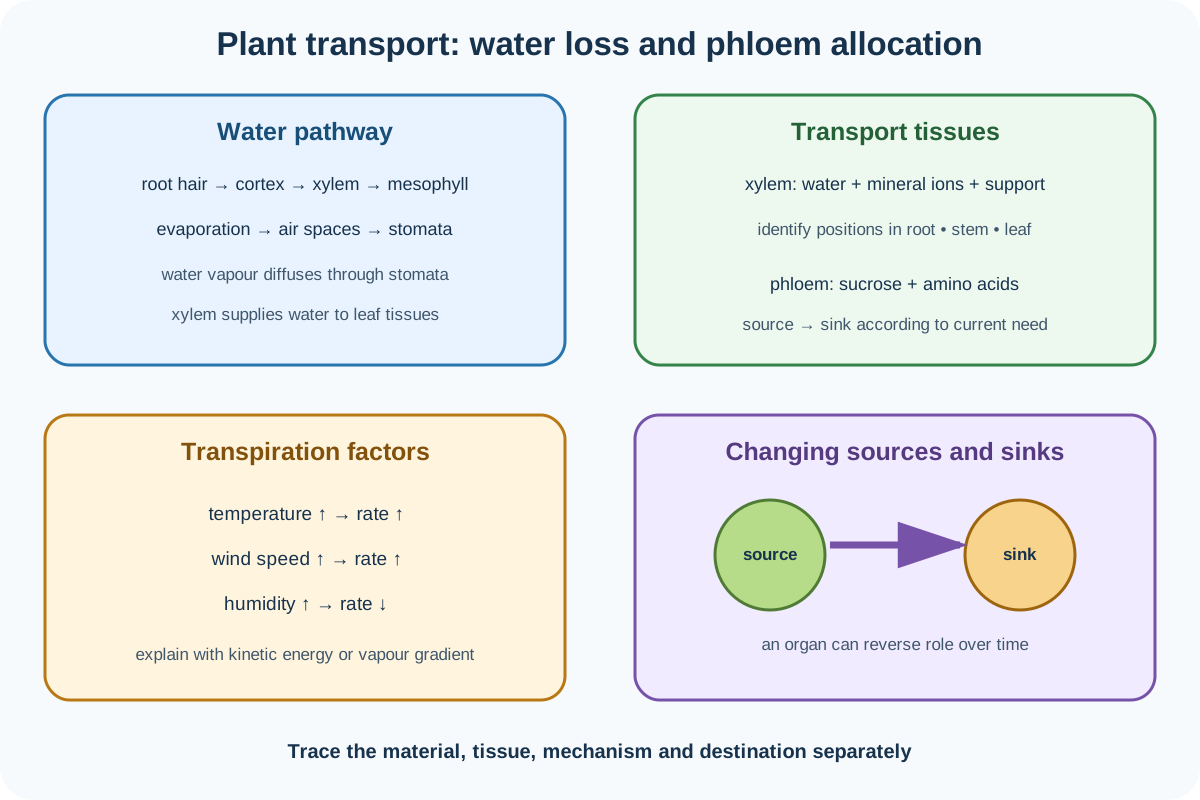
Topic 8 of Cambridge IGCSE Co-ordinated Sciences 0654 and 0973 separates two transport systems. Xylem transports water and mineral ions and supports the plant. Phloem translocates sucrose and amino acids between sources and sinks. Official sections 8.1 to 8.4 connect tissue positions to water uptake, transpiration, environmental effects, wilting and changing source-sink relationships.
Xylem and phloem ownership
Xylem transports water and dissolved mineral ions from roots through stems to leaves and other tissues. It also provides mechanical support. Phloem transports sucrose and amino acids between plant regions.
In a non-woody dicotyledonous root, xylem is central and often forms a cross or star shape, with phloem between its arms. In a stem, vascular bundles are arranged around the outside of the central region; xylem lies toward the inside of each bundle and phloem toward the outside. In a leaf vascular bundle, xylem lies closer to the upper surface and phloem closer to the lower surface.
Use tissue relationships when a section is rotated. "Top" and "bottom" are not reliable labels in an unfamiliar root or stem image.
The 0654 outcome requires tissue functions and positions, not detailed xylem-vessel adaptations. Keep structure answers at the root, stem and leaf tissue-position level unless a question supplies additional information.
Water uptake and the pathway to leaves
Root hair cells are specialised epidermal cells with long extensions. Their large surface area increases contact with water around soil particles and increases uptake of water and mineral ions.
Water enters root hair cells by osmosis down a water-potential gradient through a partially permeable cell membrane. Mineral-ion uptake may involve active transport when ions move against a concentration gradient. Those mechanisms are established in Topic 3; Topic 8 focuses on the route through the plant.
The required water pathway is:
root hair cells
root cortex cells
xylem
mesophyll cells
Water crosses the root cortex and enters xylem. It travels upward in the xylem of root and stem, enters the leaf vascular bundles and reaches mesophyll cells.
A suitable stain can make the pathway through above-ground parts visible. Coloured regions in stem and leaf sections indicate where the water-carried stain travelled. This supports identification of xylem, but the stain itself does not prove every molecular part of the transpiration mechanism. Preparation, sectioning and controls belong in the practical hub.
Check this topic from memory
Attempt the matching topic bank before reopening the notes. Use each missed idea to decide what to review next.
Transpiration is the loss of water vapour from leaves. Water evaporates from moist mesophyll cell surfaces into interconnecting leaf air spaces. Water vapour then diffuses out through stomata down a water-vapour concentration gradient.
The large internal surface area created by mesophyll cell surfaces and interconnected air spaces allows evaporation across a wide area. The size and number of stomata affect the available route for vapour diffusion. More or wider open stomata can provide a greater pathway for loss under comparable conditions.
Do not define transpiration as liquid water flowing through xylem or as all water loss from an entire plant. The assessed definition is water-vapour loss from leaves.
Temperature, wind speed and humidity
Higher temperature gives water molecules more kinetic energy. Evaporation from mesophyll surfaces occurs more rapidly, and faster molecular movement can increase diffusion, so transpiration rate usually rises when other factors are controlled.
Greater wind speed removes humid air from near the leaf surface. This maintains a steep water-vapour concentration gradient between leaf air spaces and the surrounding atmosphere, increasing diffusion and transpiration.
Higher humidity means the surrounding air already contains more water vapour. The gradient from the saturated or humid internal leaf spaces to the outside is smaller, so net diffusion and transpiration rate decrease.
Cambridge Core explicitly requires investigation and description of temperature and wind-speed effects. Supplement adds explanation of temperature, wind speed and humidity. In a graph answer, use the actual variable and evidence before applying these mechanisms.
Wilting
Wilting occurs when water loss exceeds water uptake, causing plant cells to lose water. Vacuoles become smaller, turgor pressure falls and non-woody tissues lose support. Leaves and stems droop, which can reduce exposed surface area and therefore further water loss.
Temporary wilting can be reversed if water becomes available before permanent damage. Severe or prolonged shortage can damage tissues. Do not define wilting only as "the plant is dry"; connect water balance to loss of cell turgidity.
Translocation: Supplement
Translocation is the movement of sucrose and amino acids in phloem from sources to sinks.
A source is a plant region that releases sucrose or amino acids into the transport pathway. A photosynthesising leaf is commonly a sucrose source. A storage organ releasing stored carbohydrate during new growth can also become a source.
A sink is a region that uses or stores sucrose or amino acids. Growing roots, fruits, seeds, flowers, meristems and storage organs can act as sinks. Sucrose may be respired, converted to storage material or used to build other molecules. Amino acids may be used to make proteins.
The same organ can change role over time. A storage organ is a sink while accumulating carbohydrate, then becomes a source when reserves are mobilised for growth. A developing leaf is initially a sink but can become a source once it photosynthesises more carbohydrate than it uses.
Because a plant can have sources and sinks above or below one another, phloem transport is not simply "downward". State the source-to-sink relationship for the particular material and time.
Interpret plant-transport evidence
A potometer measures water uptake by a cut shoot, often through movement of an air bubble or water meniscus. Water uptake is commonly used as an estimate of transpiration rate, but the quantities are not identical because some absorbed water is used or retained.
When comparing conditions, control leaf area, shoot type, temperature, wind speed, humidity, light exposure and measurement time as relevant. Allow the apparatus to equilibrate after changing a condition and check that connections are airtight. Detailed assembly, safe cutting, bubble reset and evaluation belong to the practical series.
A faster bubble movement indicates faster water uptake only when capillary dimensions and time are comparable. If capillary cross-sectional area is provided, volume uptake can be found from distance multiplied by area.
Worked application: explain a wind-speed result and source change
A potometer bubble moves 18 mm in five minutes in still air and 45 mm in five minutes with a fan at a fixed distance. With the same capillary and leaf area, estimated water uptake is 2.5 times faster with moving air. Wind removes humid air near the leaf, maintaining a steeper water-vapour concentration gradient, so diffusion through stomata and transpiration increase. Separately, a potato tuber is a sink while storing carbohydrate during growth but becomes a source when stored material is mobilised to supply sucrose to new shoots.
Common misconceptions and corrections
Saying xylem transports sucrose. Xylem transports water and mineral ions.
Saying phloem transports only water. It translocates sucrose and amino acids.
Omitting xylem support. Support is one of its three required functions.
Identifying vascular tissue only from page orientation. Use position within the organ and bundle.
Putting phloem inside xylem in a stem bundle. Xylem is toward the inside and phloem toward the outside.
Saying root hairs increase cell volume only. Their main named advantage is large surface area.
Starting the water route at xylem. Water first enters root hair cells and crosses cortex cells.
Ending the route at stomata. The required tissue pathway ends at mesophyll cells before vapour loss.
Saying water enters root hairs by active transport. Water enters by osmosis.
Saying all mineral ions enter by diffusion. Active transport may be needed against a gradient.
Calling stain movement proof of phloem transport. Water-carried stain marks the xylem route.
Defining transpiration as water uptake. It is loss of water vapour from leaves.
Describing liquid water diffusing through stomata. Water evaporates, then vapour diffuses out.
Omitting evaporation from mesophyll surfaces. It begins the leaf-loss pathway.
Saying air spaces reduce surface area. They help create a large internal evaporating surface.
Calling guard cells stomata. A stoma is the pore between guard cells.
Saying higher temperature reduces kinetic energy. It increases molecular kinetic energy.
Saying wind blocks diffusion. It removes humid boundary air and steepens the gradient.
Saying high humidity steepens the outward gradient. It reduces the gradient.
Explaining humidity through temperature alone. Use outside water-vapour concentration.
Calling wilting a result of increased turgor. Cells lose water and turgor falls.
Saying wilted tissue is always dead. Temporary wilting can be reversible.
Defining translocation as water movement in xylem. It is sucrose and amino-acid movement in phloem.
Saying phloem always transports downward. Direction depends on source and sink positions.
Calling a source any organ that contains sugar. A source releases material for transport.
Calling a sink only a root. Any using or storing region can be a sink.
Assigning permanent source or sink status. Roles can change with development and season.
Equating potometer uptake exactly with transpiration. It is an estimate because some water is used or retained.
Comparing bubble distances from different capillaries directly. Cross-sectional area affects volume.
Assessment guidance
Keep the two transport tissues separate by material, position and function. Identify xylem and phloem from their relative positions in root, stem and leaf sections. Trace water in the exact order from root hair to cortex, xylem and mesophyll before explaining evaporation and vapour diffusion. For environmental factors, state how temperature changes kinetic energy, wind changes boundary air and humidity changes the gradient. Explain wilting through water balance and turgor. Define translocation with sucrose, amino acids, phloem, sources and sinks, then use the scenario's time and organ role rather than assuming a fixed direction.
Retrieval practice
Label xylem and phloem in unfamiliar root, stem and leaf sections and justify every choice. Reconstruct the complete soil-to-air water route and predict temperature, wind and humidity effects. Then classify six changing plant organs as sources or sinks and explain two role reversals over time.
Theory and practical ownership
This theory note owns vascular-tissue functions and positions, the water pathway, transpiration, environmental mechanisms, wilting and source-sink translocation. The separate Biology practical hub owns stained-shoot preparation, potometer assembly and sealing, variable control, range and repeats, measurement, safety, tables, graphs and evaluation.