

Co-ordinated Sciences Biology B17: Variation and Selection
Cambridge IGCSE Co-ordinated Sciences 0654 Biology B17 notes with worked examples, misconception checks and assessment guidance.
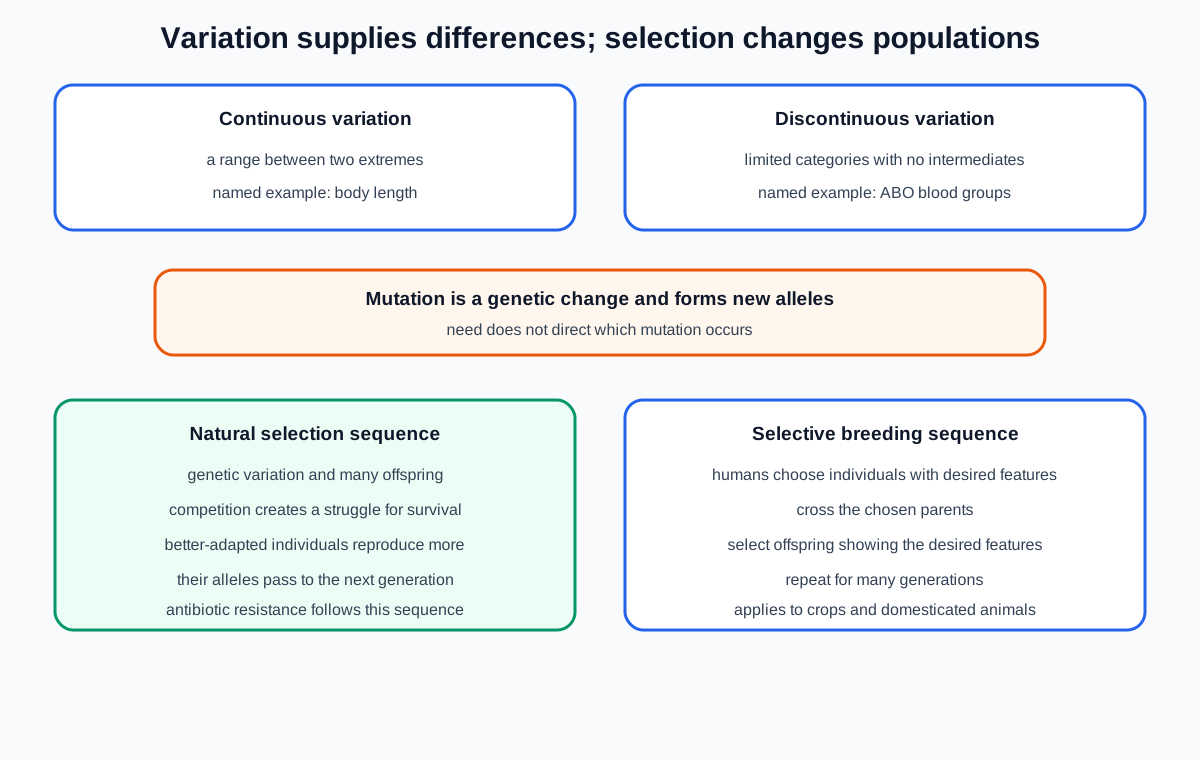
Biology B17 of Cambridge IGCSE Co-ordinated Sciences 0654 follows differences within a species through mutation, natural selection and selective breeding. Official sections B17.1 and B17.2 cover continuous and discontinuous variation, new alleles formed by mutation, the full natural-selection sequence, antibiotic resistance and repeated human selection of crop plants or domesticated animals. Adaptive-feature case studies are outside this boundary.
Variation within a species
Variation means differences between individuals of the same species. Variation can be observed in measurements, categories, physiology, behaviour or other phenotypes.
The pattern matters because it affects graph choice, explanation and how selection can act.
Continuous variation
Continuous variation produces a range of phenotypes between two extremes. Body length is the named example. Measurements can take many intermediate values and usually form a distribution rather than separate categories.
Continuous variation is caused by both genes and the environment. Many genes may contribute, while nutrition, health, activity and other environmental conditions influence the observed value.
A histogram is suitable when continuous measurements are grouped into class intervals. Adjacent bars touch because the scale is continuous. Sample size, measurement precision and representative sampling affect the distribution.
Discontinuous variation
Discontinuous variation produces a limited number of phenotypes with no intermediates. ABO blood groups are the named example.
It is usually caused by genes only in this level of model. Individuals fall into categories, so a bar chart with separated bars is appropriate.
Discontinuous does not mean that only two categories exist. ABO has four phenotypes, but no continuous intermediate between them.
Mutation and genetic variation
A mutation is a genetic change. A gene mutation is a random change in the base sequence of DNA. Mutation can create a new allele.
Random means a mutation does not occur because an organism needs a particular feature. Its effect may be harmful, neutral or advantageous in a particular environment.
Ionising radiation and some chemicals increase mutation rate. These mutagens increase probability; they do not direct the exact useful change.
Mutation is a genetic change and is the process by which new alleles form. The new allele exists before selection can favour or remove it. Do not describe mutation as a purposeful response to need.
Environmental effects can create phenotypic variation without creating a new allele. A suntan or increased muscle size acquired during life is not automatically inherited.
Check this topic from memory
Attempt the matching topic bank before reopening the notes. Use each missed idea to decide what to review next.
Start the topic quiz