

Cambridge IGCSE Physics Notes 1.5: Forces, Moments and Centre of Gravity
Cambridge IGCSE Physics notes on resultant force, friction, springs, moments, equilibrium, centre of gravity, stability, and circular motion.
Q: What does Cambridge IGCSE Physics Notes 1.5: Forces, Moments and Centre of Gravity cover?
A: It follows official Cambridge Physics section 1.5 for syllabuses 0625 and 0972, with Core ideas separated from Supplement depth.
Forces change motion or shape. Their combined translational effect is described by resultant force, while their turning effect is described by moment.
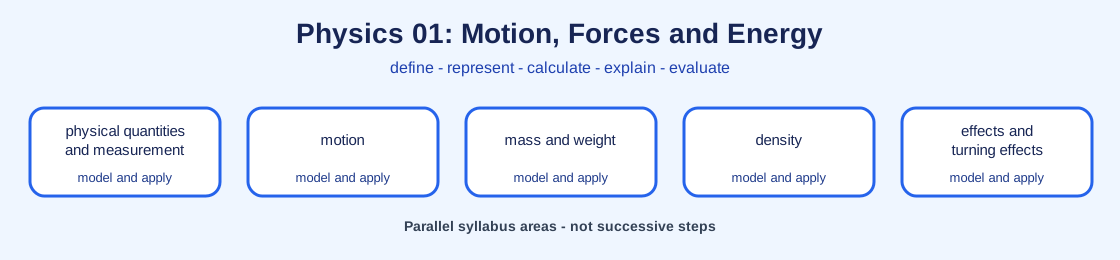
The ideas that organise this section
- Zero resultant force means no acceleration, not necessarily no motion.
- Moment depends on force and perpendicular distance from the pivot.
- Stability improves when the centre of gravity is lower and the base is wider.
Core route
Core candidates should be ready to describe, calculate, interpret, and apply the following:
- Describe force effects, friction, drag, load-extension behaviour, and resultants along one line.
- Calculate moments and apply the principle of moments to equilibrium.
- Determine centre of gravity experimentally and relate it to stability.
Supplement route
Extended candidates study all Core content and add the following depth:
- Use spring constant and limit of proportionality.
- Apply resultant force to acceleration and describe circular motion qualitatively.
- Resolve or combine forces where the syllabus permits vector treatment.
Formula route
- Relationship: force = mass x acceleration.
- Relationship: spring constant = force / extension.
- Relationship: moment = force x perpendicular distance.
Write the relationship before substituting. Convert units first, keep extra figures during working, and round only the final answer to sensible precision.
Build a connected model
In Forces, Moments and Centre of Gravity, a strong answer connects the named quantity or model to observable evidence. Begin by defining the physical quantity in words or with its relationship. Identify which values are scalars and which require a direction. Represent the situation with a labelled diagram, graph, field pattern, ray or circuit when that makes the relationship visible. The representation is part of the reasoning: its labels, arrows and scale should agree with the written explanation.
Check this topic from memory
Attempt the matching topic bank before reopening the notes. Use each missed idea to decide what to review next.
Start the topic quiz