

Cambridge IGCSE Physics Notes 3.1: General Properties of Waves
Cambridge IGCSE Physics notes on transverse and longitudinal waves, wave speed, frequency, wavelength, reflection, refraction, and diffraction.
Q: What does Cambridge IGCSE Physics Notes 3.1: General Properties of Waves cover?
A: It follows official Cambridge Physics section 3.1 for syllabuses 0625 and 0972, with Core ideas separated from Supplement depth.
Waves transfer energy without net transfer of matter and are described by amplitude, wavelength, frequency, period, and speed.
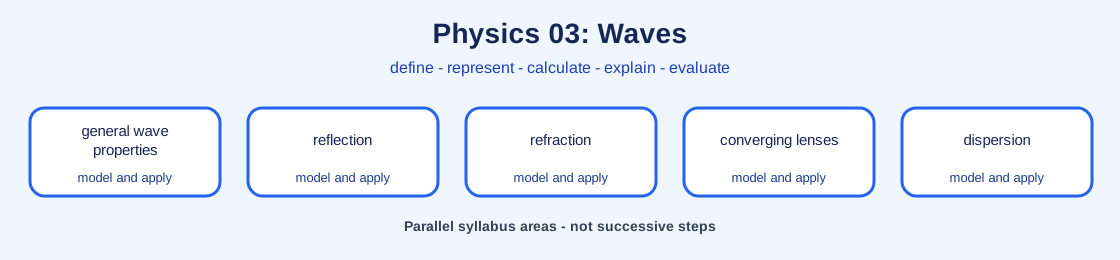
The ideas that organise this section
- Classify waves by the direction of vibration relative to travel.
- Frequency is set by the source, while speed and wavelength respond to the medium.
- Diffraction is most noticeable when wavelength is comparable with the gap or obstacle size.
Core route
Core candidates should be ready to describe, calculate, interpret, and apply the following:
- Describe transverse and longitudinal waves and use wavefront diagrams.
- Calculate wave speed, frequency, wavelength, and period.
- Describe reflection, refraction, and diffraction using ripple-tank or other examples.
Supplement route
Extended candidates study all Core content and add the following depth:
- Explain refraction as a speed change while frequency remains constant.
- Relate diffraction strength to wavelength and gap size.
- Use displacement-distance and displacement-time graphs without confusing their horizontal axes.
Formula route
- Relationship: wave speed = frequency x wavelength.
- Relationship: frequency = 1 / period.
Write the relationship before substituting. Convert units first, keep extra figures during working, and round only the final answer to sensible precision.
Build a connected model
In General Properties of Waves, a strong answer connects the named quantity or model to observable evidence. Begin by defining the physical quantity in words or with its relationship. Identify which values are scalars and which require a direction. Represent the situation with a labelled diagram, graph, field pattern, ray or circuit when that makes the relationship visible. The representation is part of the reasoning: its labels, arrows and scale should agree with the written explanation.
For a calculation, write the governing relationship before substitution, convert prefixes and time units, keep unrounded values during working and attach the correct final unit. For a qualitative question, use a cause-link-consequence chain. Name what changes, state the physical mechanism that links the change to the system, and then give the measurable result. If two cases are compared, hold unrelated variables constant and use the same physical principle for both.
Check this topic from memory
Attempt the matching topic bank before reopening the notes. Use each missed idea to decide what to review next.
Start the topic quiz