

Cambridge IGCSE Physics Notes 3.2: Light
Cambridge IGCSE Physics light notes on reflection, refraction, refractive index, total internal reflection, lenses, images, and dispersion.
Q: What does Cambridge IGCSE Physics Notes 3.2: Light cover?
A: It follows official Cambridge Physics section 3.2 for syllabuses 0625 and 0972, with Core ideas separated from Supplement depth.
Ray diagrams represent how light changes direction at surfaces and through lenses, allowing image position and optical behaviour to be predicted.
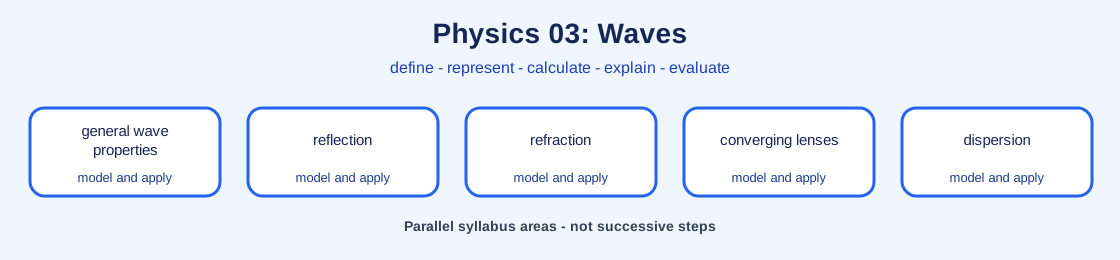
The ideas that organise this section
- Measure angles from the normal, not from the surface.
- Refraction occurs because speed changes at a boundary; frequency remains constant.
- A converging lens can form real or virtual images depending on object position.
Core route
Core candidates should be ready to describe, calculate, interpret, and apply the following:
- Apply the law of reflection and construct plane-mirror ray diagrams.
- Describe refraction, converging lenses, image properties, and dispersion.
- Use principal rays to locate images in standard lens arrangements.
Supplement route
Extended candidates study all Core content and add the following depth:
- Calculate refractive index and critical angle and explain total internal reflection.
- Use lens terminology and magnification quantitatively where required.
- Explain optical fibres and other applications of internal reflection.
Formula route
- Relationship: refractive index = sine of incidence angle / sine of refraction angle.
- Relationship: magnification = image height / object height.
Write the relationship before substituting. Convert units first, keep extra figures during working, and round only the final answer to sensible precision.
Build a connected model
In Light, a strong answer connects the named quantity or model to observable evidence. Begin by defining the physical quantity in words or with its relationship. Identify which values are scalars and which require a direction. Represent the situation with a labelled diagram, graph, field pattern, ray or circuit when that makes the relationship visible. The representation is part of the reasoning: its labels, arrows and scale should agree with the written explanation.
For a calculation, write the governing relationship before substitution, convert prefixes and time units, keep unrounded values during working and attach the correct final unit. For a qualitative question, use a cause-link-consequence chain. Name what changes, state the physical mechanism that links the change to the system, and then give the measurable result. If two cases are compared, hold unrelated variables constant and use the same physical principle for both.
Check this topic from memory
Attempt the matching topic bank before reopening the notes. Use each missed idea to decide what to review next.
Start the topic quiz