

Pearson International A Level Biology Core Practical 15: Investigate yeast respiration using a redox indicator
Pearson IAL Biology practical notes on investigate yeast respiration using a redox indicator.
This guide practises interpreting a defined redox-indicator endpoint in an approved yeast investigation. It is not a complete validated respiration assay or a claim to reproduce Pearson's prescribed procedure. Use current course documents, the specified indicator and approved safety instructions; distinguish the timed indicator response from the biological rate inferred.
Aim and scientific principle
Use the colour change of an artificial hydrogen carrier as a timed proxy for reducing conditions during yeast respiration.
Begin by translating the title into a testable question. Identify what is deliberately changed, what is measured directly, what is calculated and what must remain controlled. Predict a relationship only after naming the mechanism. A prediction without a reason is weak; a reason without measurable variables cannot guide a practical design.
Apparatus and setup
Use a yeast suspension, respiratory substrate, specified redox indicator, buffer where required, test tubes, pipettes, thermostatic water bath and timer. Consider measuring range, resolution, uncertainty, calibration and suitability for the sample, not the instrument name alone. Draw a labelled setup that shows the reaction volumes, temperature control and the point at which timing begins. Include a no-yeast or inactive-yeast control to identify non-biological colour change.
Before collecting results, check zero readings, calibration, leaks, alignment or sterility as relevant. Record the instrument resolution beside the first raw-data table. If a digital device displays more digits than its underlying accuracy supports, do not treat every digit as equally certain.
Method
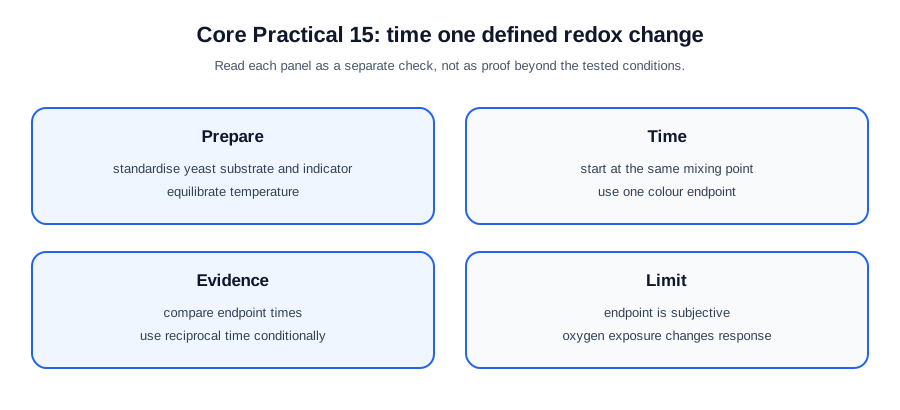
- Equilibrate the yeast, substrate and indicator at the selected temperature before mixing.
- Start timing at the same mixing point in every trial and apply one predeclared colour endpoint.
- Repeat across the tested condition while keeping yeast, substrate, indicator volume, pH and oxygen exposure controlled.
- Compare endpoint times or use reciprocal time as a rate proxy only when every trial represents the same indicator change.
Plan the analysis before starting. This reveals whether an additional measurement is needed for a derived quantity and prevents a completed experiment from lacking a mass, length, concentration, background or calibration value. A method should be detailed enough for another trained student to reproduce, while avoiding decorative steps that do not affect validity.
Variables and controls
Check this topic from memory
Attempt the matching topic bank before reopening the notes. Use each missed idea to decide what to review next.
Start the topic quiz