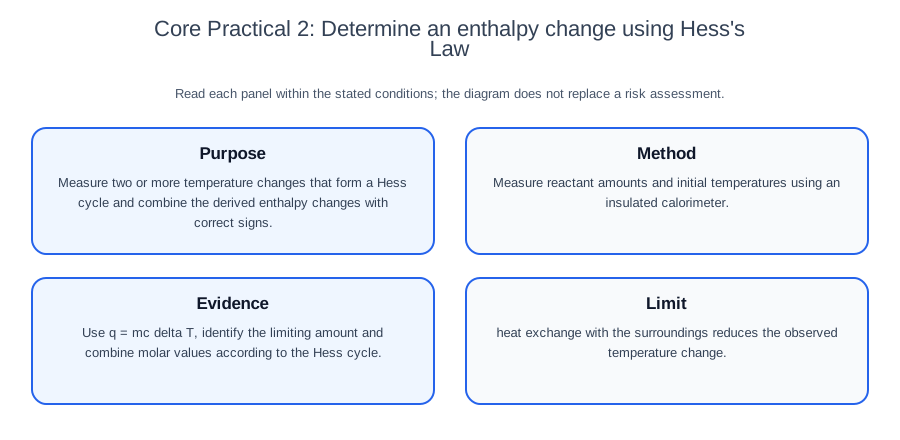
This outline develops a Hess-cycle calculation from approved calorimetry measurements. It is not a complete validated procedure or approval of reactants,quantities or apparatus. Choose those through the local practical plan and substance-specific risk assessment. Check current Pearson documents for course-specific requirements.
Aim and scientific principle
Measure appropriate calorimetry routes and combine their thermochemical equations to obtain a target enthalpy change. Match species,amounts,physical states and solution conditions;temperature changes alone do not define a Hess cycle.
Begin by translating the title into a testable question. Identify what is deliberately changed, what is measured directly, what is calculated and what must remain controlled. Predict a relationship only after naming the mechanism. A prediction without a reason is weak; a reason without measurable variables cannot guide a practical design.
Apparatus and setup
Use insulated cups with lids, thermometer or temperature probe, measured solutions or solids, balance, pipette or cylinder and stirrer. Consider measuring range, resolution, uncertainty, calibration and suitability for the sample, not the instrument name alone. Draw a labelled scientific setup that shows the working geometry and exactly where readings are taken. Include a control or blank when it distinguishes the target effect from drift, contamination or background response.
Before collecting results, check zero readings, calibration, leaks, alignment or sterility as relevant. Record the instrument resolution beside the first raw-data table. If a digital device displays more digits than its underlying accuracy supports, do not treat every digit as equally certain.
Method
Write the balanced target equation and each proposed route,including states and solution conditions. Check that multiplying,reversing and adding the routes actually gives the target equation;include dilution or dissolution steps if needed to reconcile different states.
With the approved calorimeter and reactants,record amounts,concentrations and initial temperatures. Account for separately mixed components if their initial temperatures differ. Record temperature against time before and after the approved addition,with consistent stirring and the addition time noted.
Estimate a justified temperature change and heat balance. State assumptions about reacting-solution mass,specific heat capacity,calorimeter heat capacity and exchange with external surroundings. An observed maximum/minimum is not automatically the adiabatic temperature change;extrapolation is valid only with an appropriate time-response model.
Check this topic from memory
Attempt the matching topic bank before reopening the notes. Use each missed idea to decide what to review next.
Establish reaction completion and extent,assign the reaction heat sign,normalise to the written equation and combine the route enthalpies with the same algebraic multipliers. Repeat comparable measurements and evaluate uncertainties and common biases. Do not interpret a small temperature change as proof that the reaction itself is nearly thermoneutral.
Plan the analysis before starting. This reveals whether an additional measurement is needed for a derived quantity and prevents a completed experiment from lacking a mass, length, concentration, background or calibration value. A method should be detailed enough for another trained student to reproduce, while avoiding decorative steps that do not affect validity.
Variables and controls
Independent variable: reaction route or reactant combination.
Dependent variable: temperature change and derived molar enthalpy change.
Important controls: solution composition and amounts,initial temperatures,calorimeter configuration,stirring,addition and logging timing. Maintain or account for differences that the route itself requires;do not claim all concentrations or volumes are identical when the balanced cycle requires different mixtures.
For each control, state how it is maintained or monitored. Simply writing "keep temperature constant" is incomplete if the method has no bath, probe, equilibration time or other means of doing so. Choose a range wide enough to reveal the relationship but within safe and scientifically valid limits. Choose the number, range and spacing of values for the expected response and analysis. Concentrating values near an uncertain threshold or optimum can be more useful than uniform spacing; no fixed count establishes an adequate design.
What is distinctive about this practical
At constant pressure with only pressure-volume work,the reaction heat equals its enthalpy change. In an ideal insulated model with a common initial temperature and final equilibration, qrxn=−(mc+Ccal)ΔT. Here the solution heat term uses its total participating mass and appropriate specific heat capacity;the separate calorimeter heat-capacity term must not double-count equipment already included in an effective calibration. Neglecting equipment heat capacity or using water properties for a solution requires justification. Heat exchange,evaporation,other mixing/dissolution effects or unequal initial temperatures need additional accounting.
For a single stated reaction, ξ=nconsumed/ν relates extent to the amount actually consumed and its positive stoichiometric coefficient. The molar reaction enthalpy for the equation as written is ΔrH=qrxn/ξ. For an equation scaled to one mole of a selected species,its consumed amount can therefore serve as the denominator;that shortcut does not transfer unchanged to every equation scale.
If routes combine with algebraic multipliers, ΔrHtarget=∑iaiΔrHi. Reversing a route changes its sign,and multiplying its equation scales its enthalpy. Match temperature,pressure,physical states and solution conditions before cancellation. Two biased route estimates need not produce an error of the same sign in their difference;agreement with a reference can also arise from cancellation.
Recording and processing results
Retain the balanced route equations,amounts and concentrations,time-temperature readings,addition time,mass and heat-capacity basis,completion evidence and any correction model. Show the solution/calorimeter heat balance before assigning the reaction sign and normalising by reaction extent. Convert joules to kilojoules consistently. Keep the algebraic multipliers attached to the route values and report the target equation and conditions. Include shared calibration and heat-capacity assumptions in the uncertainty discussion;do not treat correlated route errors as automatically independent. Put units in column headings,record instrument-consistent raw readings and distinguish repeats from means. Investigate and document anomalies rather than deleting inconvenient results.
Choose a fitted line, curve or ruled joins according to the data, scientific relationship and question; do not connect or smooth points mechanically. A gradient should use a large triangle and values read from the fitted line. When a relationship is linearised, explain the transformation and connect gradient or intercept to the requested physical quantity. When observations are categorical, define the category rule before seeing the result.
Safety, ethics and responsible practice
Use the approved substance-specific risk assessment,eye protection and appropriate controls for the actual reagents,temperature changes,addition and spills. Choose any lid or venting arrangement through that assessment;insulation is not permission to seal a gas-producing reaction. This outline does not authorise a named reaction,quantity or hands-on procedure.
Worked application: from raw evidence to a defensible conclusion
Consider a constructed algebraic cycle with states A,B and C at matching conditions. If A to C has enthalpy change −50.0kJmol−1 of the stated transformation,and B to C has −20.0kJmol−1,the target A to B is obtained by adding A to C to the reverse of B to C,giving −30.0kJmol−1. These are invented illustration values,not measured data or an approved reaction scale. Merely adding the two measured numbers would instead describe the wrong algebraic combination.
As a separate constructed bias check,if the first route estimate is −45.0kJmol−1 and the second remains −20.0kJmol−1,the inferred target is −25.0kJmol−1. If only the second estimate changes to −15.0kJmol−1,the inferred target is −35.0kJmol−1. Thus making one exothermic route less negative can move the target in either direction,depending on its multiplier. This arithmetic does not validate a real cycle,heat-transfer correction or reaction completion.
Evaluation: limitation, effect and improvement
Limitation: external heat exchange,neglected equipment heat capacity,an unsuitable solution heat-capacity assumption or incomplete reaction can bias route estimates. Different initial temperatures and unaccounted mixing/dissolution heat can also invalidate the simple heat balance.
Likely effect: when the surroundings tend to restore the initial temperature,external exchange commonly attenuates the observed change. Under the stated common-temperature ideal model,neglecting a positive calorimeter heat capacity also reduces the inferred reaction-heat magnitude. Neither observation fixes the sign of the combined Hess error;derive that from each route error and its algebraic multiplier. Other heat inputs or unequal starting temperatures can change the direction.
Targeted improvement: use the approved insulated configuration,characterise the relevant heat capacity,log the thermal response and use a justified correction model. Check initial conditions,reaction extent and state matching. Extrapolation alone does not correct incomplete reaction,unaccounted mixing or an invalid Hess cycle.
Separate random variation, systematic bias and model limitation. Repeats help reveal random variation but do not remove a zero error. Calibration establishes the relation between reference values and indications; appropriate adjustment or correction can address an identified offset. It does not make biased sampling representative. Finer resolution and greater repeatability are distinct properties, and finer resolution may improve an estimate only when the reading is a material source of uncertainty.
Common misconceptions and corrections
Repeats automatically make a result accurate. Repeats estimate random variation; they do not correct a biased method or calibration error.
A control variable is just a list item. Explain the apparatus or procedure that keeps it stable.
The line must pass through every point. Use the overall pattern and a best-fit relationship, then investigate justified anomalies.
Percentage error and percentage uncertainty are interchangeable. Error compares a measured value with a suitable reference. Uncertainty characterises dispersion of values attributed to the measurand; it may be expressed as a standard uncertainty or an interval with stated coverage, and includes more than resolution alone. State the reference, denominator and uncertainty convention used.
A successful endpoint proves the theory. The observation supports a conclusion only within the method, range and assumptions tested.
More sophisticated apparatus is always better. The improvement must address the dominant limitation and be practical in the stated context.
Assessment guidance
Pearson states that IAL practical skills are assessed mainly in Unit 3 and Unit 6, with related theory also assessable in the other unit papers. Planning answers need an operational independent variable, a measured dependent variable, a justified range, controls, repeats, safety and a stated analysis. Data answers need units, consistent precision, sensible significant figures and transparent calculations. Graph answers need labelled axes, a scale using the grid well and line treatment appropriate to the data and question. Evaluation answers should use a limitation-effect-improvement chain specific to the apparatus. Do not claim that a memorised core-practical recipe is the only acceptable method when the question supplies a different valid context.
Retrieval practice
Extend or adapt this practical to answer a related question. Where the design uses a continuous variable, justify its planned values. List apparatus with range and resolution where relevant, control methods, a raw record layout, the expected analysis and one hazard-control pair. Then identify one random uncertainty, one systematic bias and one model limitation. Explain which can be reduced by repeats, which needs calibration followed by appropriate correction or adjustment, or a redesign, and how your conclusion would change if the anomaly were confirmed.