

Pearson International A Level Further Mathematics: FP3 Further Pure Mathematics 3
Pearson International A Level Further Mathematics notes on hyperbolic functions, coordinate systems, calculus, vectors and matrices.
FP3 is an externally assessed modular unit used within Pearson Edexcel International A Level Further Mathematics. The current Mathematics, Further Mathematics and Pure Mathematics specification is Issue 3. This note follows the official FP3 order and keeps qualification cash-in choices separate from the mathematical content: your centre must still confirm that the unit combination is eligible for the award you intend to claim.
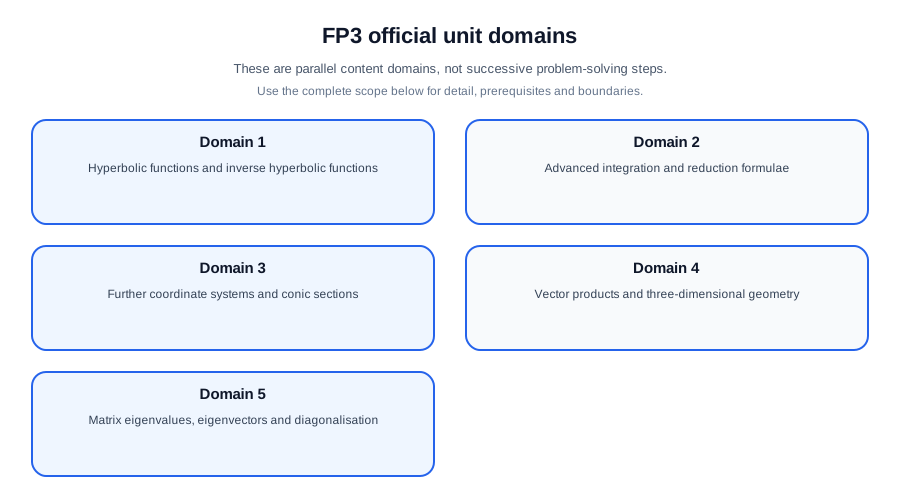
Official unit scope
- Hyperbolic functions and inverse hyperbolic functions.
- Advanced integration and reduction formulae.
- Further coordinate systems and conic sections.
- Vector products and three-dimensional geometry.
- Matrix eigenvalues, eigenvectors and diagonalisation.
The specification assumes prerequisite knowledge stated for the unit, so later-unit questions may combine earlier methods without re-teaching them. Treat the list above as an integrated toolkit. A question can begin in one topic and finish in another, such as using algebra to form a model, calculus to optimise it and a graph to interpret the result.
Core reasoning and methods
- Use exponential definitions to prove hyperbolic identities rather than borrowing circular-function signs.
- For a plane or line problem, choose vector, parametric or Cartesian form according to the required intersection or distance.
- Before diagonalising, verify that enough independent eigenvectors exist.
Write mathematical arguments so another reader can reproduce every transition. Define symbols that are introduced, preserve exact values until a decimal is requested, and place restrictions beside the step that creates them. Calculator use can support arithmetic, graph exploration and checking, but it does not replace a proof, derivation or required chain of working.
When a model is used, state the simplifying assumptions and interpret the answer in the original setting. A mathematically valid root may be inadmissible because it lies outside a time interval, represents a negative length, violates a probability range or conflicts with a geometric domain. The final check is therefore both algebraic and contextual.
Worked example
For the matrix with rows (2, 1) and (1, 2), the characteristic equation is
Check this topic from memory
Attempt the matching topic bank before reopening the notes. Use each missed idea to decide what to review next.
Start the topic quiz