

Pearson International A Level Pure Mathematics: P4 Pure Mathematics 4
Pearson International A Level Pure Mathematics notes on proof, algebra, coordinate geometry, binomial expansion, calculus and vectors.
P4 is an externally assessed modular unit used within Pearson Edexcel International A Level Pure Mathematics. The current Mathematics, Further Mathematics and Pure Mathematics specification is Issue 3. This note follows the official P4 order and keeps qualification cash-in choices separate from the mathematical content: your centre must still confirm that the unit combination is eligible for the award you intend to claim.
This page explains P4 in the separate Pure Mathematics award. If your registered award is Pearson IAL Mathematics, use the Mathematics P4 route note, where P4 is compulsory alongside P1 to P3 and an approved applied pair.
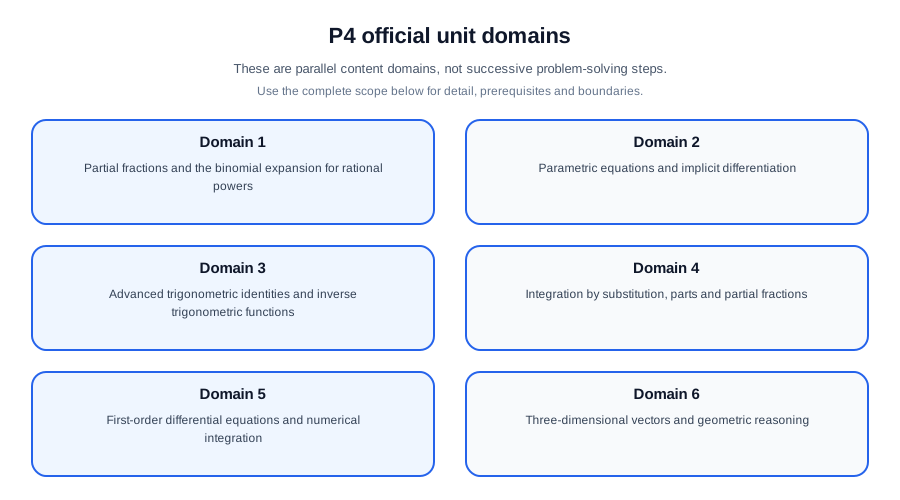
Official unit scope
- Partial fractions and the binomial expansion for rational powers.
- Parametric equations and implicit differentiation.
- Advanced trigonometric identities and inverse trigonometric functions.
- Integration by substitution, parts and partial fractions.
- First-order differential equations and numerical integration.
- Three-dimensional vectors and geometric reasoning.
The specification assumes prerequisite knowledge stated for the unit, so later-unit questions may combine earlier methods without re-teaching them. Treat the list above as an integrated toolkit. A question can begin in one topic and finish in another, such as using algebra to form a model, calculus to optimise it and a graph to interpret the result.
Core reasoning and methods
- Match the partial-fraction form to repeated and irreducible denominator factors before solving coefficients.
- Choose substitution when a composite structure and its derivative are present; choose integration by parts for a product that simplifies when differentiated.
Check this topic from memory
Attempt the matching topic bank before reopening the notes. Use each missed idea to decide what to review next.
Start the topic quiz