

Pearson International A Level Pure Mathematics: FP3 Further Pure Mathematics 3
Pearson International A Level Pure Mathematics notes on hyperbolic functions, coordinate systems, calculus, vectors and matrices.
FP3 is an externally assessed modular unit used within Pearson Edexcel International A Level Pure Mathematics. The current Mathematics, Further Mathematics and Pure Mathematics specification is Issue 3. This note follows the official FP3 order and keeps qualification cash-in choices separate from the mathematical content: your centre must still confirm that the unit combination is eligible for the award you intend to claim.
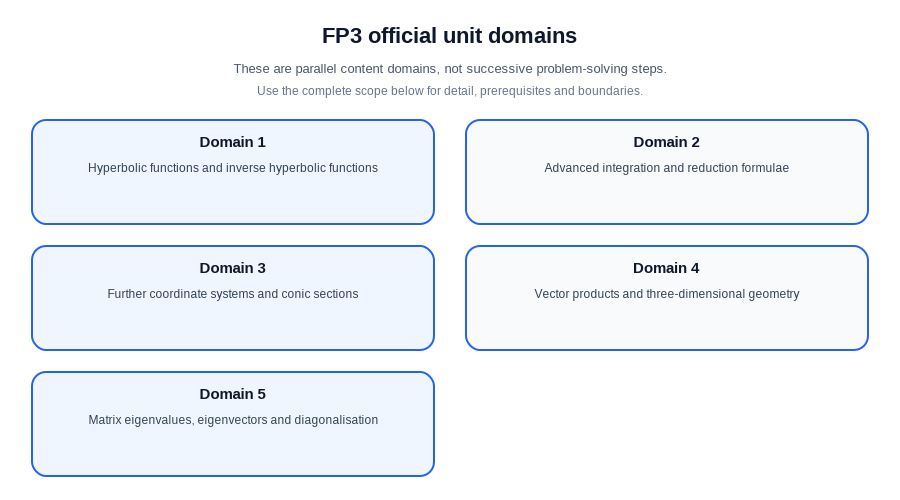
Official unit scope
- Hyperbolic functions and inverse hyperbolic functions.
- Advanced integration and reduction formulae.
- Further coordinate systems and conic sections.
- Vector products and three-dimensional geometry.
- Matrix eigenvalues, eigenvectors and diagonalisation.
The specification assumes prerequisite knowledge stated for the unit, so later-unit questions may combine earlier methods without re-teaching them. Treat the list above as an integrated toolkit. A question can begin in one topic and finish in another, such as using algebra to form a model, calculus to optimise it and a graph to interpret the result.
Core reasoning and methods
- Use exponential definitions to prove hyperbolic identities rather than borrowing circular-function signs.
- For a plane or line problem, choose vector, parametric or Cartesian form according to the required intersection or distance.
- Before diagonalising, verify that enough independent eigenvectors exist.
Write mathematical arguments so another reader can reproduce every transition. Define symbols that are introduced, preserve exact values until a decimal is requested, and place restrictions beside the step that creates them. Calculator use can support arithmetic, graph exploration and checking, but it does not replace a proof, derivation or required chain of working.
When a model is used, state the simplifying assumptions and interpret the answer in the original setting. A mathematically valid root may be inadmissible because it lies outside a time interval, represents a negative length, violates a probability range or conflicts with a geometric domain. The final check is therefore both algebraic and contextual.
Worked example
For the matrix with rows (2, 1) and (1, 2), the characteristic equation is - 1 = 0, giving eigenvalues 3 and 1. An eigenvector for 3 is proportional to (1, 1), while one for 1 is proportional to (1, -1). These independent directions form an invertible modal matrix, so diagonalisation is possible. Multiplication by the original matrix stretches the first direction by 3 and the second by 1. This geometric interpretation checks both eigenpairs and explains why powers of the matrix become easier in the diagonal basis.
The transferable method is to identify the target, select a representation that exposes it, carry out a justified procedure and then check the result independently. If the question gives a result to prove, work from known information toward it rather than assuming the displayed result in an intermediate step.
Connections across the unit
Build a revision map with one row per official content heading. For each row, record a trigger phrase, a standard representation, one method, one condition and one frequent error. Then add links between rows. Algebra supports every unit; graphs reveal roots and rates; trigonometric or probability models impose domain restrictions; calculus or algorithms produce results that still need interpretation.
The formula booklet is a resource, not a substitute for recognition. Practise deciding which formula applies, rearranging it safely and checking that the required assumptions hold. Also distinguish formulae supplied in the booklet from results the specification expects students to know.
How FP3 functions in this award
Within Pure Mathematics, FP3 belongs to an award built entirely from Pure and Further Pure units. Give extra attention to proof, exact structure and dependencies between successive pure topics. Build a chain from P1 foundations through P4 calculus and vectors into the FP extensions. The syllabus content is shared with other awards, but this page's learning purpose is the all-pure route.
Turn that perspective into a route-specific revision artefact. Place FP3 in the qualification sequence, draw arrows to two prerequisites and two later or applied uses, and annotate each arrow with the exact method transferred. The official mathematics stays stable, while the study decisions reflect the award in which the unit is being claimed.
Common misconceptions and corrections
- Assuming hyperbolic identities have exactly the same signs as trigonometric identities. Derive the sign from the exponential definitions or a known identity: hyperbolic identities do not inherit every circular-trigonometric sign.
- Treating an eigenvector as unique. Any non-zero scalar multiple represents the same eigen-direction
- Claiming distinct eigenvalues are necessary for diagonalisation. They are sufficient in the usual finite-dimensional setting, but repeated eigenvalues can still have enough eigenvectors
- Copying calculator output without validation. Give the requested exact form or accuracy, and use substitution, estimation, dimensions or a second method to check it.
- Ignoring the qualification route. Unit content may be shared across awards, but the result cannot automatically be counted in every cash-in combination.
Assessment guidance
The FP3 paper is 1 hour 30 minutes and carries 75 marks. Answer all questions and show the mathematical structure that earns method marks. Use diagrams for mechanics, geometry, vectors and networks; label probability events; and state hypotheses or modelling assumptions precisely. Keep exact values through intermediate work unless the question directs otherwise. For numerical answers, round only at the end and state units where relevant. If an answer is rejected by a domain, explain why. When an algorithm, proof or iterative method is requested, display the prescribed steps rather than reporting only the final calculator value.
Retrieval practice
Create five mixed questions that collectively use every official content heading listed above. For each, write the trigger, method, condition, final check and one plausible wrong turn. Complete one question without notes, mark the exact step where your reasoning first diverged, and redo it using a different representation. Finally, explain aloud how FP3 contributes to International A Level Pure Mathematics and ask your centre to verify the intended unit combination before cash-in.
Official source and boundaries
Pearson Edexcel, International Advanced Level Mathematics, Further Mathematics and Pure Mathematics specification, Issue 3. This independently written study note summarises the official FP3 content without reproducing a past-paper question or mark scheme.
Return to the International A Level Pure Mathematics notes hub.
Check this topic from memory
Attempt the matching topic bank before reopening the notes. Use each missed idea to decide what to review next.
Start the topic quiz