The principles topic supplies the particle, atomic, bonding and quantitative language used throughout 4CH1. It is not a single isolated chapter: later questions on rates, equilibrium, acids, metals and organic chemistry assume that these foundations are secure.
The official specification separates statements that all candidates study from additional bold content assessed through Paper 2. Check your centre's entry route before deciding that a subtopic can be omitted.
Particle ideas and separation
In a solid, particles vibrate about fixed positions. In a liquid, particles remain close but move past one another. In a gas, particles are much farther apart and move rapidly in random directions. Heating increases their average kinetic energy; it does not make the particles themselves larger.
Changes of state are physical changes because no new substance forms. During melting or boiling, transferred energy overcomes attractions between particles. The temperature remains constant during a pure substance's change of state because the energy is changing particle arrangement rather than increasing average kinetic energy.
Choose a separation method from the property that differs:
Mixture
Useful difference
Suitable method
Insoluble solid and liquid
Particle size and insolubility
Filtration
Dissolved solid and solvent
Volatility
Crystallisation or simple distillation
Two miscible liquids
Boiling temperature
Fractional distillation
Coloured soluble substances
Attraction to phases and solubility
Check this topic from memory
Attempt the matching topic bank before reopening the notes. Use each missed idea to decide what to review next.
For chromatography, calculate the retention factor using distances measured from the original pencil baseline:
Rf=distance travelled by solvent frontdistance travelled by substance
Atomic structure and the Periodic Table
The proton number identifies an element. The nucleon number is the total number of protons and neutrons. Isotopes have the same number of protons but different numbers of neutrons, so they are atoms of the same element with different masses.
For a neutral atom, the number of electrons equals the number of protons. When an atom forms a positive ion, it loses electrons; when it forms a negative ion, it gains electrons. Do not change the proton number when writing an ion's electronic configuration.
The relative atomic mass shown in the Periodic Table is a weighted mean. For two isotopes:
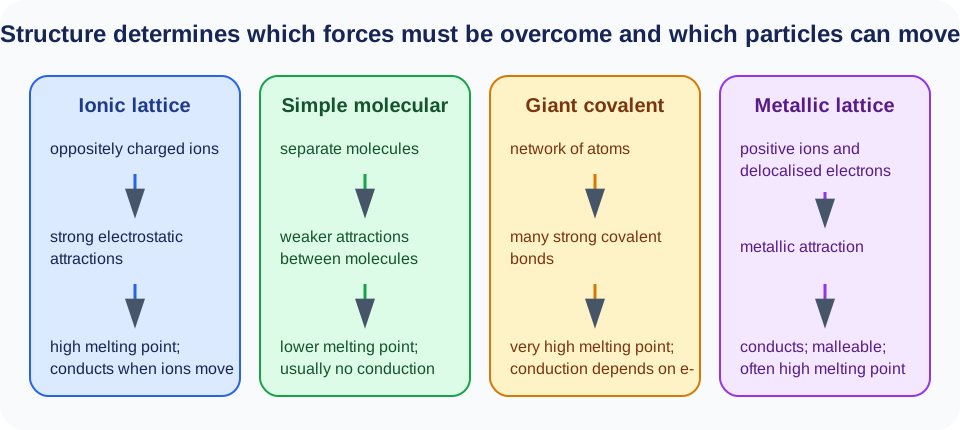
Bonding explanations score best when they link three layers: structure, particles or bonding, then the observed property.
Ionic compounds contain oppositely charged ions in a giant lattice. Strong electrostatic attractions require much energy to overcome, so melting points are high. They conduct only when molten or dissolved because the ions can then move.
Simple molecular substances have strong covalent bonds within molecules but weaker attractions between molecules. Melting or boiling overcomes the intermolecular attractions, not the covalent bonds.
Giant covalent structures contain many strong covalent bonds. Diamond is hard and does not conduct because all four outer electrons of each carbon atom are used in bonds. Graphite conducts because each carbon atom contributes one delocalised electron.
Metals contain positive ions attracted to delocalised electrons. The mobile electrons carry charge, while layers of ions can slide without destroying the metallic attraction.
Formulae, equations and quantitative chemistry
Start every reacting-mass calculation with a balanced equation. Its coefficients give mole ratios, not mass ratios. A dependable sequence is:
balance the equation
convert the given quantity to moles
apply the coefficient ratio
convert to the requested quantity
attach the correct unit and check significant figures
Useful relationships include:
n=Mrm
c=Vn
Use volume in dm3 for molar concentration. Divide a volume in cm3 by 1000 before substituting.
Percentage yield compares the amount obtained with the theoretical maximum:
Atom economy instead measures how much of the reactants becomes the desired product. A reaction can have a high percentage yield but poor atom economy because these quantities answer different questions.
Electrolysis
During electrolysis, positive ions move to the negative cathode and gain electrons. Negative ions move to the positive anode and lose electrons. Electron gain is reduction; electron loss is oxidation.
For a molten ionic compound, only its ions are present. In an aqueous electrolyte, water contributes ions too, so predicting the products requires the specification's discharge rules. An electrode equation must balance both atoms and charge. For example:
CuX2++2eX−Cu
Worked example
Magnesium reacts with hydrochloric acid:
Mg+2HClMgClX2+HX2
Find the mass of magnesium needed to produce 0.150 mol of hydrogen.
The equation is already balanced. Its coefficients show a 1:1 mole ratio between magnesium and hydrogen, so 0.150 mol of hydrogen requires 0.150 mol of magnesium. Using m=nMr and Ar(Mg)=24.3:
m=0.150×24.3=3.645g
The data are given to three significant figures, so report 3.65g. A common wrong approach multiplies by the coefficient 2 from hydrochloric acid. That coefficient relates hydrochloric acid to magnesium; it does not change the 1:1 magnesium-to-hydrogen ratio.
Common misconceptions
Particles do not expand when heated. Their average kinetic energy and, often, their average separation increase.
Melting a simple molecular substance does not break its covalent bonds. It overcomes attractions between molecules.
An isotope does not have a different proton number. Changing the proton number changes the element.
Equation coefficients are mole ratios, not direct mass ratios. Convert through moles.
The cathode is not always negative in every electrochemical context, but it is the negative electrode in the electrolytic cells studied here. Identify the process before applying a sign rule.
Assessment guidance
Pearson can assess these principles through definitions, explanations, calculations, diagrams and unfamiliar applications. For a describe question, state the relevant pattern or observation. For explain, add the scientific cause and connect it to the stated outcome. In structure-property questions, naming a structure alone is incomplete: identify the particles, the relevant bonding or attraction, and whether charged particles can move. In calculations, show the balanced equation, mole conversion and ratio even if a calculator gives the final value. Paper 2 can draw on all Paper 1 content as well as the additional specification statements, so do not revise the papers as unrelated courses.
Check yourself
Explain why solid sodium chloride does not conduct electricity but molten sodium chloride does.
A chromatogram spot travels 3.6cm while the solvent front travels 6.0cm. Calculate its Rf value.
Calculate the amount of substance in 5.85g of sodium chloride, Mr=58.5.
Explain why graphite conducts electricity but diamond does not, despite both containing only carbon.
For each explanation, check that you have linked structure to particles or bonding and then to the property. For each calculation, check the equation, conversion, unit and final precision.
Official specification and next topic
This chapter follows the Principles of Chemistry content in Pearson Edexcel International GCSE Chemistry 4CH1. Always use the specification issue applying to your examination series.