

Pearson International GCSE Chemistry 2: Inorganic Chemistry
Pearson International GCSE Chemistry notes on groups, gases, reactivity, extraction, acids, salts and analysis.
Inorganic chemistry uses electronic structure, periodic patterns and reactivity to predict what substances do. The strongest answers do more than recall a trend: they connect a position in the Periodic Table or the reactivity series to a reaction, an observation or a suitable preparation method.
The official 4CH1 specification distinguishes content common to both papers from additional bold content assessed through Paper 2. Use the specification issue for your examination series and check your centre's entry route.
Groups in the Periodic Table
Elements in the same group have the same number of outer-shell electrons, which gives them similar chemical reactions.
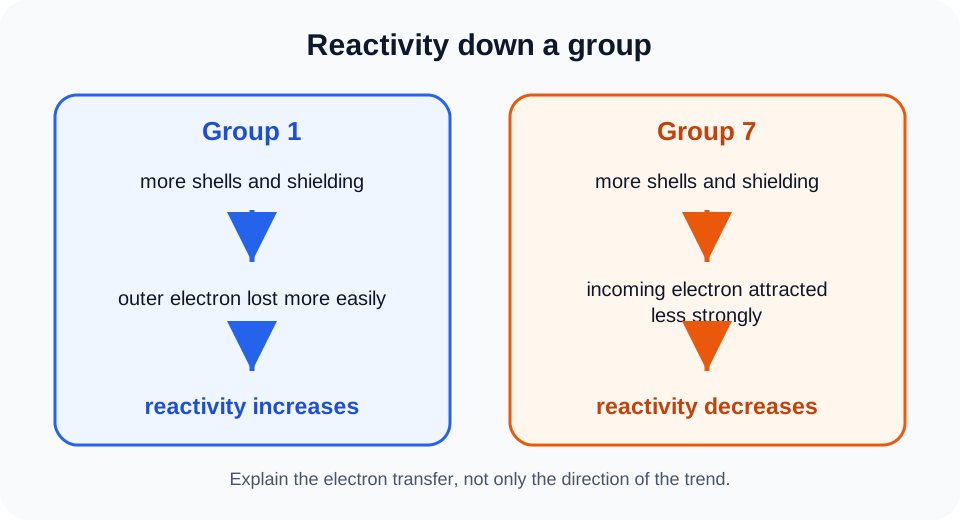
Group 1 metals form (1+) ions by losing one outer electron. Reactivity increases down the group because the outer electron is farther from the nucleus and more shielded by inner shells. The nuclear attraction on that electron is weaker, so it is lost more easily. Reactions with water become faster and more vigorous, producing a metal hydroxide and hydrogen.
Group 7 halogens form (1-) ions by gaining one electron. Reactivity decreases down the group because an incoming electron is farther from the nucleus and more shielded. A more reactive halogen displaces a less reactive halide from solution. Chlorine therefore displaces bromide and iodide, but iodine does not displace chloride.
Group 0 noble gases have complete outer shells. They are very unreactive and exist as single atoms. Their boiling points increase down the group because larger atoms have stronger attractions between them, so more energy is required to separate the atoms.
Gases, atmosphere and environmental chemistry
Dry air is approximately 78 percent nitrogen and 21 percent oxygen, with small amounts of noble gases and carbon dioxide. Oxygen supports combustion and can be estimated experimentally by reacting it with a substance and measuring the decrease in gas volume.
Complete combustion of a hydrocarbon produces carbon dioxide and water. In limited oxygen, incomplete combustion can produce carbon monoxide and carbon. Carbon monoxide is poisonous because it reduces the blood's ability to carry oxygen. Sulfur dioxide from sulfur-containing fuels contributes to acid rain, while oxides of nitrogen form at high engine temperatures and contribute to acid rain and photochemical pollution.
Carbon dioxide, methane and water vapour absorb outgoing infrared radiation. The greenhouse effect is a natural process that keeps Earth warm enough for life, but increased greenhouse-gas concentrations enhance it. Keep the causal chain precise: a gas absorbs infrared radiation, more energy is retained in the atmosphere, and average global temperature can rise.
Reactivity, extraction and corrosion
Check this topic from memory
Attempt the matching topic bank before reopening the notes. Use each missed idea to decide what to review next.
Start the topic quiz