

Pearson Further Pure Mathematics 1: Logarithmic Functions and Indices
Pearson International GCSE Further Pure Mathematics notes on indices, exponentials and logarithms.
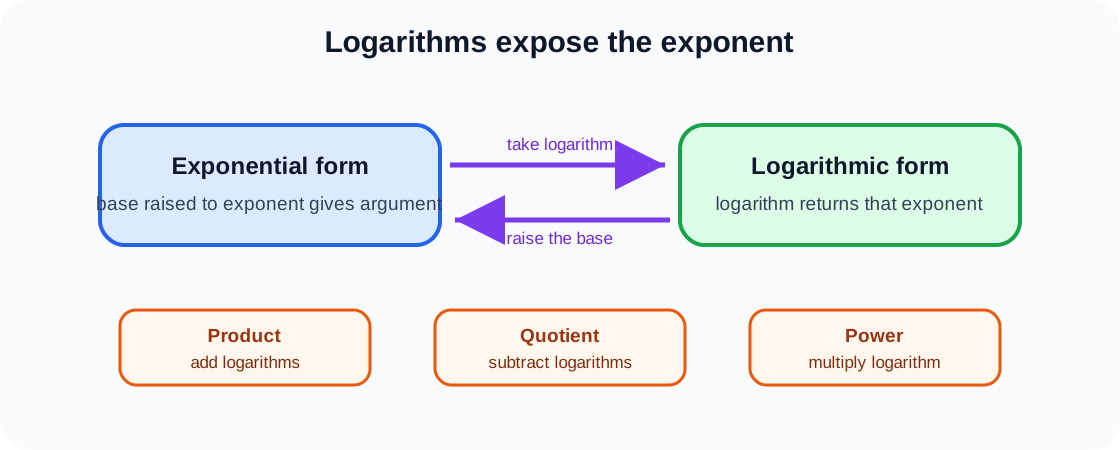
Indices and logarithms are inverse descriptions of exponential relationships.
Pearson 4PM1 uses these ideas as algebraic tools and as functions. Index laws simplify multiplicative structure, while logarithms expose an unknown exponent. Every logarithmic manipulation must preserve a positive argument and a valid base.
Main ideas
- Apply index laws to positive, negative, zero and fractional powers.
- Convert between exponential and logarithmic form.
- Use logarithm laws to combine expressions and solve equations.
- Recognise the domain restrictions of logarithmic expressions.
- Model repeated multiplicative change with exponential functions.
Index laws from repeated multiplication
For the same non-zero base, multiplying powers adds indices and dividing subtracts them. Raising a power to another power multiplies indices. A zero index gives one, while a negative index gives the reciprocal of the corresponding positive power.
A fractional index combines a root and a power. The denominator names the root and the numerator names the power. Depending on the real-number context, an even root requires a non-negative radicand. Rewrite fractional powers as roots when checking possible values and domains.
Index laws require the same base. Terms with unlike bases cannot be merged by adding exponents unless the bases are first expressed as powers of a common number. Addition of powers has no corresponding simple index rule.
Exponential functions
An exponential function has the variable in the exponent. For a positive base greater than one it increases, passes through vertical value one when the exponent is zero and approaches zero without reaching it as the input decreases. For a base between zero and one it decreases.
Multiplying an exponential function changes vertical scale; adding outside the exponential translates it vertically. A horizontal asymptote shifts with that translation. The function remains one-to-one for a valid positive base other than one, so it has a logarithmic inverse.
Repeated percentage growth has form initial amount multiplied by a fixed multiplier raised to time. Decay uses a multiplier between zero and one. The model assumes the same proportional change each period; changing rates require a different model.
Logarithmic definition and restrictions
The logarithm to base b of a positive number x is the exponent to which b must be raised to obtain x. The base must be positive and not equal to one, while the argument must be positive.
Check this topic from memory
Attempt the matching topic bank before reopening the notes. Use each missed idea to decide what to review next.
Start the topic quiz