

Pearson Further Pure Mathematics 2: The Quadratic Function
Pearson International GCSE Further Pure Mathematics notes on quadratic functions, roots and transformations.
Quadratics are a meeting point for algebra and graphs. The same function can expose its coefficients, roots or turning point depending on how it is written. Pearson International GCSE Further Pure Mathematics (4PM1) expects you to choose between these forms, solve quadratic equations and inequalities, connect roots with coefficients, and reason about graphs and parameters. The aim is not merely to obtain two numbers. It is to understand what those numbers say about a parabola and when a proposed answer is admissible.
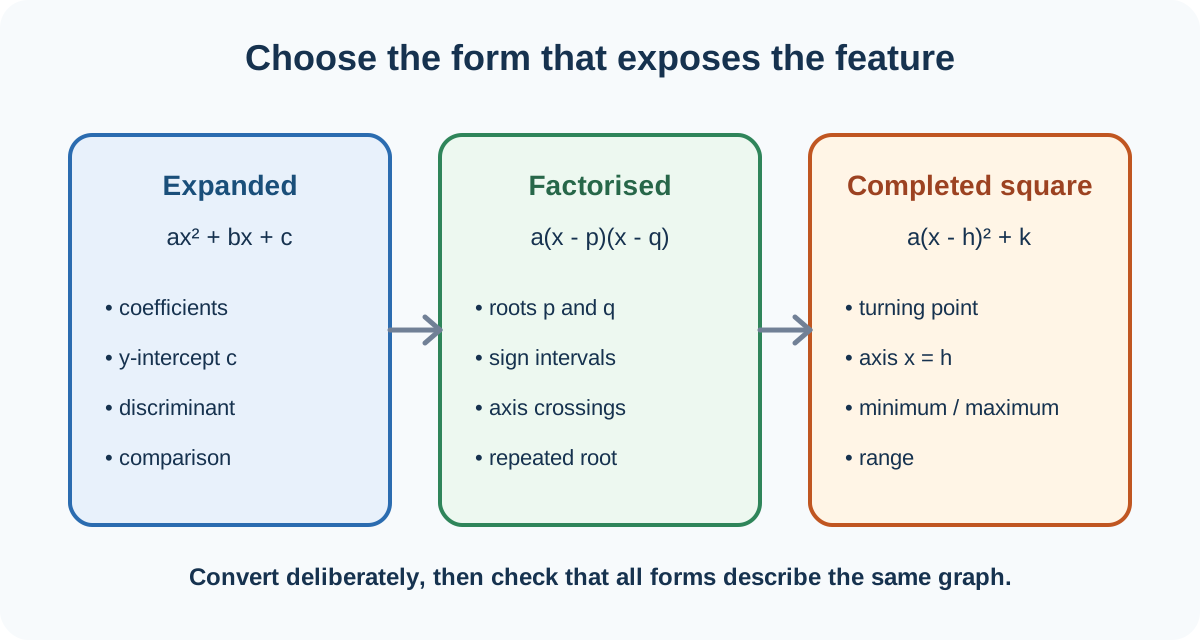
1. Three forms, three useful views
For a non-zero constant a, a quadratic function has expanded form f(x) = ax² + bx + c. This form immediately identifies the leading coefficient and the vertical intercept f(0) = c. The sign of a controls orientation: the parabola opens upwards if a is positive and downwards if a is negative. A larger magnitude of a produces a narrower graph than the corresponding graph with a smaller magnitude.
If the real roots are p and q, factorised form is f(x) = a(x - p)(x - q). It exposes the horizontal intercepts and makes the sign of the function easier to analyse. A repeated factor, such as (x - p)², gives one repeated root. The graph touches the horizontal axis there instead of crossing it.
Completed-square form is f(x) = a(x - h)² + k. It exposes the turning point (h, k) and axis of symmetry x = h. If a is positive, k is the minimum value; if a is negative, k is the maximum value. For the full real domain, this also gives the range. Do not confuse the sign inside the bracket with the coordinate: (x + 3)² has axis x = -3.
2. Completing the square accurately
When the coefficient of x² is 1, use
x² + bx = (x + b/2)² - (b/2)².
For a general leading coefficient, factor it from both quadratic and linear terms first. For example,
3x² - 12x + 7 = 3(x² - 4x) + 7 = 3[(x - 2)² - 4] + 7 = 3(x - 2)² - 5.
The multiplication by 3 applies to both terms inside the square brackets. This is why completing the square without first managing the leading coefficient often creates an incorrect constant. The result shows that the turning point is (2, -5) and the minimum value is -5.
The same method solves equations. Rearrange until the squared expression is isolated, take both square-root branches, and then check any restrictions. If
Check this topic from memory
Attempt the matching topic bank before reopening the notes. Use each missed idea to decide what to review next.
Start the topic quiz