

Pearson Further Pure Mathematics 3: Identities and Inequalities
Pearson International GCSE Further Pure Mathematics notes on algebraic identities and inequalities.
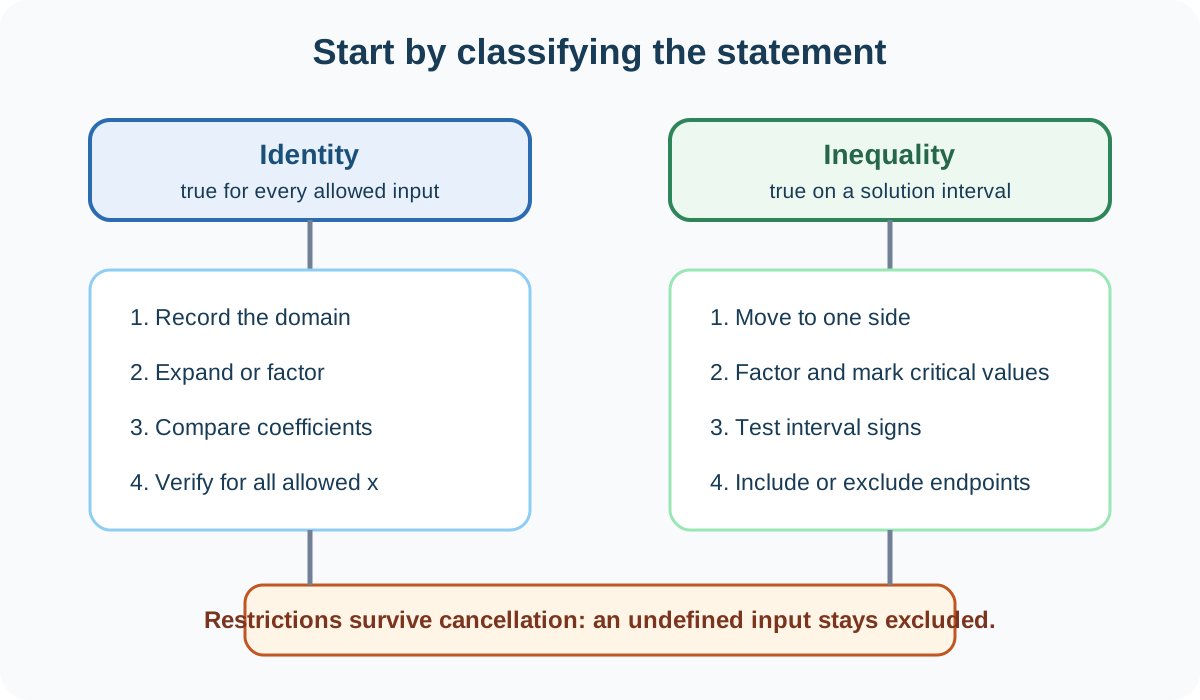
An equation is true for particular solution values, but an identity is true for every value in its domain. An inequality asks where one expression is greater or smaller than another, so its answer is usually an interval rather than an isolated number. Pearson International GCSE Further Pure Mathematics (4PM1) connects these ideas through polynomial algebra, factor and remainder theorems, coefficient comparison, and sign analysis. Strong solutions preserve domain restrictions and justify why a sign holds across an interval.
1. Equation, identity and implication
An equation such as x + 2 = 7 is true only when x = 5. An identity such as (x + 2)² ≡ x² + 4x + 4 is true for all real x. The symbol ≡ signals identity, although a question may use words instead. To prove an identity, transform one side into the other by valid algebra, or independently simplify both sides to the same expression. Checking several numerical values can expose an error but cannot prove a statement for every permissible input.
An implication has a direction. From x = 3 it follows that x² = 9, but x² = 9 does not imply x = 3 because x = -3 is also possible. Squaring both sides, multiplying by a possibly zero expression, or cancelling a factor can therefore introduce or remove possibilities. Mark these logical risks and check candidates in the original condition.
Domain comes first for rational expressions. In (x² - 9)/(x - 3), the original denominator excludes x = 3. Factorisation gives (x - 3)(x + 3)/(x - 3) = x + 3 only when x ≠ 3. The simplified expression agrees everywhere else, but it does not restore the missing input.
2. Polynomial identities and coefficients
An identity containing unknown constants can be solved by comparing coefficients. Expand and collect like powers first. If
A(x - 1) + B(x + 2) ≡ 5x + 1,
then the left side is (A + B)x + (-A + 2B). Equality for every x requires A + B = 5 and -A + 2B = 1. Solving simultaneously gives A = 3 and B = 2. Matching one convenient input may find one relationship, but enough independent relationships are needed to determine every unknown.
Substitution can be efficient when an identity is already in factor form. Values that make factors zero isolate constants. This is especially useful in partial-fraction-style decompositions. However, substitution must use values allowed by the identity's domain, and the finished constants should be checked by expansion or by matching all coefficients.
Check this topic from memory
Attempt the matching topic bank before reopening the notes. Use each missed idea to decide what to review next.
Start the topic quiz