

Pearson Further Pure Mathematics 5: Series
Pearson International GCSE Further Pure Mathematics notes on arithmetic and geometric series.
A sequence is an ordered list of terms; a series is the result of adding terms. This distinction determines whether a question asks for one term or an accumulated total. Pearson International GCSE Further Pure Mathematics (4PM1) develops arithmetic and geometric sequences, their finite sums, and convergent infinite geometric series. The essential skill is to identify the repeated operation, define the first term and index consistently, and test whether a formula's conditions are satisfied.
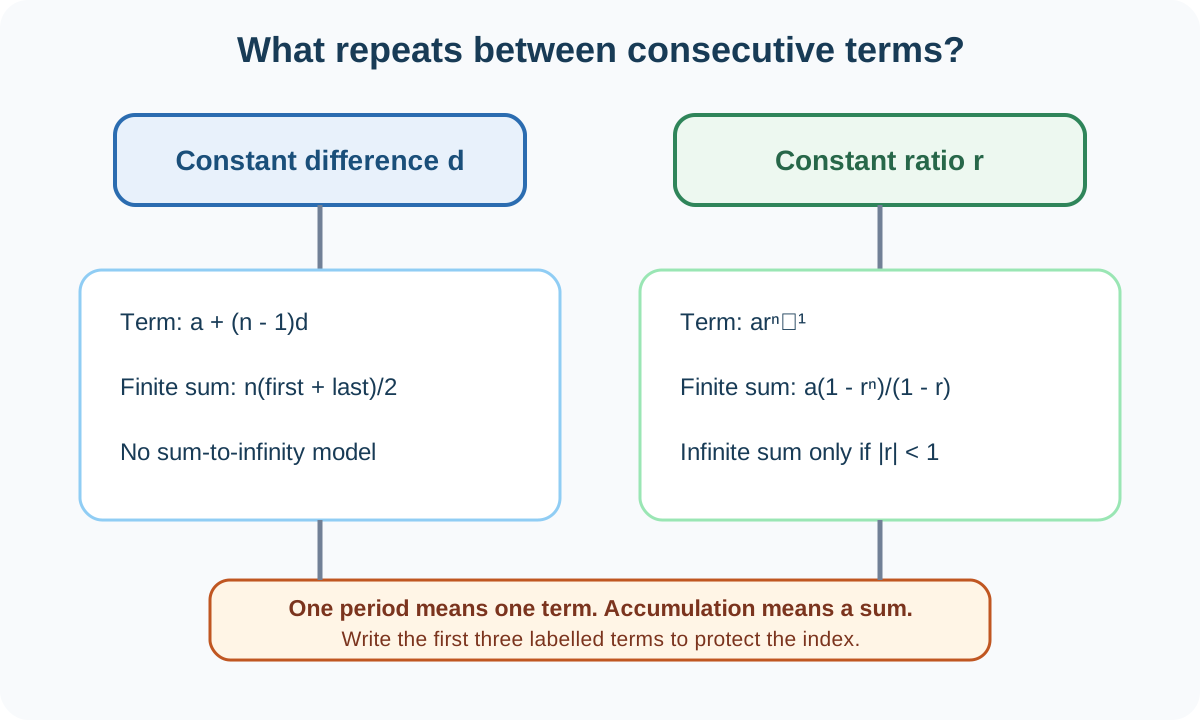
1. Sequence notation and indexing
Write the terms before selecting a formula. If the first listed term is u₁, then the term number starts at 1. Some contexts naturally begin at u₀, such as an initial population before any yearly change. Both conventions are valid, but changing convention midway causes an off-by-one error.
The notation uₙ refers to the term in position n. The notation Sₙ refers to the sum of the first n terms. Thus uₙ = Sₙ - Sₙ₋₁ for n ≥ 2. A question asking for the value during year 12 needs a term; one asking for the total received over 12 years needs a sum.
An explicit formula gives uₙ directly. A recurrence defines each term from earlier terms and needs initial data. For example, uₙ₊₁ = uₙ + 4, u₁ = 7 generates 7, 11, 15 and so on. Calculate a few terms from a recurrence to verify that its index and operation match the context.
2. Arithmetic sequences
An arithmetic sequence has a constant difference d. With first term a,
uₙ = a + (n - 1)d.
The factor is n - 1 because no difference has yet been added at the first term. If the final term l is known, use l = a + (n - 1)d to determine the number of terms. Check that the resulting n is a positive integer when it represents a position.
The sum of the first n terms is
Sₙ = n[2a + (n - 1)d]/2,
or equivalently Sₙ = n(a + l)/2. The second form says that the sum is the number of terms multiplied by the average of the first and last terms. It is useful when the endpoints are known. The first form is useful when a, d and n are known.
Arithmetic models fit constant additive change: rows that gain a fixed number of seats, a salary increasing by a fixed amount, or equally spaced measurements. A negative difference models steady decrease. Such a sequence has no finite infinite sum unless it eventually terminates; its terms do not approach zero in the required way.
Check this topic from memory
Attempt the matching topic bank before reopening the notes. Use each missed idea to decide what to review next.
Start the topic quiz