

Pearson Further Pure Mathematics 6: The Binomial Series
Pearson International GCSE Further Pure Mathematics notes on binomial expansions and coefficients.
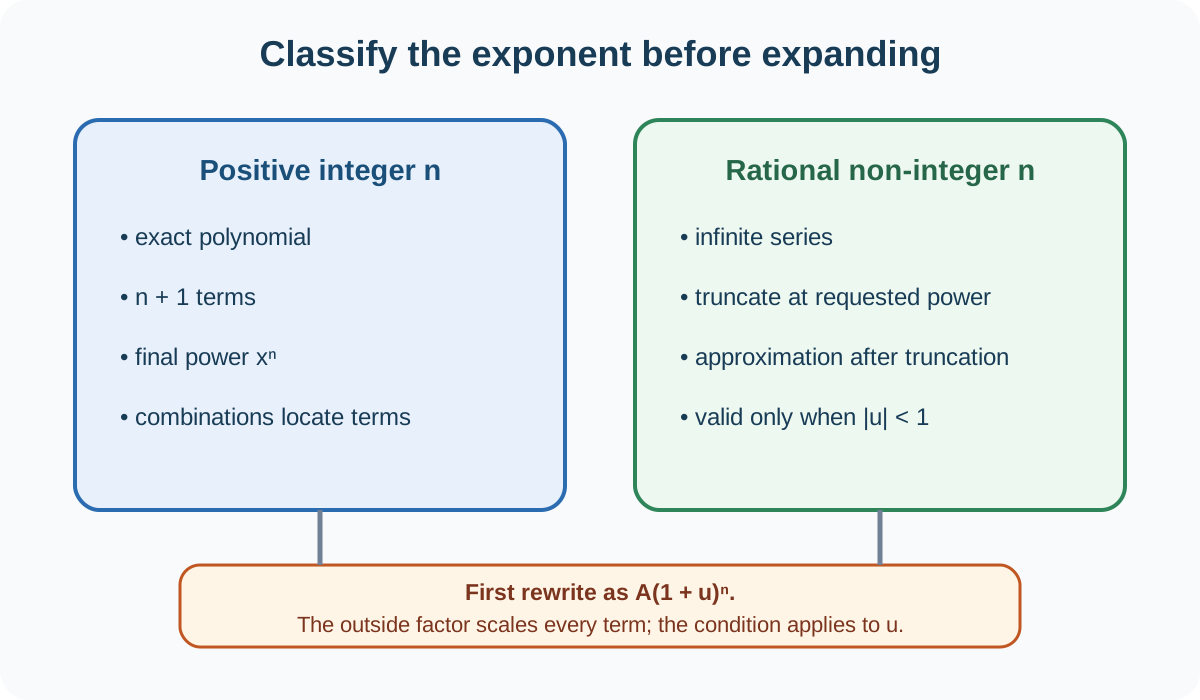
The binomial series turns a power of two terms into an ordered expansion. Pearson International GCSE Further Pure Mathematics (4PM1) requires two related cases: positive integer powers, which terminate exactly, and rational powers, which produce an infinite series valid for |x| < 1. The formula is most useful when you can generate only the required terms, track powers and signs, and state the validity condition whenever the expansion is infinite.
1. Positive integer powers
For a positive integer n,
(1 + x)ⁿ = 1 + nx + [n(n - 1)/2!]x² + [n(n - 1)(n - 2)/3!]x³ + ... + xⁿ.
The expansion terminates after n + 1 terms. Its coefficients can also be written using combinations. In the expansion of (a + b)ⁿ, the term indexed by r from zero is
Tᵣ₊₁ = C(n, r)aⁿ⁻ʳbʳ,
where C(n, r) = n!/[r!(n - r)!]. The first term corresponds to r = 0, so term position is r + 1. As r increases, the power of the first expression falls and the power of the second rises. Their exponents always sum to n.
For example, the general term of (2 - 3x)⁵ is C(5, r)2⁵⁻ʳ(-3x)ʳ. Keeping the negative sign inside the powered bracket shows that signs alternate according to whether r is even or odd. Expanding the sign separately too early is a common source of errors.
Integer binomial coefficients are symmetric: C(n, r) = C(n, n - r). This explains why coefficient rows read the same in reverse. The sum of all coefficients in (1 + x)ⁿ is found by setting x = 1, giving 2ⁿ. The alternating sum is found by setting x = -1, giving zero for positive n.
2. Finding a specified term or coefficient
The general term avoids a complete expansion. Suppose a question asks for the coefficient of xᵏ. Write the general term, combine all powers of x, set the resulting exponent equal to k, and solve for the integer index r. Only then evaluate the numerical coefficient.
If the binomial is (axᵖ + bxᑫ)ⁿ, its general term contains x to the power p(n - r) + qr. A constant term requires this exponent to equal zero. A requested term exists only if the resulting r is an integer satisfying 0 ≤ r ≤ n. State when no admissible index exists rather than forcing a fractional combination index.
In a product, more than one pairing can contribute to the same power. For example, the coefficient of
Check this topic from memory
Attempt the matching topic bank before reopening the notes. Use each missed idea to decide what to review next.
Start the topic quiz