

Pearson Further Pure Mathematics 7: Scalar and Vector Quantities
Pearson International GCSE Further Pure Mathematics notes on vectors, magnitude and geometric proofs.
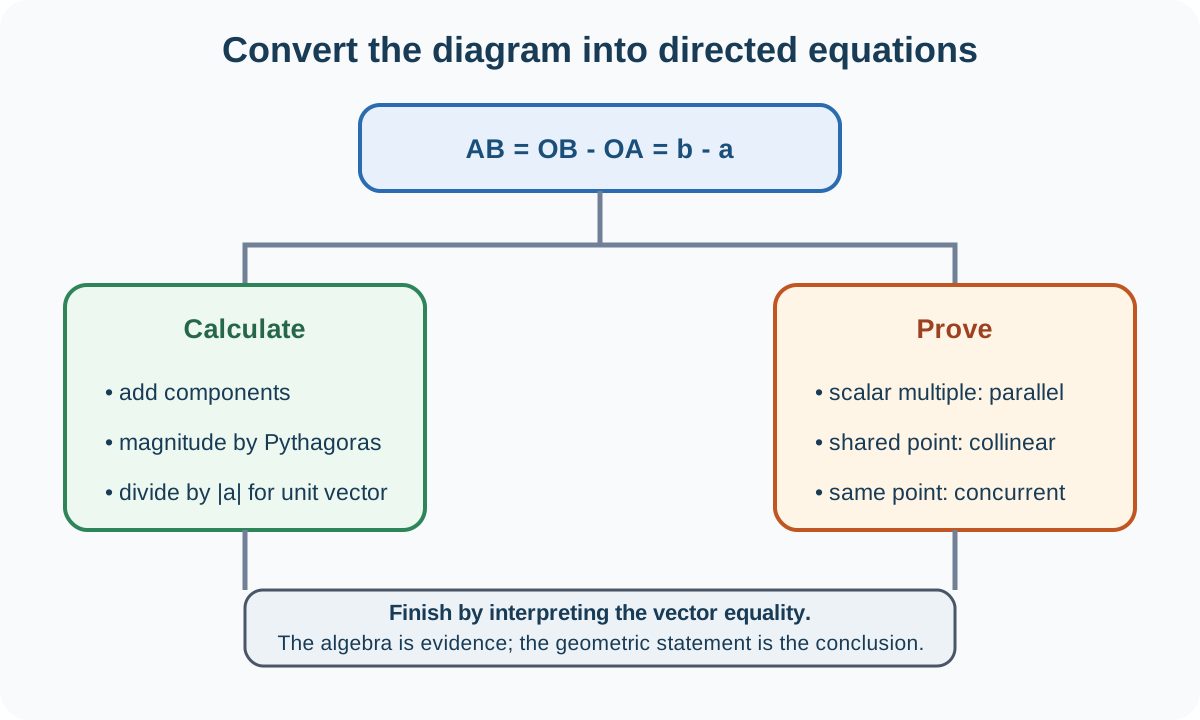
A scalar records magnitude only, while a vector records magnitude and direction. Pearson International GCSE Further Pure Mathematics (4PM1) uses coplanar vectors, components in the i and j directions, magnitudes, position vectors, unit vectors and vector proofs. The official geometric applications include collinearity, parallel lines, concurrency and internal division in a given ratio. The power of the method is that one directed equation can replace several angle or length arguments.
1. Scalars, vectors and notation
Mass, time and temperature are scalars because a number and unit describe them. Displacement and velocity are vectors because direction matters. The magnitude of vector a is written |a|; it is a non-negative scalar and is not interchangeable with the vector itself.
A directed segment from A to B is vector AB. Reversing its direction changes its sign: BA = -AB. Vectors are equal when they have the same magnitude and direction, even if drawn in different positions. This freedom allows a vector to be translated parallel to itself during geometric reasoning.
The zero vector has magnitude zero and no unique direction. Be cautious when using scalar multiples for parallelism: two non-zero vectors are parallel if one is a scalar multiple of the other. The zero vector is not evidence for the direction of a line.
2. Addition, subtraction and scalar multiplication
Vector addition follows the triangle rule. Travelling by a and then b has resultant a + b. In a parallelogram, the diagonal from the shared starting point represents the same sum. Addition is commutative and associative, so the order of free-vector addition does not change the resultant.
Subtraction means adding the opposite: a - b = a + (-b). On a diagram, use a route between named points. For any points A, B and C, AB + BC = AC. This path identity protects direction signs better than relying on a visual guess.
Multiplying a by scalar k changes its magnitude by factor |k|. If k is negative, direction reverses. Parallel vectors have the form b = ka for some scalar k, provided the relevant vectors are non-zero. If 0 < k < 1, b points the same way but is shorter.
If a
Check this topic from memory
Attempt the matching topic bank before reopening the notes. Use each missed idea to decide what to review next.
Start the topic quiz