

Pearson Further Pure Mathematics 8: Rectangular Cartesian Coordinates
Pearson International GCSE Further Pure Mathematics notes on coordinate geometry, ratios and straight lines.
Rectangular Cartesian coordinates translate geometric conditions into algebra. Pearson International GCSE Further Pure Mathematics (4PM1) specifies distance, internal division in a given ratio, gradient, equations of straight lines, and conditions for parallel or perpendicular lines. This chapter follows that official boundary. Circle equations, which appeared in the earlier scaffold, are not listed in this 4PM1 topic and are therefore not presented as required content here.
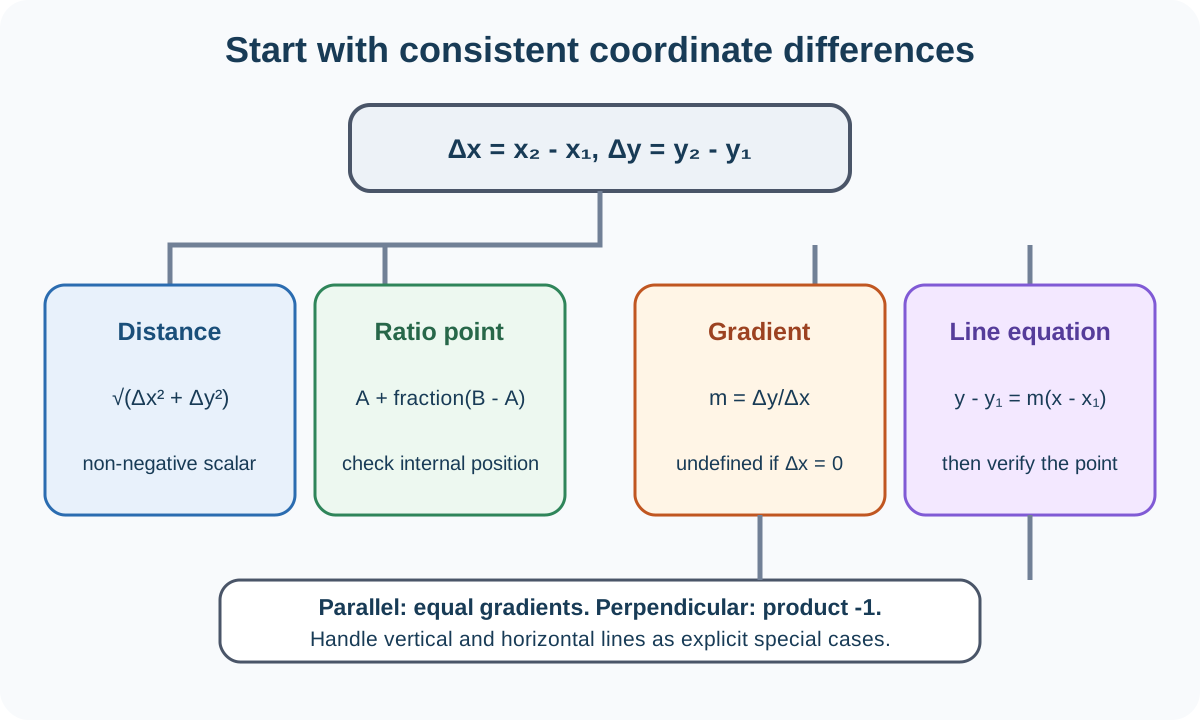
1. Coordinates and displacement
A point (x, y) records horizontal and vertical position relative to perpendicular axes. From A(x₁, y₁) to B(x₂, y₂), the horizontal change is x₂ - x₁ and the vertical change is y₂ - y₁. Keeping the same endpoint-minus-start order in both components prevents sign inconsistencies.
Swapping the points reverses both changes, but quantities such as distance and gradient remain unchanged: squaring removes both signs in distance, while the two negative signs cancel in the gradient ratio. This provides a useful check. If only one difference reverses, the calculation has mixed directions.
A coordinate diagram should support algebra, not replace it. Mark approximate point positions, but calculate exact differences from the given coordinates. A sketch can expose an impossible sign, such as reporting a positive gradient for a line that falls from left to right.
2. Distance between two points
The horizontal and vertical changes form perpendicular sides of a right triangle. Pythagoras gives
AB² = (x₂ - x₁)² + (y₂ - y₁)²,
so
AB = √[(x₂ - x₁)² + (y₂ - y₁)²].
Distance is non-negative. Preserve an exact square root when possible, especially if it will be compared with another length. To prove a triangle is isosceles, compare squared distances and avoid unnecessary roots. To prove it is right-angled, show that the square of the longest side equals the sum of the other two squared lengths.
Distance is a scalar, whereas the ordered pair of coordinate changes is directed. Do not add distances as though they contain direction. If a context asks for total path length through several points, calculate each segment length before adding.
3. Dividing a line in a ratio
If P divides the segment joining A(x₁, y₁) and B(x₂, y₂) internally in the ratio AP : PB = m : n, then
P = ([nx₁ + mx₂]/[m + n], [ny₁ + my₂]/[m + n]).
The coefficient on each endpoint uses the opposite segment's ratio number. This makes geometric sense: if m is large,
Check this topic from memory
Attempt the matching topic bank before reopening the notes. Use each missed idea to decide what to review next.
Start the topic quiz