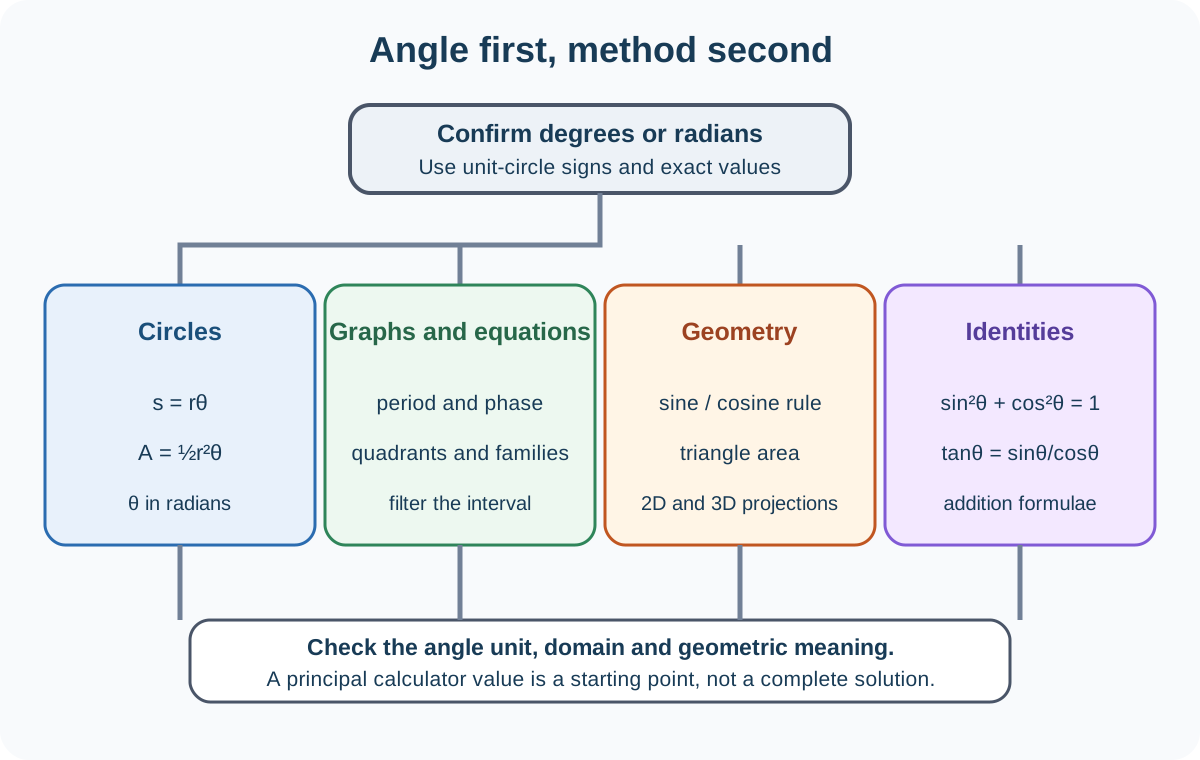
Trigonometry connects angle, ratio, circular motion, geometry and periodic functions. Pearson International GCSE Further Pure Mathematics (4PM1) requires radians, arc length and sector area; sine, cosine and tangent for angles of any magnitude; exact values and graphs; two- and three-dimensional applications; sine and cosine formulae; core identities and addition formulae; and complete solutions of simple trigonometric equations on stated intervals. The goal is not a single calculator angle but a complete, unit-consistent argument.
Radians measure an angle as arc length divided by radius. This definition gives the circle formulas
s = rθ and A = (1/2)r²θ,
where θ must be in radians. Here s is arc length and A is sector area. If an angle is supplied in degrees, convert it before using these forms. For a major sector, ensure the selected angle matches the requested arc rather than automatically using the smaller central angle.
Radians carry no physical dimension, but stating “radians” clarifies angle mode. Calculator settings must match the question. A numerically plausible answer can still be wrong if degrees were entered in radian mode.
2. Ratios for angles of any magnitude
On the unit circle, a point at angle θ has coordinates (cos θ, sin θ). Therefore cosine is the horizontal coordinate and sine the vertical coordinate. Tangent is sin θ/cos θ where cosine is non-zero. Signs follow the quadrant:
quadrant I: all three positive;
quadrant II: sine positive;
quadrant III: tangent positive;
quadrant IV: cosine positive.
Reference angles connect related values. For example, sin 120° = sin 60° = √3/2, while cos 120° = -cos 60° = -1/2. Determine the reference angle, then apply the sign from the actual quadrant.
Exact values for 30°, 45° and 60°, and their radian equivalents, should be known. They can be derived from an equilateral triangle split in half and an isosceles right triangle. Preserve exact surds and fractions unless a decimal is requested.
Angles outside one turn are reduced using periodicity. Sine and cosine repeat every 360° or 2π. Tangent repeats every 180° or π. Negative angles travel clockwise and can also be related using
Check this topic from memory
Attempt the matching topic bank before reopening the notes. Use each missed idea to decide what to review next.
The graph of y = sin x has amplitude 1, period 2π, passes through the origin and ranges from -1 to 1. The graph of y = cos x has the same amplitude and period but begins at 1 when x = 0. The graph of y = tan x has period π, zeros at integer multiples of π, and vertical asymptotes where cos x = 0.
For y = A sin(Bx + C) + D or the cosine equivalent, |A| is amplitude, 2π/|B| is period in radians, and D shifts the midline. Rewrite Bx + C as B(x + C/B) to identify horizontal translation. A negative A reflects in the horizontal axis.
For tangent, there is no amplitude because its range is unbounded. Its period is π/|B|, and its asymptotes must be transformed along with the curve. A sketch should label zeros, maxima or minima where applicable, asymptotes and enough of the interval to show periodic behavior.
4. Identities and addition formulae
The central identities are
sin² θ + cos² θ = 1 and tan θ = sin θ/cos θ.
Rearrangements such as 1 - sin² θ = cos² θ allow an expression to be written in one function. When square roots are introduced, the sign depends on the angle's quadrant; cos θ is not always the positive square root of 1 - sin² θ.
The addition formulae include
sin(A + B) = sin A cos B + cos A sin B,
cos(A + B) = cos A cos B - sin A sin B,
and the corresponding tangent formula. Difference formulas follow by replacing B with -B. These formulas can derive exact non-standard angles, simplify expressions and solve equations. Pearson supplies the formulas and does not require formal proofs, but careful substitution and signs remain essential.
Double-angle relationships follow by setting A = B. For example, sin 2A = 2 sin A cos A. Use only transformations justified by an identity. Checking a proposed identity at one numerical angle may detect an error but does not prove it.
5. Non-right-angled triangles
For sides a, b, c opposite angles A, B, C, the sine formula is
a/sin A = b/sin B = c/sin C.
Use it when a known side-angle opposite pair is available. Finding an angle from its sine can create the ambiguous case because sin θ = sin(180° - θ). Test both candidates against the triangle's angle sum and side ordering.
The cosine formula is
c² = a² + b² - 2ab cos C.
Use it for three sides or for two sides and the included angle. Rearrange carefully when finding an angle and verify that the longest side faces the largest angle.
The area formula is
Area = (1/2)ab sin C,
where C is the included angle between sides a and b. An exterior or non-included angle must first be related to the required included angle.
6. Two- and three-dimensional problems
In a three-dimensional solid, isolate a right triangle containing the requested line or angle. A line's angle with a plane is the angle between the line and its orthogonal projection onto that plane. It is not generally the angle between the line and any convenient edge in the plane.
The angle between two planes is measured in a cross-section perpendicular to their line of intersection. Construct one line in each plane perpendicular to the common intersection; the angle between those lines is the dihedral angle. Label right angles and explain why the chosen cross-section represents the requested angle.
Often a 3D problem needs two stages: calculate a face diagonal using Pythagoras, then use that result in a second triangle. Preserve exact values between stages to avoid accumulated rounding. A scale sketch helps identify the triangle but does not establish perpendicularity without geometric justification.
7. Solving trigonometric equations
Use a systematic process:
simplify with identities or factorisation;
isolate one trigonometric ratio where possible;
solve for the complete set of angles of the inner expression;
undo any phase shift or multiplier;
retain only values in the original interval;
substitute or inspect the graph to check completeness.
For sin u = k, use the principal reference angle and the sine-positive or sine-negative quadrants. For cosine, use its quadrants; for tangent, use period π or 180°. Generate values over the transformed interval for u, not merely one standard turn, before solving back for x.
Equations involving sin² x or cos² x can often be rewritten as a quadratic in one ratio. Factor or solve the quadratic, then handle every admissible ratio value. Never divide by sin x or cos x without separately checking when that factor equals zero, because division could discard solutions.
State endpoint conventions exactly. An interval 0 ≤ x < 2π includes zero but excludes 2π, even though they represent the same direction. Answers should use the units requested and be ordered clearly.
Worked example: transformed equation on a finite interval
Solve sin(2x - 30°) = 1/2 for 0° ≤ x < 360°. Let u = 2x - 30°. The transformed interval is -30° ≤ u < 690°. Sine equals 1/2 at u = 30° + 360°k or u = 150° + 360°k. Within the transformed interval, these give u = 30°, 150°, 390°, 510°. Now solve 2x - 30° = u, so x = (u + 30°)/2. Therefore x = 30°, 90°, 210°, 270°. All four values lie in the original interval. Substitution confirms that the inner angles are respectively 30°, 150°, 390° and 510°, each with sine 1/2. Working in the transformed interval prevents the two later solutions from being missed.
Common misconceptions and how to correct them
Using circle formulas with degree input. Convert to radians before applying s = rθ or A = (1/2)r²θ.
Ignoring quadrant signs for related angles. Find the reference angle, then use unit-circle coordinates to determine signs.
Rounding exact values prematurely. Keep surds and fractions through algebra and geometry calculations.
Treating tangent as having amplitude. Tangent is unbounded; describe its period, zeros and asymptotes instead.
Moving a transformed graph in the sign shown inside. Factor the inner coefficient and identify the horizontal translation carefully.
Taking only the positive square root from an identity. Determine the sign from the angle or interval.
Using the sine formula without checking the ambiguous case. Test both supplementary angles when inverse sine determines an angle.
Using a non-included angle in (1/2)ab sin C. Identify the angle physically between the selected sides.
Choosing an arbitrary edge as a projection in 3D. The projection must lie in the plane and be perpendicular from the relevant point.
Giving only the calculator's principal solution. Use quadrants and periodicity over the transformed interval.
Cancelling a trigonometric factor that could be zero. Solve the zero-factor branch separately before division.
Mixing degree and radian periods. Use 360°/180° or 2π/π consistently with the stated unit.
Assessment guidance
Write the angle unit at the start and verify calculator mode. In exact-value work, show the reference angle and quadrant sign. Graph sketches need a labelled scale, period, intercepts, extrema or asymptotes, and any transformation of the midline. In triangle problems, pair each side with its opposite angle and state why sine rule, cosine rule or the area formula applies. For 3D questions, identify the projection or perpendicular cross-section explicitly before using trigonometry. In identities, transform one side through valid equalities rather than checking examples. For equations, show the general angle families or a complete quadrant method, transform the interval when the argument is transformed, and filter endpoints only at the end. Substitute solutions to detect missed signs or extraneous values.
Retrieval practice
Convert between degrees and radians and derive the arc and sector formulas from radian measure. Reconstruct exact values and quadrant signs from the unit circle. Then state the core identities, addition formulas, sine and cosine rules, and triangle area formula. Finish by solving a transformed trigonometric equation over an interval and explaining how you proved the solution list complete.