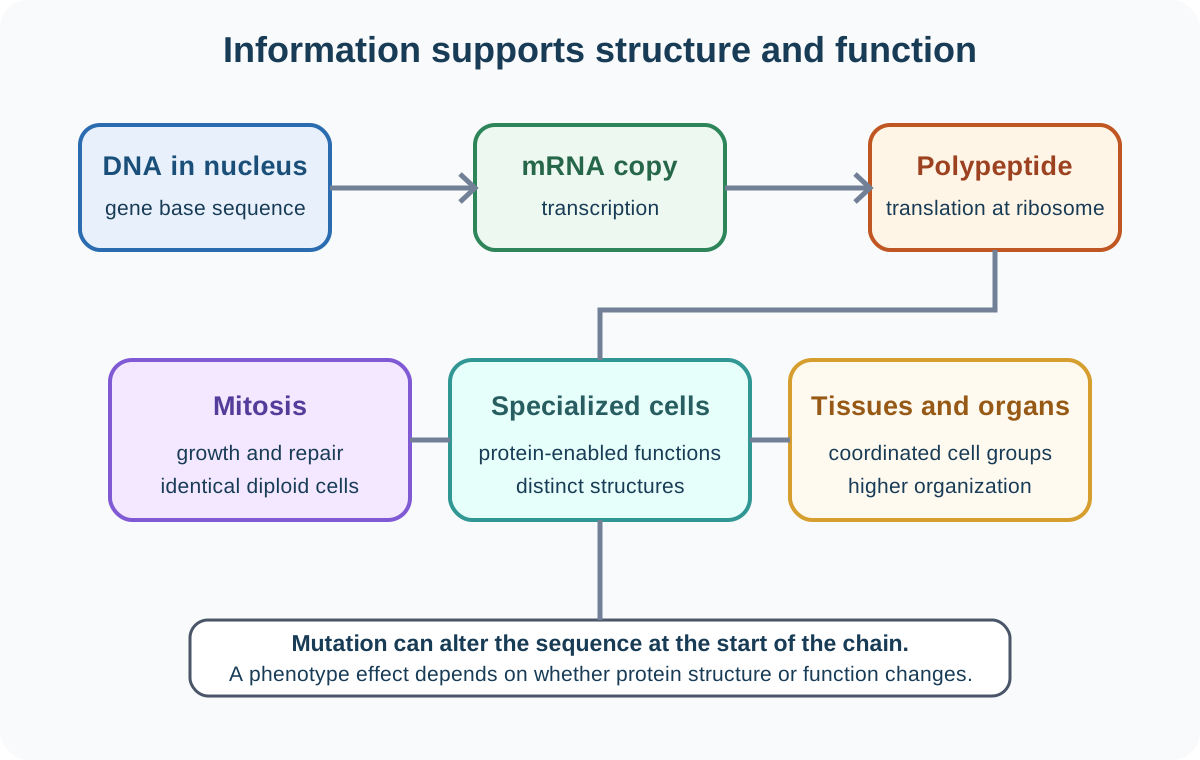
Cells are the smallest living units of the human body, but their behavior depends on molecular information and cooperation in tissues. Pearson Edexcel International GCSE Human Biology (4HB1) Topic 1 spans cell ultrastructure, DNA and RNA, replication, gene expression and mutation, genetic engineering, mitosis, stem cells, tissue organization, major tissue types and reproductive-cell adaptations. This theory chapter owns structures and mechanisms. The separate practical-skills hub owns microscope setup, specimen handling, measurement and evaluation.
1. Cell structures and recognition
The cell membrane forms a selectively permeable boundary. It controls movement between cytoplasm and surroundings and contains proteins involved in transport and cell signalling. It is not an impermeable wall.
The nucleus contains chromosomes and therefore most genetic information. A chromosome is a long DNA molecule associated with proteins. Genes occupy particular positions on chromosomes. During much of the cell cycle, individual chromosomes are not visible as separate condensed bodies.
Mitochondria are sites of aerobic respiration and ATP production. Cells with high energy demands, such as muscle cells, often contain many mitochondria. Ribosomes assemble polypeptides during translation. Ribosomes may be free in cytoplasm or associated with rough endoplasmic reticulum.
Endoplasmic reticulum is a membrane network. Rough endoplasmic reticulum, carrying ribosomes, helps synthesize and transport proteins. Smooth endoplasmic reticulum has other roles such as lipid synthesis, although the official recognition list emphasizes the organelle rather than an exhaustive subtype account.
Pearson requires recognition in light-microscope and transmission-electron-microscope images. Light microscopy reveals cells, nuclei and larger tissue patterns; TEM gives thin internal sections with much greater resolution. Image contrast and section plane affect appearance, so identify structures using position, membranes and context rather than shape alone.
2. DNA structure
DNA consists of two nucleotide strands coiled into a double helix. Each nucleotide contains a sugar, phosphate and nitrogen-containing base. The bases pair complementarily: adenine with thymine, and cytosine with guanine. Hydrogen bonds link complementary bases across the two strands.
The base sequence stores information. Complementary pairing allows one strand to specify the other, which is essential in replication and transcription. Do not describe hydrogen bonds as joining neighboring nucleotides along one strand; the sugar-phosphate backbone has different covalent bonds.
A gene is a length of DNA whose base sequence codes for a specific protein. Within the 4HB1 boundary, three bases code for one amino acid, and base order determines amino-acid order. The complete relationship also depends on gene expression and protein folding, but avoid importing unnecessary advanced regulation into a response asking for the specified coding principle.
Check this topic from memory
Attempt the matching topic bank before reopening the notes. Use each missed idea to decide what to review next.
Before mitosis, DNA replicates. The two strands separate as hydrogen bonds between complementary bases are broken. Each original strand acts as a template. Free nucleotides align by complementary base pairing, and DNA polymerase helps form the new strands.
Each resulting DNA molecule contains one original strand and one newly synthesized strand. This semi-conservative outcome preserves sequence information when pairing is accurate. Replication is not the same as mitosis: replication copies DNA during interphase, while mitosis later separates replicated chromosomes into nuclei.
Errors can occur during copying. Repair mechanisms correct many, but a persistent sequence change is a mutation.
4. RNA and protein synthesis
RNA is a second nucleic acid. It is generally single stranded, contains ribose rather than deoxyribose, and uses uracil instead of thymine. Messenger RNA carries a copy of genetic information from DNA in the nucleus to ribosomes.
During transcription, one DNA strand acts as a template for complementary mRNA formation in the nucleus. The mRNA leaves the nucleus and associates with a ribosome. During translation, the ribosome reads mRNA codons. Transfer RNA molecules bring particular amino acids through complementary anticodon-codon matching. The amino acids join into a polypeptide chain.
Transcription produces RNA; translation produces a polypeptide. DNA remains in the nucleus in this simplified account. A protein may require folding or modification after the polypeptide is built, but the specified sequence is nucleus transcription, mRNA transfer, ribosomal translation and polypeptide formation.
5. Mutation and phenotype
A DNA mutation changes the base sequence. It may change an mRNA codon, which may change an amino acid and therefore protein structure or function. This can influence phenotype. However, not every mutation changes phenotype: a changed codon may specify the same amino acid, occur outside the relevant coding sequence, or have little effect on protein function.
Avoid stating that mutation is always harmful. Effects can be harmful, neutral or occasionally beneficial depending on gene, environment and context. A mutation in a body cell affects that cell lineage, while inheritance requires a relevant mutation to be present in gamete-forming lineage.
6. Genetic engineering
Genetic engineering deliberately changes genetic material to give an organism a useful characteristic. Human insulin production uses genetically modified bacteria carrying the human insulin gene. Cultured bacteria express the gene, and the product is harvested and purified.
Genetically modified plants may produce vaccine antigens, such as examples related to hepatitis B, or improve nutritional health. Golden Rice is engineered to provide a precursor used to make vitamin A, addressing deficiency risk where rice is a major food.
Benefits include scalable production and targeted traits. Limitations and debates include access, cost, gene flow, ecological effects, regulation and public acceptance. Distinguish scientific evidence about risk from ethical or socioeconomic judgments.
7. Mitosis and the cell cycle
Mitosis supports growth, repair, cloning and asexual reproduction. Following DNA replication, it divides one nucleus so daughter cells receive genetically identical chromosome sets, barring mutation. Cytokinesis divides the cell afterward.
The four named stages are:
Prophase: chromosomes condense and become visible; nuclear organization changes.
Metaphase: chromosomes align at the cell equator.
Anaphase: sister chromatids separate and move to opposite poles.
Telophase: chromosome sets reach the poles and new nuclei form.
The outcome is two genetically identical diploid daughter cells. Mitosis does not halve chromosome number and does not directly create gametes. Cell-cycle control matters because uncontrolled division can contribute to tumour formation.
8. Stem cells and ethics
Stem cells can self-renew and develop into other body-cell types. Embryonic stem cells can form a wider range of cell types than most adult stem cells. Adult stem cells, such as blood-forming stem cells in bone marrow, are more restricted but already have established treatments.
Potential benefits include replacing damaged cells, studying development and testing treatments. Risks include immune rejection, uncontrolled growth, infection or uncertain long-term behavior. Embryonic research raises ethical questions about embryo status and consent. Adult-cell approaches may raise fewer embryo-related concerns but can be harder to obtain and less versatile.
An evaluation should separate evidence, uncertainty and values. It should compare realistic alternatives rather than asserting that one source is simply “better”.
9. From cells to tissues and organs
Specialized cells with related functions form tissues. Several tissues combine in an organ, and organs cooperate in organ systems. Organization creates division of labor, but each level depends on transport and communication with others.
Bone is a living connective tissue with cells embedded in a mineralized matrix, providing support, protection and mineral storage. Voluntary skeletal muscle has long striated fibres under conscious control. Involuntary smooth muscle lacks visible striations and controls internal tubes. Cardiac muscle is striated, branched and contracts rhythmically in the heart.
Blood is a fluid connective tissue containing red cells, white cells and platelets in plasma. Nervous tissue contains neurons specialized for rapid communication and supporting cells. Squamous epithelium forms thin surfaces, such as cheek lining cells in simple observations. Ciliated epithelium lines parts of the respiratory tract; cilia move mucus and trapped particles.
When interpreting a micrograph, link structure to function but do not claim features invisible at that resolution.
10. Specialized reproductive cells
A sperm cell is small and motile. Its flagellum drives movement, mitochondria supply ATP, the haploid nucleus carries paternal chromosomes, and the acrosome contains substances helping penetration of egg coverings.
An ovum is large and non-motile, with a haploid nucleus, nutrient-containing cytoplasm and cell-surface features involved in fertilisation. After one sperm fuses, changes help prevent entry by additional sperm.
Both are gametes and therefore haploid, but their contrasting structures reflect different roles. Avoid saying the ovum is “passive”; its membrane, cytoplasm and molecular interactions are essential to fertilisation and early development.
Worked example: mutation to phenotype reasoning
A base substitution changes one codon in a gene for a membrane transport protein. Explain why the change might alter cell function but might also have no observable effect. If transcription copies the altered DNA sequence, the mRNA codon may change. During translation, a different tRNA may deliver a different amino acid, altering the polypeptide's primary structure. Folding or the transport site could then change, reducing movement across the membrane and affecting cell phenotype. However, the genetic code has redundancy, so the new codon might specify the same amino acid. Even an amino-acid substitution may occur away from a functional region and leave folding sufficiently intact. The mutation-to-phenotype chain is therefore possible, not automatic, and evidence about protein activity is needed.
Common misconceptions and how to correct them
Calling the cell membrane an impermeable wall. It is selectively permeable and contains transport and signalling proteins.
Saying chromosomes are separate visible rods at all times. They condense visibly during division but are less distinct during interphase.
Placing respiration in ribosomes. Mitochondria support aerobic ATP production; ribosomes synthesize polypeptides.
Saying hydrogen bonds form the sugar-phosphate backbone. They link complementary bases between strands.
Confusing replication with transcription. Replication copies DNA; transcription produces RNA from a DNA template.
Saying DNA leaves the nucleus for translation. mRNA carries the copied information to ribosomes.
Treating every mutation as a phenotype change. Redundancy and protein tolerance can make a mutation silent or neutral.
Claiming genetic engineering transfers a whole human chromosome to bacteria. A selected gene is inserted into a suitable vector and host.
Placing DNA replication inside mitosis. Replication precedes mitosis during interphase.
Saying mitosis produces haploid gametes. It produces genetically identical diploid daughter cells in this human-body context.
Treating all stem cells as equally potent. Embryonic and adult stem cells differ in developmental range and practical constraints.
Describing tissue as one large cell. A tissue is an organized group of cells and extracellular material with related function.
Calling all muscle voluntary. Smooth and cardiac muscle are involuntary.
Saying cilia make mucus. Goblet cells secrete mucus; cilia move it.
Assessment guidance
Use the precise biological scale requested: organelle, cell, tissue or organ. In image questions, identify only features supported by resolution and section context. Mechanism answers should use ordered causal links, especially for replication, protein synthesis and mutation. Distinguish DNA, gene, chromosome, codon, amino acid and protein rather than substituting the terms. Mitosis responses need stage order and the diploid, genetically identical outcome. Evaluations of genetic engineering or stem cells should balance benefits, risks, uncertainties and ethical considerations without presenting values as experimental facts. When structure-function marks are available, name the feature, state what it enables and connect it to the cell or tissue role.
Retrieval practice
Draw and label the required cell structures, then compare what light microscopy and TEM can support. Reconstruct DNA replication and the transcription-translation sequence, explain two possible mutation outcomes, order the four mitosis stages, compare embryonic and adult stem cells, and link the structures of five tissue types plus sperm and ovum to their functions.