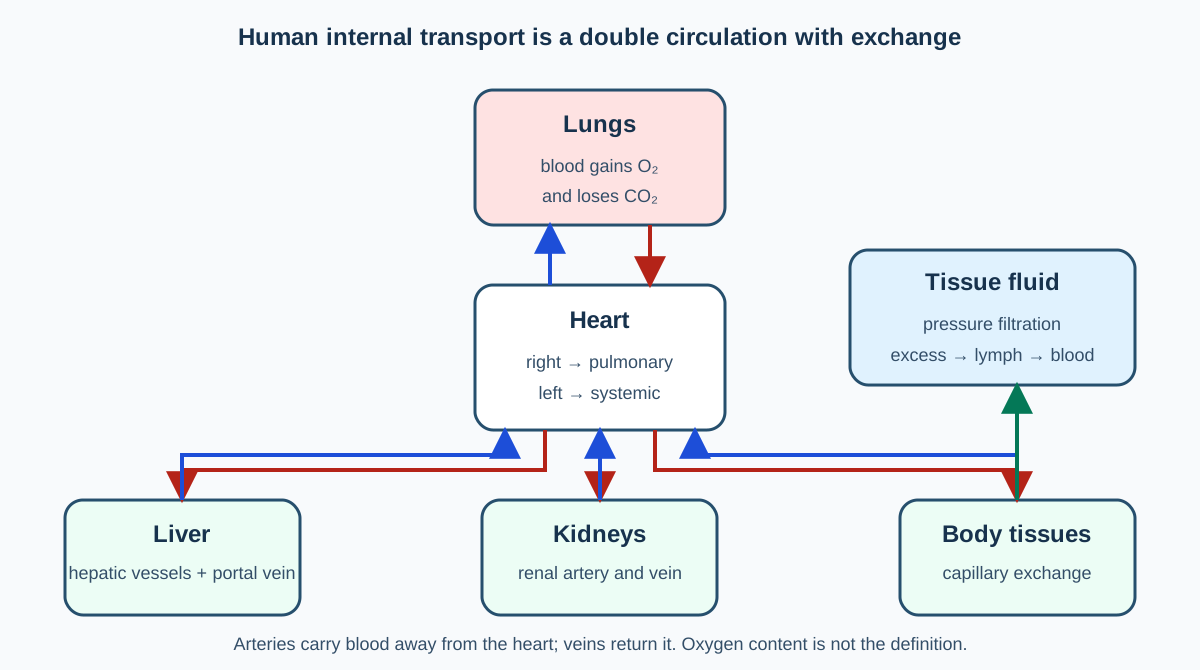
Internal transport supplies cells, removes wastes, distributes heat and hormones, and supports defence. Pearson Edexcel International GCSE Human Biology (4HB1) Topic 9 links blood, tissue fluid and vessels with the double circulation, heart disease, blood-pressure control and monoclonal antibodies. The unifying habit is to trace material or pressure through a named route and relate structure to function.
1. Blood and plasma
Blood contains plasma, erythrocytes, white blood cells and platelets. Plasma is the liquid transport medium. It carries dissolved digested food such as glucose and amino acids, urea from the liver toward the kidneys, hormones from glands to target tissues, and much of the carbon dioxide from respiring cells. It also distributes heat energy.
Erythrocytes carry oxygen. Phagocytes engulf pathogens and debris, while lymphocytes recognize antigens and produce specific antibodies. Platelets are cell fragments that participate in clotting. These components work together rather than representing four independent transport systems.
2. Tissue fluid and lymph
At the arterial end of a capillary bed, blood hydrostatic pressure forces water and small dissolved substances through capillary walls. Cells and most plasma proteins remain in blood because they are too large to pass readily. The filtered liquid is tissue fluid, which bathes cells and provides a short exchange path for oxygen, glucose, carbon dioxide and other substances.
Farther along the capillary, hydrostatic pressure has fallen. Much fluid returns to blood, assisted by the osmotic effect of retained plasma proteins. Excess tissue fluid enters blind-ended lymph vessels. Lymph passes through the lymphatic system and eventually rejoins the bloodstream.
Tissue fluid is not identical to plasma because it contains far less protein, and it is not the same as lymph until it enters lymphatic vessels.
3. Erythrocytes and oxygen transport
Erythrocytes contain haemoglobin, which binds oxygen reversibly in the lungs and releases it in tissues. Their biconcave shape creates a large surface-area-to-volume ratio and a thin centre for rapid diffusion. Mature human erythrocytes lack a nucleus and most organelles, leaving more space for haemoglobin. Their flexible membrane allows passage through narrow capillaries.
They do not use the transported oxygen aerobically because they lack mitochondria. This preserves oxygen for other tissues.
4. ABO blood groups
ABO group depends on A and B antigens on erythrocyte surfaces and antibodies in plasma. Group A has A antigen and anti-B antibodies; B has B antigen and anti-A; AB has both antigens and neither antibody; O has neither antigen and both antibodies.
Check this topic from memory
Attempt the matching topic bank before reopening the notes. Use each missed idea to decide what to review next.
If incompatible red cells are transfused, recipient antibodies can bind donor antigens, causing agglutination and haemolysis. Therefore blood is typed and cross-matched. The simple ABO table is not the whole clinical decision because other antigen systems, including rhesus, also matter.
For red-cell transfusion, group O cells lack A and B antigens, while group AB recipients lack anti-A and anti-B antibodies. Do not turn this into an unrestricted “universal” rule without considering other antigens and matching.
5. Defence and clotting
Phagocytes surround and digest pathogens through phagocytosis. Lymphocytes recognize specific antigens and produce specific antibodies. Antibody binding can neutralize a target or mark it for destruction. Specificity arises from complementary binding sites, not because one antibody attacks every pathogen.
When a vessel is damaged, platelets adhere and release signals that promote clotting. An enzyme-controlled cascade converts soluble fibrinogen into insoluble fibrin. Fibrin forms a mesh that traps blood cells and strengthens the plug, limiting blood loss and entry of pathogens. Pearson does not require names of other intermediates or clotting enzymes.
6. Arteries, veins and capillaries
Arteries carry blood away from the heart at relatively high pressure. They have thick walls containing muscle and elastic tissue, a relatively small lumen and no valves along most of their length. Elastic recoil helps maintain pressure between beats and produces the pulse.
Veins return blood at lower pressure. They have thinner walls, larger lumens and valves that prevent backflow. Skeletal-muscle contraction can compress veins and assist return.
Capillaries have a lumen about one erythrocyte wide and walls one cell thick, providing a short diffusion distance. Extensive branching gives a large exchange area and reduces flow speed across the network.
Vessel identity depends on direction relative to the heart, not oxygen content. The pulmonary artery is deoxygenated and pulmonary vein oxygenated.
7. Double circulation and major organs
The right side of the heart pumps deoxygenated blood through the pulmonary artery to lungs. Oxygenated blood returns through pulmonary veins to the left side. The left ventricle pumps it through the aorta to the body, and venae cavae return it to the right atrium.
The hepatic artery supplies oxygenated blood to the liver. The hepatic portal vein carries absorbed nutrients from the intestine to the liver, and the hepatic vein drains the liver toward the vena cava. Renal arteries supply kidneys and renal veins return blood after regulation and waste removal.
The pulmonary and systemic circuits operate in series. Separate pressures protect delicate lung capillaries while supporting forceful systemic delivery.
8. Heart structure and the cardiac cycle
The atria receive blood and ventricles eject it. The left ventricle has the thickest wall because it generates pressure for the systemic circuit. The septum separates oxygenated and deoxygenated sides. Atrioventricular valves prevent ventricular backflow into atria; semilunar valves prevent arterial backflow into ventricles. Tendinous cords stop atrioventricular valves inverting.
During atrial systole, atria contract and complete ventricular filling. During ventricular systole, ventricular pressure rises, atrioventricular valves close and blood is ejected once pressure opens semilunar valves. During diastole, chambers relax and refill. Valves open or close because of pressure differences, not because they actively contract.
Coronary arteries supply the cardiac muscle itself. Blockage deprives myocardium of oxygen and can cause a heart attack.
9. Coronary heart disease and treatment
Coronary heart disease develops when atherosclerotic plaques narrow coronary arteries. A plaque can rupture and promote a clot, sharply reducing oxygen delivery to heart muscle. Risk is influenced by smoking, high blood pressure, adverse blood-lipid patterns, diabetes, inactivity, diet, age and inherited factors.
Prevention includes avoiding smoking, regular activity, a balanced diet, healthy body mass and management of blood pressure, diabetes and lipids. These reduce risk but cannot guarantee prevention.
A stent is a mesh tube used to hold a narrowed artery open, improving flow. Statins reduce liver production of LDL cholesterol and lower cardiovascular risk. Plant stanol esters reduce intestinal cholesterol absorption and may modestly lower LDL as part of an appropriate diet. Beta blockers block adrenaline-related effects, slowing the heart and reducing workload; they can be used for conditions including angina and some forms of heart failure.
An artificial heart or mechanical support device can maintain circulation as a bridge to transplant or, in selected cases, longer-term support. A donor heart can restore pumping in severe disease, but availability, major surgery and compatibility constrain its use.
10. Heart-transplant problems
The recipient immune system recognizes donor antigens as foreign and may reject the heart. Tissue matching and immunosuppressive medicines reduce this risk, but rejection can still occur. Suppressing immunity raises infection risk and can produce other adverse effects. Patients need lifelong monitoring and medicine adherence.
Other problems include limited donor supply, surgical complications, clotting, infection and gradual disease of transplanted vessels. Ethical allocation must balance urgency, likely benefit and fairness. A transplant can greatly improve life but is not a simple cure.
11. Blood pressure and hypertension
Systolic pressure is the peak arterial pressure during ventricular contraction. Diastolic pressure is the lower pressure during ventricular relaxation. A reading is written systolic over diastolic in millimetres of mercury.
Hypertension is persistently elevated arterial pressure, usually confirmed using repeated suitable measurements. It often causes no symptoms but increases damage to arteries, heart, brain and kidneys. Risk factors include age, family history, high-salt diet, excess body mass, inactivity, smoking, excess alcohol and chronic stress; some diseases and medicines also contribute.
Prevention and management may involve reducing salt, balanced diet, activity, weight management, avoiding smoking and limiting alcohol, plus prescribed medicine when appropriate. ACE inhibitors reduce formation of angiotensin II, decreasing vasoconstriction and aldosterone-related salt and water retention. Blood vessels relax and blood pressure falls. Treatment choice and monitoring are clinical decisions.
12. Producing monoclonal antibodies
An antigen is injected into a mouse to stimulate a specific lymphocyte clone. Antibody-producing lymphocytes are isolated, commonly from the spleen, and fused with rapidly dividing tumour cells. The resulting hybridoma cells combine antibody production with the ability to divide repeatedly. The correct hybridoma is selected, cloned and cultured. Its identical cells produce one specific antibody, which is harvested and purified.
Modern therapeutic antibodies may be engineered to reduce immune reactions in patients, but the hybridoma sequence remains the Pearson production model.
13. Detecting and treating disease
Monoclonal antibodies bind one target antigen. In detection, an antibody can carry a fluorescent marker, enzyme or other label. Binding reveals the location or quantity of a disease-associated target, as in diagnostic tests or imaging.
In cancer treatment, an antibody may bind an antigen more common on cancer cells and block a growth signal, recruit immune attack or deliver a drug or radioactive substance. Specific targeting can reduce exposure of other cells, but it is not perfect: targets may also occur on healthy cells, tumours vary, and side effects can occur.
Worked application: choosing evidence-based cardiovascular interventions
A patient has a narrowed coronary artery, high LDL cholesterol and hypertension. A stent could physically widen the narrowed segment and improve local blood flow, but it would not remove the biological tendency to develop plaques elsewhere. A statin could lower LDL production and future cardiovascular risk, while an ACE inhibitor could reduce blood pressure by reducing angiotensin-II effects. Diet, activity and smoking status remain relevant risk modifiers. These interventions address different parts of the causal chain and may be combined under clinical supervision. A transplant would not be a proportionate first response to one narrowed vessel because it involves scarce donor tissue, major surgery, rejection and lifelong immunosuppression. The best examination answer compares mechanism, benefit, limitation and appropriate scale rather than naming the most dramatic treatment.
Common misconceptions and how to correct them
Calling plasma colourless water. It contains many dissolved transport substances and proteins.
Saying tissue fluid contains normal numbers of erythrocytes. Cells and most proteins remain in blood.
Equating tissue fluid with lymph. It becomes lymph after entering lymphatic vessels.
Saying erythrocytes need a nucleus to carry oxygen. Loss of the nucleus creates haemoglobin space.
Treating group O blood as universally safe in every context. Other antigens and cross-matching matter.
Saying antibodies engulf pathogens. Phagocytes engulf; antibodies bind specific antigens.
Saying fibrin is normally dissolved in plasma. Soluble fibrinogen is converted into insoluble fibrin.
Defining an artery as oxygenated. It is defined by flow away from the heart.
Putting the thickest wall in the right ventricle. The left ventricle serves the higher-resistance systemic circuit.
Saying statins dissolve an existing clot instantly. They mainly lower LDL and future risk.
Treating stents as a cure for all atherosclerosis. They open selected narrowed regions.
Calling a transplant rejection-free after matching. Matching reduces but does not eliminate risk.
Diagnosing hypertension from one reading. Persistent elevation requires appropriate confirmation.
Saying ACE inhibitors directly destroy cholesterol. They act on a blood-pressure hormone pathway.
Calling every laboratory antibody monoclonal. Monoclonal antibodies are identical products of one clone.
Assuming targeted cancer treatment affects no healthy cells. Specificity improves targeting but is not absolute.
Assessment guidance
For blood questions, match each component to a transported substance or mechanism. Explain tissue-fluid formation through pressure, capillary permeability, protein retention and lymph drainage. Vessel comparisons should pair structure with pressure, direction or exchange. Trace circulation using named chambers, valves and vessels rather than saying “to the body”. Cardiovascular treatment answers need mechanism, intended benefit and limitation, with risk-factor language rather than guarantees. Distinguish systolic from diastolic by cardiac phase. For monoclonal antibodies, give the full antigen-lymphocyte-fusion-hybridoma-selection-cloning sequence, then explain detection or treatment through complementary antigen binding.
Retrieval practice
Draw a capillary bed showing tissue-fluid formation and lymph return. Build comparison tables for blood cells, ABO groups and three vessel types. Trace blood through heart, lungs, liver and kidneys, reconstruct one cardiac cycle, and map five cardiovascular interventions to mechanisms and limitations. Finally, reproduce hybridoma production and two distinct monoclonal-antibody applications from memory.