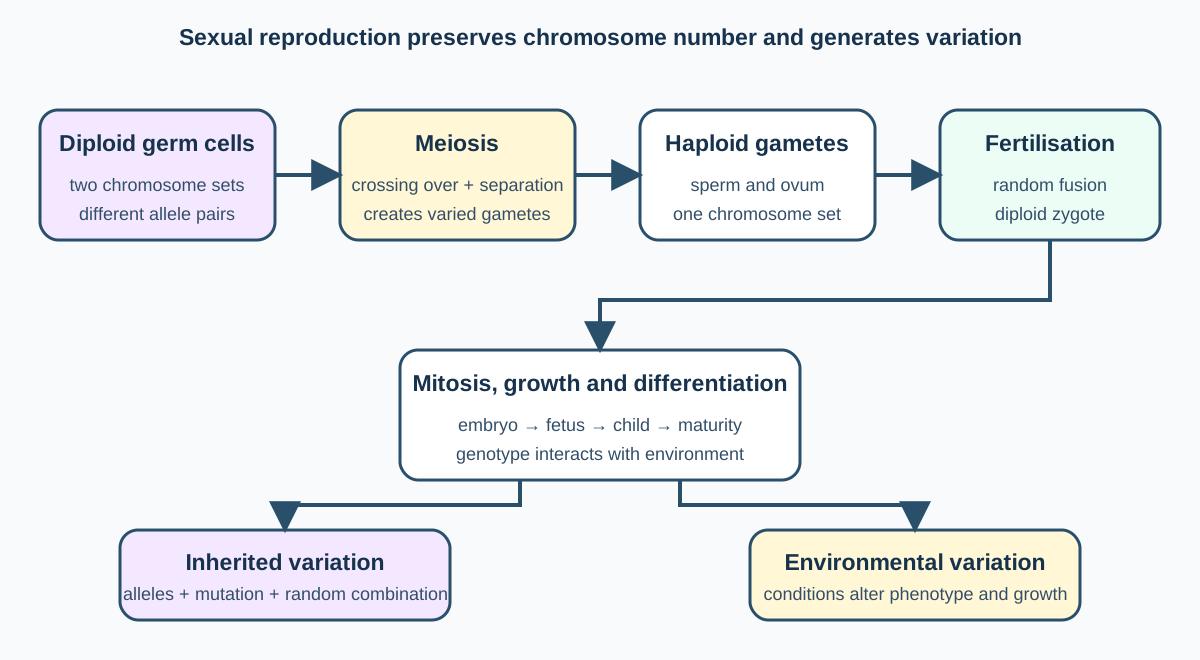
Reproduction transmits genetic information while meiosis and random fertilisation create variation. Pearson Edexcel International GCSE Human Biology (4HB1) Topic 11 connects reproductive anatomy, hormones, pregnancy, contraception and IVF with alleles, genetic diagrams, pedigrees and inherited conditions. The chapter moves from cells to families, so every explanation must keep chromosome, gene, allele, genotype and phenotype at the correct level.
1. Gametes, fertilisation and embryonic development
Fertilisation is fusion of a haploid sperm nucleus with a haploid ovum nucleus, forming a diploid zygote. The zygote divides repeatedly by mitosis. Cell number increases, cells differentiate and an embryo forms. Later growth and organ development produce a fetus.
Mitosis preserves chromosome number and produces genetically similar daughter cells, aside from mutation. Meiosis is a reduction division: one diploid germ cell ultimately produces haploid gametes. Homologous chromosomes pair, exchange sections through crossing over, and separate independently; chromatids later separate. These processes generate genetically different gametes.
At fertilisation, one sperm and one ovum combine at random. This restores diploid chromosome number and adds another source of variation.
2. Male reproductive system
Testes produce sperm and testosterone. They lie in the scrotum, which supports a temperature below core body temperature for sperm production. Sperm mature and are stored in the epididymis, then travel through sperm ducts. Seminal vesicles and the prostate add fluids that nourish and protect sperm, forming semen. The urethra carries semen through the penis during ejaculation.
Sperm production occurs in seminiferous tubules, while testosterone is made by cells between tubules. The urethra is a shared outlet for urinary and reproductive systems, but urine and semen are not normally released simultaneously.
3. Female reproductive system
Ovaries contain developing follicles, release ova and produce oestrogen and progesterone. Oviducts carry the ovum and are the usual site of fertilisation. The uterus has a muscular wall and a vascular endometrium where implantation occurs. The cervix forms the lower opening of the uterus, and the vagina receives sperm and forms the birth canal.
The ovum is released into an oviduct, not directly into the uterus. Implantation is embedding of the embryo in the uterine lining and is distinct from fertilisation.
4. Menstrual-cycle hormones
FSH from the pituitary stimulates follicle development and oestrogen secretion. Oestrogen rebuilds the endometrium. At moderate concentrations it inhibits FSH; sustained high oestrogen helps trigger an LH surge. LH causes ovulation and formation of the corpus luteum.
Check this topic from memory
Attempt the matching topic bank before reopening the notes. Use each missed idea to decide what to review next.
The corpus luteum secretes progesterone, maintaining the endometrium and inhibiting FSH and LH. If pregnancy does not occur, the corpus luteum degenerates, progesterone and oestrogen fall, and menstruation follows. If pregnancy occurs, progesterone remains high, later supported principally by the placenta, maintaining the uterine lining and reducing uterine contraction.
The cycle is a feedback network, not four hormones rising in a simple fixed sequence. Timing varies among individuals.
5. Pregnancy and birth
The placenta is an exchange organ between maternal and fetal circulations. Oxygen and nutrients pass toward the fetus; carbon dioxide and urea pass toward the mother. The two blood supplies normally remain separate, reducing direct mixing while allowing diffusion across a thin exchange barrier.
The umbilical cord contains vessels connecting fetus and placenta. Umbilical arteries carry deoxygenated blood and wastes from fetus to placenta; the umbilical vein returns oxygenated, nutrient-rich blood. Amniotic fluid cushions the fetus, allows movement and helps maintain a stable environment.
During birth, rhythmic uterine contractions dilate the cervix and push the fetus through the vagina. Positive feedback involving oxytocin strengthens contractions until delivery. The placenta is expelled afterward.
Breast milk provides suitable nutrition, water and antibodies, is hygienic and changes with infant needs. Breastfeeding supports bonding and can reduce infection risk, but individual feeding decisions can depend on medical and personal circumstances.
6. Growth and sexual development
Human growth is rapid before and just after birth, steadier during childhood, rises during the adolescent growth spurt and slows toward maturity. A growth curve plots size, such as mass or height, against age. Rate is represented by the gradient, not the height of the curve alone.
Oestrogen contributes to female secondary sexual characteristics such as breast development and wider hips. Testosterone contributes to male characteristics such as facial hair, deeper voice and increased muscle development. Both hormones occur in all sexes at different typical concentrations and have wider physiological roles.
7. Contraception
Barrier methods, including condoms, prevent sperm reaching the ovum. Condoms also reduce transmission of many sexually transmitted infections when used correctly. Hormonal methods alter ovulation, cervical mucus or endometrium and include pills, implants, injections and hormonal intrauterine systems. Copper intrauterine devices impair sperm function and fertilisation; hormonal intrauterine systems release progestogen.
Natural fertility-awareness methods identify fertile times and avoid unprotected intercourse then. They avoid medicines or devices but require careful, consistent tracking and are more affected by cycle variation and user error. Male sterilisation blocks sperm ducts; female sterilisation blocks oviducts. Both are intended to be permanent.
Advantages and disadvantages must be compared by effectiveness in typical use, reversibility, duration, side effects, need for procedures, user control, STI protection, cost and suitability. No method is best for everyone, and only barrier methods such as condoms provide meaningful STI protection.
8. IVF
In vitro fertilisation can improve pregnancy chances for some forms of infertility. Hormones stimulate maturation of several follicles. Eggs are collected and combined with sperm in a laboratory, or a sperm may be injected into an egg when clinically indicated. Resulting embryos are cultured for several days, assessed and one or more are transferred into the uterus according to clinical policy. Additional suitable embryos may be frozen.
IVF can bypass blocked oviducts and assist with several sperm or ovulation problems. Limitations include invasive procedures, hormonal side effects, cost, emotional burden, variable success and risks associated with multiple pregnancy if multiple embryos are transferred. It increases chance but never guarantees pregnancy.
9. Genetics vocabulary
A gene is a DNA sequence influencing a characteristic, often by coding for a protein. Alternative forms are alleles. A diploid cell has two chromosome sets; a haploid gamete has one.
A genotype is the allele combination, while phenotype is the observable characteristic produced by genotype and environment. Two identical alleles are homozygous; two different alleles are heterozygous. A dominant allele affects phenotype in a heterozygote; a recessive allele is expressed only when no dominant allele is present. In co-dominance, both alleles contribute distinctly to the heterozygous phenotype.
Dominant does not mean common, stronger or beneficial. Recessive does not mean an allele disappears.
10. Genetic diagrams and probability
A monohybrid cross starts with parental genotypes, identifies gamete alleles, combines them in a Punnett square and states genotype and phenotype probabilities. Each conception is an independent event; a 1 in 4 probability does not mean exactly one affected child in every four-child family.
Human sex chromosomes are typically XX in females and XY in males. Ova carry X; sperm carry X or Y. An X-bearing sperm produces XX and a Y-bearing sperm produces XY, giving approximately equal probabilities at fertilisation. The sperm determines which of these chromosome combinations forms.
Random fertilisation means any compatible sperm may fuse with the ovum. Together with meiosis, it produces genetic variation.
11. ABO multiple alleles
The ABO gene has three common alleles: Iᴬ, Iᴮ and i. Iᴬ and Iᴮ are co-dominant; both are dominant to i. Genotypes IᴬIᴬ or Iᴬi produce group A, IᴮIᴮ or Iᴮi group B, IᴬIᴮ group AB, and ii group O.
One individual carries only two alleles, even though three exist in the population. This distinction is the meaning of multiple alleles.
12. Pedigrees
A pedigree records phenotype and biological relationships across generations. Squares conventionally represent males, circles females, shaded symbols the phenotype under study, horizontal lines reproductive pairs and vertical lines descendants.
A recessive condition can appear in children of two unaffected heterozygous parents and may skip generations. A dominant condition usually has an affected parent, although mutation and incomplete records can complicate real families. Sex-linked recessive conditions often affect more males because one altered allele on their single X chromosome is expressed.
Infer only what the pedigree proves. An unaffected person may still be a carrier.
13. Inherited conditions
Haemophilia and red-green colour blindness can be inherited as X-linked recessive conditions. Males with the altered allele on their X are affected; heterozygous females are usually carriers, although biology can be more complex than the simple model.
Polydactyly in the Pearson model is caused by a dominant allele, so affected people can be heterozygous or homozygous. Cystic fibrosis is caused by recessive CFTR alleles; affected individuals inherit an altered allele from each parent. Defective chloride transport produces thick secretions that affect lungs and other organs.
The condition affects a person; avoid language that reduces someone to a genotype.
14. Viral gene therapy for cystic fibrosis
Scientists can remove harmful viral genes and insert a functional CFTR gene into a viral vector. The vector enters target airway cells and delivers the gene, allowing some cells to make functional CFTR protein and improve chloride and water movement. Delivery to enough long-lived airway cells, immune responses and repeated dosing are major challenges.
This is the mechanism Pearson requires, but the status must be stated accurately: viral-vector lung gene therapies for cystic fibrosis remain investigational and are being tested in clinical trials, not routine curative treatment. The transferred gene may not reach every target cell or persist permanently.
15. Sources of variation
Genetic variation arises through mutation, meiosis and random fertilisation. Environmental variation arises from factors such as nutrition, activity, education or exposure. Many characteristics, including height and body mass, reflect interaction between many genes and environment.
Classifying a characteristic as “both” should be supported by a mechanism: inherited potential can be modified by environmental conditions.
Worked example: recessive inheritance and independent events
Two unaffected parents are carriers for cystic fibrosis, with genotypes Ff and Ff, where f is the recessive altered allele. Each parent produces F and f gametes. A Punnett square gives FF, Ff, Ff and ff, so each pregnancy has a 1 in 4 probability of an affected ff child, a 1 in 2 probability of an unaffected carrier and a 1 in 4 probability of an unaffected non-carrier in this simplified model. If their first child is affected, the next child’s probability remains 1 in 4 because gamete production and fertilisation occur again independently. The ratio predicts outcomes across many conceptions, not an exact sequence within one family. Genetic counselling would interpret real test results and family context rather than relying only on a classroom diagram.
Common misconceptions and how to correct them
Saying fertilisation is cell division. It is fusion of haploid gamete nuclei.
Using meiosis for embryo growth. Embryonic growth uses mitosis.
Saying meiosis produces identical gametes. Crossing over and independent separation generate variation.
Putting fertilisation in the uterus. It usually occurs in an oviduct.
Confusing implantation with fertilisation. Implantation occurs after divisions of the zygote.
Saying FSH directly causes menstruation. Falling ovarian hormones permit breakdown of the endometrium.
Saying maternal and fetal blood normally mix freely. Exchange occurs across the placenta without normal direct mixing.
Reversing umbilical vessels. Arteries travel away from the fetal heart toward placenta; the vein returns.
Treating all contraceptive methods as STI protection. Condoms provide the relevant barrier protection.
Saying sterilisation is easily reversible. It is intended as permanent.
Calling IVF guaranteed. Success varies and treatment can fail at several stages.
Using dominant to mean common. Dominance describes heterozygous expression.
Confusing genotype with phenotype. Genotype is allele combination; phenotype is expressed characteristic.
Saying a person carries all three ABO alleles. A diploid individual has two.
Assuming one affected recessive child changes the next probability. Conceptions are independent.
Saying fathers pass an X-linked allele to sons. Sons receive their father’s Y in the standard XY model.
Calling every unaffected pedigree member a non-carrier. Recessive carriers are usually unaffected.
Presenting CF viral gene therapy as an established cure. It remains investigational.
Attributing all variation to genes. Environmental and combined effects are common.
Assessment guidance
Reproductive answers should use named structures and distinguish fertilisation, implantation and birth. Hormone questions need source, target or effect, timing and feedback. Contraception comparisons should pair mechanism with one realistic advantage and disadvantage, including STI protection where relevant. For genetic diagrams, define symbols, show parental genotypes and gametes, then state probability and phenotype in words. Pedigree conclusions must distinguish definite from possible genotypes. Sex-linked crosses require alleles attached to X chromosomes. Gene-therapy answers should explain vector modification, delivery, target-cell expression and limitations, while accurately labelling current clinical status.
Retrieval practice
Trace gametes through both reproductive systems, reconstruct meiosis and fertilisation, and draw the menstrual-cycle hormone network. Compare five contraceptive classes and sequence IVF. Define ten genetics terms, complete autosomal, ABO and X-linked crosses, infer a pedigree cautiously, and explain how viral CFTR delivery could alter airway-cell function while remaining investigational.