

Pearson Edexcel International GCSE Human Biology Practical Skills 2: Food tests and enzyme investigations
Pearson Edexcel International GCSE Human Biology Practical Skills 4HB1 notes on food tests and enzyme investigations.
This chapter consolidates Pearson Edexcel International GCSE Human Biology (4HB1) outcomes 2.3, 2.4, 2.5, 2.8 and 2.10: food tests, vitamin C, food energy, enzyme temperature and pH, and immobilised-enzyme action. It is a practical ownership page. The theory hub explains molecules and enzyme mechanisms; this page owns methods, measurements, controls, safety, processing and evaluation.
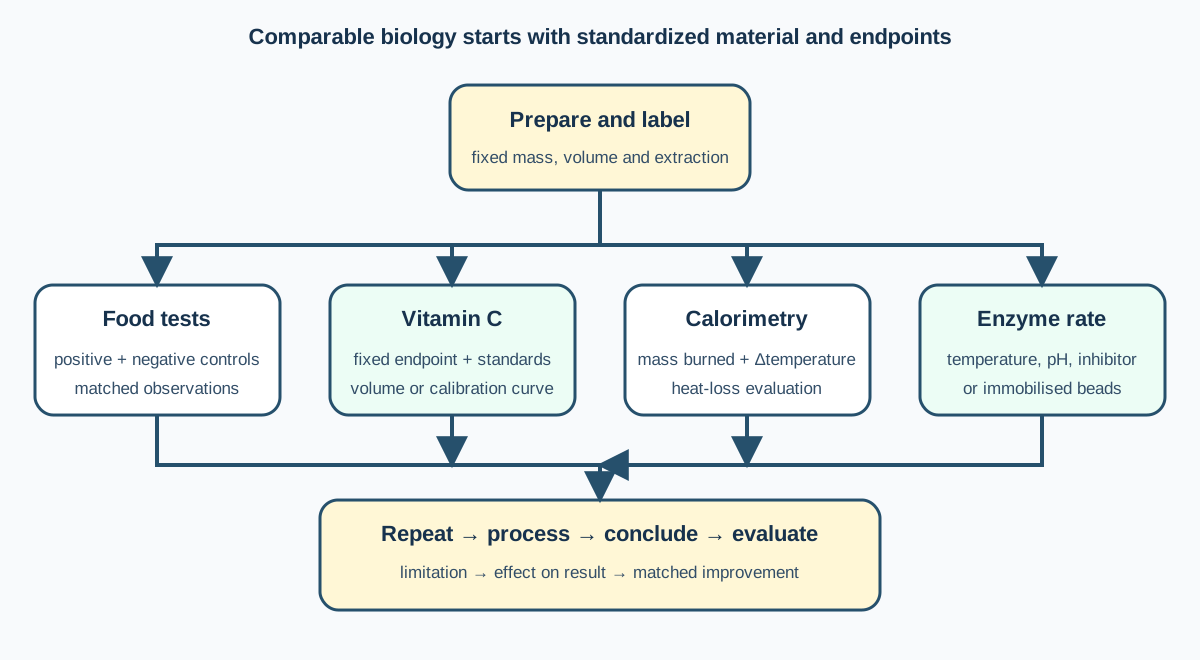
1. Preparing food samples
Use a measured mass or volume of food and a measured volume of distilled water. Grind solid material with a mortar and pestle, mix thoroughly and filter if particles would obscure colour. Label every tube and keep extraction ratios identical when comparing foods.
An unstandardized “spoonful” makes concentration comparisons invalid. A negative test can mean the nutrient is absent, below detection limit or not extracted effectively. Include a known positive control and a distilled-water negative control where practical.
Wear eye protection and treat test reagents as laboratory chemicals. Do not taste tested food. Use a water bath rather than a naked flame where flammable ethanol is present.
2. Tests for glucose, starch, protein and lipid
For reducing sugar, add Benedict’s reagent to the sample and heat in a hot water bath for a standardized time. A blue solution remaining is negative; green, yellow, orange or brick-red precipitate indicates increasing reducing-sugar response under matched conditions. Colour categories are semi-quantitative unless calibrated with standards or measured instrumentally.
For starch, add iodine solution. Orange-brown turning blue-black is positive. This test does not require heating.
For protein, add biuret reagent according to the approved laboratory method. Blue changing to lilac or purple is positive. Some protocols add sodium hydroxide and dilute copper sulfate separately; these reagents require careful handling.
For lipid, mix the sample with ethanol, then pour the ethanol extract into water. A cloudy white emulsion indicates lipid. Keep ethanol away from flames and use stoppered vessels only as directed. A grease spot is less specific and should not replace Pearson’s standard emulsion evidence when reagents are available.
3. Qualitative vitamin C using DCPIP
DCPIP is blue and is reduced to colourless by vitamin C. Place a fixed measured volume of DCPIP in a tube, then add food extract dropwise while mixing until the blue colour just disappears and remains absent for a defined time.
If less sample is required, the sample generally has a higher vitamin C concentration, provided DCPIP volume and concentration, drop size, endpoint rule and extraction ratio are controlled. Darkly coloured foods can mask the endpoint, so filtration, dilution, a colour blank or an alternative quantitative method may be needed.
Check this topic from memory
Attempt the matching topic bank before reopening the notes. Use each missed idea to decide what to review next.
Start the topic quiz