

Pearson International GCSE Mathematics A 2: Algebra
Pearson Edexcel International GCSE Mathematics A notes on expressions, equations, graphs, sequences and functions.
Algebra turns patterns and constraints into expressions, equations, graphs and general rules.
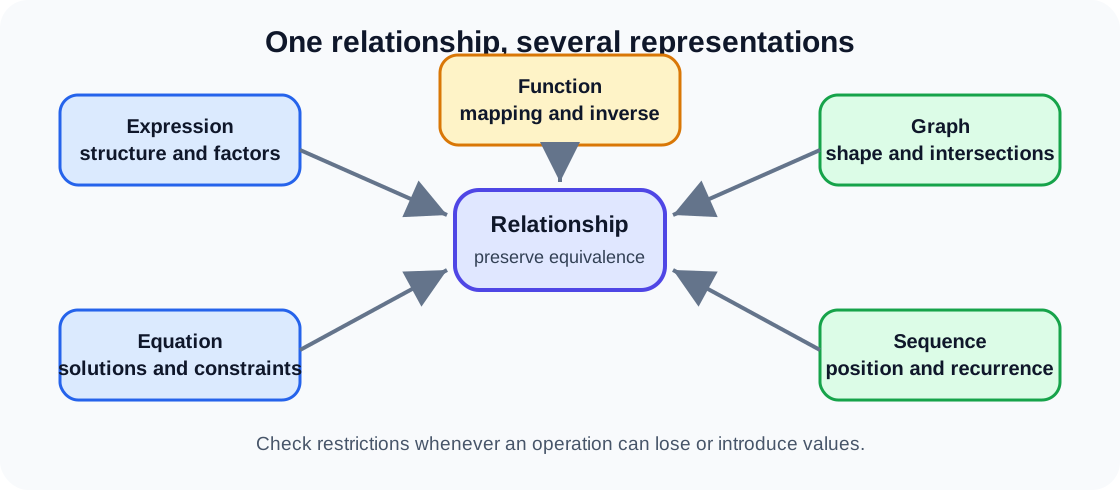
Pearson 4MA1 Algebra connects symbolic, graphical and numerical representations. The important habit is to preserve equivalence: every rearrangement, factorisation, substitution or graph interpretation must describe the same relationship under the stated domain restrictions.
Main ideas
- Simplify, expand, factorise and manipulate algebraic expressions, including indices and algebraic fractions at Higher Tier.
- Solve linear, simultaneous and quadratic equations and represent inequalities.
- Work with arithmetic, geometric and other sequences using term-to-term and position-to-term rules.
- Interpret straight-line and curved graphs, gradients, intercepts and graphical solutions.
- Use functions, composite functions and inverse functions where required.
Expressions and algebraic structure
Collect only like terms, which have the same variable part and powers. Expand brackets by multiplying every term, and factorise by reversing that process. A common factor divides every term; cancelling is valid only after numerator and denominator have been written as products.
Index laws extend number laws to algebra. When multiplying powers with the same base, add indices; when dividing, subtract indices; when raising a power to another power, multiply indices. Negative indices represent reciprocals, while fractional indices represent roots. State restrictions when a denominator could be zero.
Algebraic fractions should be factorised before cancellation. Terms separated by addition cannot be cancelled individually. When adding fractions, use a common denominator and preserve brackets around multi-term numerators.
Linear equations and formulae
Solving an equation means finding values that satisfy it. Apply the same reversible operation to both sides, expand carefully and collect variable terms. Fractions can be cleared by multiplying every term by a common multiple of denominators.
Changing the subject of a formula follows the same principle. Work outward from the target variable and reverse operations in a legal order. If the target occurs more than once, collect its terms and factorise it. Squaring or taking roots can introduce multiple possibilities or extraneous solutions, so check against the original relation.
Inequalities
Solve linear inequalities like equations, but reverse the inequality sign when multiplying or dividing by a negative number. Represent the result on a number line with an open endpoint for strict inequalities and a closed endpoint when equality is included.
Check this topic from memory
Attempt the matching topic bank before reopening the notes. Use each missed idea to decide what to review next.
Start the topic quiz