

Pearson Edexcel International GCSE Mathematics B 1: Number
Pearson Edexcel International GCSE Mathematics B 4MB1 notes on number.
Number is the foundation of Pearson Edexcel International GCSE Mathematics B (4MB1). The official topic covers arithmetic with brackets, prime factors, indices including fractional and negative powers, simple surds and rationalising denominators, number sets, metric and monetary calculations, fractions, decimals, ratios, proportions and percentages, accuracy and bounds, and standard form. Mathematics B is an alternative specification to Mathematics A, not a route from Mathematics A into Further Pure Mathematics.
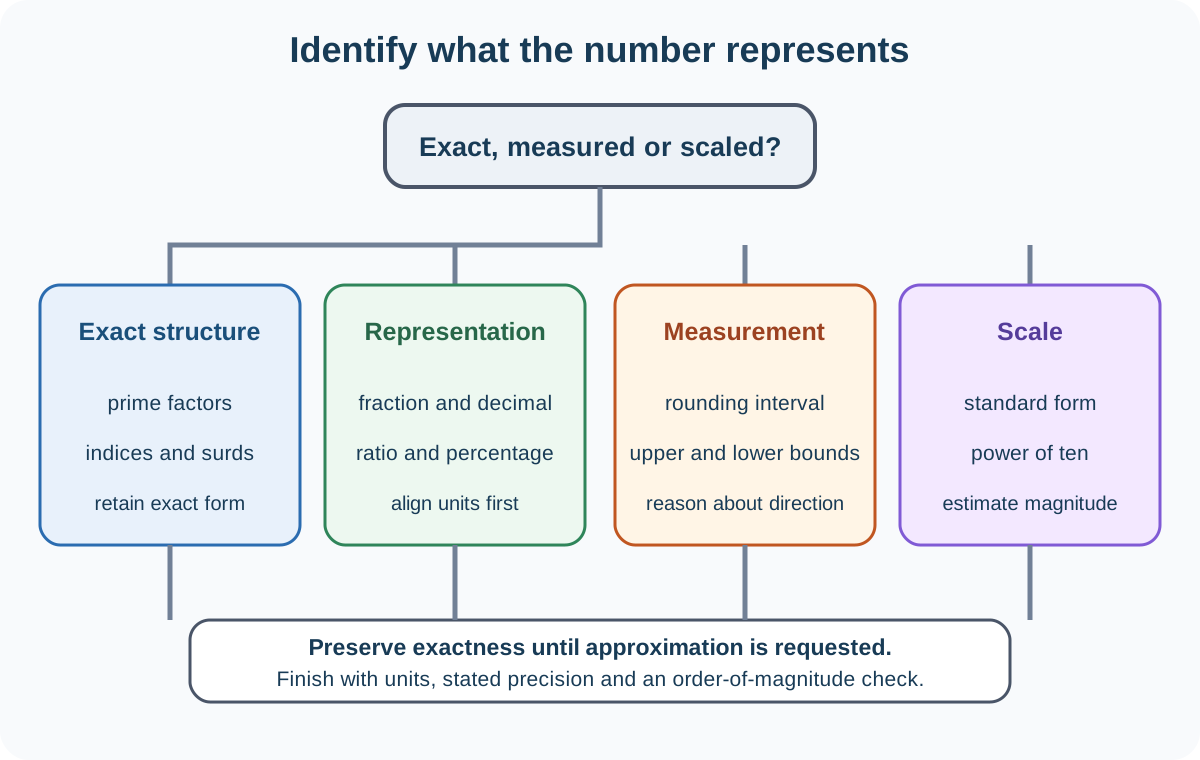
1. Arithmetic structure
The four operations are addition, subtraction, multiplication and division. Brackets determine grouping, while powers and roots are evaluated before multiplication or division, followed by addition or subtraction. Operations at the same priority are handled from left to right. A fraction bar acts as a grouping symbol for its whole numerator and denominator.
Estimate before calculating. Rounding inputs to one significant figure can reveal the expected order of magnitude and expose a misplaced decimal or incorrect calculator entry. An estimate is a check, not a substitute for the exact working requested.
Negative numbers need explicit brackets when raised to powers. The expression (-3)² equals 9, while -3² means the negative of 3² and equals -9. Similarly, subtracting a negative becomes addition, but the two signs should be simplified only after the operation is identified.
2. Prime factors, HCF and LCM
A prime number has exactly two positive factors, 1 and itself. The number 1 is not prime. Every positive integer greater than 1 can be written as a product of primes, uniquely apart from order.
Prime factor form makes highest common factors and lowest common multiples systematic. For the HCF, take each shared prime to the smaller exponent. For the LCM, take every prime present to the larger exponent. For example, if 72 = 2³ × 3² and 120 = 2³ × 3 × 5, then the HCF is 2³ × 3 = 24 and the LCM is 2³ × 3² × 5 = 360.
Use the HCF when dividing quantities into the largest equal groups with nothing left over. Use the LCM when finding the earliest repeat of cycles. The product relationship HCF(a, b) × LCM(a, b) = ab for positive integers provides a useful check.
3. Indices, powers and roots
For non-zero bases where expressions are defined:
- aᵐ × aⁿ = aᵐ⁺ⁿ;
- aᵐ/aⁿ = aᵐ⁻ⁿ;
- (aᵐ)ⁿ = aᵐⁿ;
- a⁰ = 1;
Check this topic from memory
Attempt the matching topic bank before reopening the notes. Use each missed idea to decide what to review next.
Start the topic quiz