

Pearson Edexcel International GCSE Mathematics B 2: Sets
Pearson Edexcel International GCSE Mathematics B 4MB1 notes on sets.
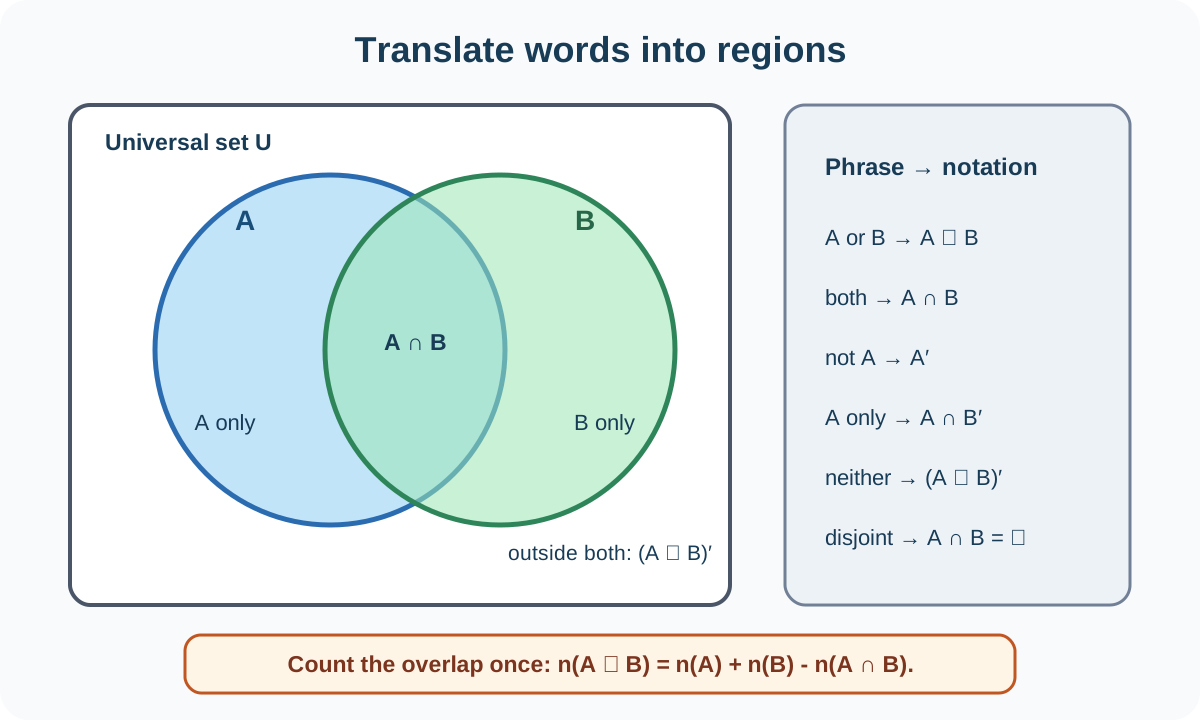
A set is a well-defined collection of distinct objects. Pearson Edexcel International GCSE Mathematics B (4MB1) requires set language and symbols, union, intersection, complements, subsets, the universal and null sets, numbers of elements, algebraically defined sets, and Venn diagrams for simple logical problems. Accurate notation matters because a misplaced complement or an incorrect region changes the logical claim.
1. Describing sets
Sets are usually named with capital letters and their elements are listed inside braces. For example, A = {2, 4, 6}. Order does not matter, and repeated entries do not create additional elements: {2, 4, 4, 6} describes the same set.
Roster notation lists elements. Set-builder notation states a rule, such as B = {x : x is an integer and 1 ≤ x < 5}. Here the colon means “such that”. The listed form is B = {1, 2, 3, 4}. When a set is defined algebraically, identify the underlying number domain. The solutions of x² = 4 differ depending on whether x is restricted to positive integers or allowed to be real.
The symbol x ∈ A means x is an element of A, while x ∉ A means it is not. These symbols relate an object to a set. They are different from subset symbols, which relate one set to another.
2. Universal and null sets
The universal set, often written U or ξ, contains every element under discussion. Complements are defined relative to it, so the universal set must be known before “not in A” is meaningful.
The null or empty set, ∅, has no elements. It is not the same as {0}, which contains one element, zero. It is also not {∅}, which contains the empty set as one element.
Every set is a subset of itself, and the empty set is a subset of every set. These statements concern containment, not whether the empty set is visibly listed as an element.
3. Subsets
If every element of A also belongs to B, then A is a subset of B. Notation conventions vary between texts for subset and proper subset, so interpret the symbols used by the question. A proper subset is contained in the larger set but is not equal to it.
A set with n elements has 2ⁿ subsets because each element has two choices: included or excluded. This count includes the empty set and the full set. It has 2ⁿ - 1 proper subsets if “proper” excludes the set itself.
To disprove A ⊆ B, it is enough to find one counterexample in
Check this topic from memory
Attempt the matching topic bank before reopening the notes. Use each missed idea to decide what to review next.
Start the topic quiz