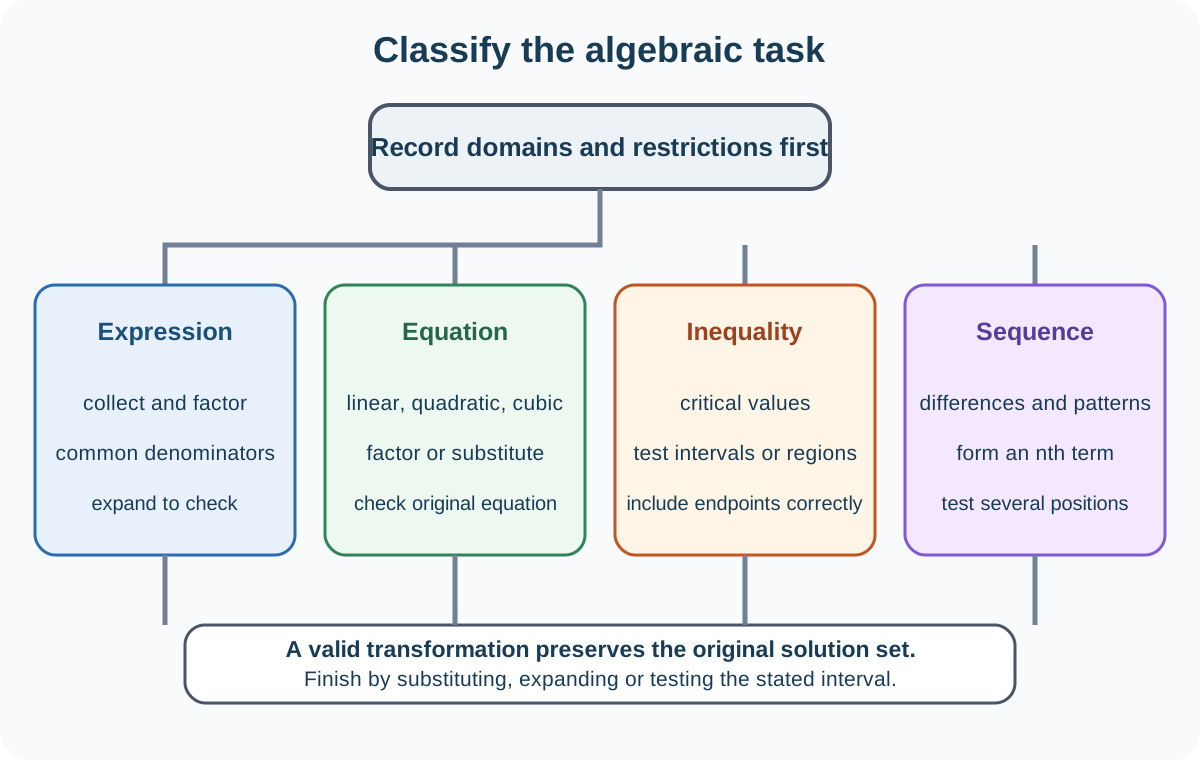
Algebra represents structure before particular numbers are known. Pearson Edexcel International GCSE Mathematics B (4MB1) covers algebraic operations with integer and fractional powers, formulae, factorisation, the factor theorem and cubic division, algebraic fractions, equations through cubic degree, two kinds of simultaneous equations, linear and quadratic inequalities, and recognition of arithmetic or common integer sequences. The topic rewards transformations that preserve equivalence and make restrictions visible.
1. Expressions and algebraic operations
Terms are like terms only when their variable parts and powers match. Thus 3x² + 5x² = 8x², but 3x² + 5x cannot be collected. Multiplication combines coefficients and uses index laws for shared bases. Division subtracts exponents and requires non-zero divisors.
Expand by multiplying every term. For two brackets, each term in one bracket multiplies every term in the other. Record signs explicitly. Factorisation reverses expansion and should be checked by multiplying back.
Common patterns include:
common factor: ab + ac = a(b + c);
difference of squares: a² - b² = (a - b)(a + b);
quadratic trinomials, where two bracket terms must reproduce both the middle term and constant;
grouping, where pairs reveal a common binomial factor.
Fractional powers follow the same index laws within their real domains. Do not combine unlike bases or add exponents across addition.
2. Formulae and changing the subject
A formula states a relationship among quantities. Substitution should use brackets around negative or compound values and retain units. To change the subject, apply inverse operations to both sides while respecting grouping.
If the required variable appears in several terms, collect those terms and factor it. For example, from P = ax + bx + c, subtract c, factor x(a + b), then divide to obtain x = (P - c)/(a + b), with a + b ≠ 0.
If the variable is squared, isolated square roots may create both positive and negative algebraic branches. A context such as length may permit only the positive value. If the variable is in a denominator, state restrictions and avoid multiplying by an expression that may be zero without preserving that case.
Dimensional consistency checks a formula: terms added together must have compatible units. It cannot prove a formula correct, but it can reveal many transcription errors.
3. Factor and remainder reasoning
Check this topic from memory
Attempt the matching topic bank before reopening the notes. Use each missed idea to decide what to review next.
For polynomial f(x), the remainder on division by (x - a) is f(a). Therefore (x - a) is a factor exactly when f(a) = 0. For a factor (px - q), its zero is x = q/p. Substitute that value rather than reading the constant with the wrong sign.
The factor theorem can determine an unknown coefficient or locate a linear factor of a cubic. Once a factor is known, divide the cubic by it using long division or coefficient methods, then factor or solve the remaining quadratic.
In algebraic long division, arrange descending powers and insert zero coefficients for missing powers. Divide leading terms, multiply back, subtract the entire row and repeat. The dividend equals divisor times quotient plus remainder. Expand this identity to verify the result.
If a cubic has three real or complex roots, its factorised form reflects them. Within the 4MB1 real-equation context, confirm every reported real root in the original polynomial.
4. Algebraic fractions
An algebraic fraction is undefined wherever its original denominator is zero. Record excluded values before factorising or cancelling. Cancellation removes common factors from a product, not separate terms across addition.
For addition or subtraction, find a common denominator and multiply complete numerators using brackets. For products, factor first and cancel common non-zero factors. For division, multiply by the reciprocal of the second fraction and include restrictions from both the original divisor and its numerator, because division by zero is undefined.
An equation containing algebraic fractions can be multiplied by a common denominator after exclusions are stated. Solve the resulting equation, then reject any candidate that makes an original denominator zero. Simplification may hide a hole but does not restore that input.
5. Linear and quadratic equations
Solving means finding values that make the original equation true. Linear equations use inverse operations while preserving equality. Expand and collect variable terms before dividing. If variables cancel, the equation may be true for every allowed input or inconsistent with no solution.
A quadratic can be solved by:
factorisation, when factors are accessible;
graphing, where horizontal intercepts give approximate roots;
completing the square, which also reveals the turning point;
the formula x = [-b ± √(b² - 4ac)]/(2a).
Rearrange to ax² + bx + c = 0 before identifying coefficients. The discriminant b² - 4ac classifies roots: positive gives two distinct real roots, zero one repeated root, and negative no real roots.
In contextual equations, both algebraic roots may not be admissible. Check signs, dimensions, domains and the original wording. A rounded root should be substituted using unrounded calculator precision when checking.
6. Cubic equations
A cubic equation may be solved by finding one root, applying the factor theorem, dividing by the corresponding linear factor and solving the remaining quadratic. Candidate rational roots can be tested from factors of the constant relative to factors of the leading coefficient, though the question structure often supplies a factor or enough information to infer one.
Do not stop after finding one root unless the question asks only for it. A cubic has up to three real roots, and a repeated factor affects multiplicity. Verify the factorisation by expansion or coefficient comparison.
7. Simultaneous equations
Two linear equations in two unknowns can be solved by elimination, substitution or graphing. Elimination scales equations so one variable cancels. Substitution expresses one variable in terms of the other. Graphically, the intersection is the common ordered-pair solution. Parallel distinct lines have no solution; equivalent lines have infinitely many.
When one equation is linear and the other quadratic, substitute the linear relationship into the quadratic equation. The result may have zero, one or two real solutions, matching the number of line-curve intersections. For each root, find the paired value from the linear equation. Do not combine all x roots with all y roots arbitrarily; each ordered pair belongs together.
Check every ordered pair in both original equations. This is especially important after squaring, clearing denominators or rounding.
8. Linear inequalities
Solve a linear inequality like an equation, but reverse the sign when multiplying or dividing by a negative quantity. Addition and subtraction do not reverse it. If the sign of a divisor is unknown, separate cases rather than dividing immediately.
On a number line, an open endpoint excludes the boundary and a closed endpoint includes it. Compound inequalities describe intersections or unions of intervals. Preserve the distinction between “and” and “or”.
In two dimensions, a linear inequality represents a half-plane. Draw its boundary line first. Use a solid line when equality is included and a dashed line when it is not. Test a point not on the line to decide which side to shade. Simultaneous inequalities require the overlap of all permitted regions. Pearson states that linear programming questions will not be set, so optimization over such regions is not treated as required here.
9. Quadratic inequalities
Move all terms to one side, factor or find roots, and create sign intervals. A continuous quadratic can change sign only at a real root. For an upward-opening quadratic with two distinct roots, it is negative between the roots and positive outside; a downward-opening quadratic reverses this pattern.
Include roots for non-strict inequalities and exclude them for strict ones. At a repeated root, the sign does not change. If there are no real roots, the quadratic keeps the sign of its leading coefficient for all real inputs. A sign chart or sketch should support the final number-line set.
10. Sequences
An arithmetic sequence has a constant difference. With first term a and difference d, its nth term is a + (n - 1)d. Pearson's stated boundary also includes recognition and continuation of common integer sequences. Examine differences, ratios and familiar structures such as squares, cubes, triangular numbers or alternating patterns.
A finite list does not uniquely determine one mathematical sequence, so use the simplest rule supported by the question's context. Confirm a proposed nth term against several given positions. Keep term number distinct from term value.
Worked example: linear-quadratic simultaneous equations
Solve y = x + 1 and x² + y² = 25. Substitute the linear equation into the quadratic relation: x² + (x + 1)² = 25. Expanding gives 2x² + 2x - 24 = 0, so x² + x - 12 = 0. Factorising gives (x + 4)(x - 3) = 0, hence x = -4 or x = 3. Pair each with y = x + 1: the solutions are (-4, -3) and (3, 4). Check: both pairs satisfy the line, and their squared coordinates sum to 25. The two solutions correspond to the two intersections of the line and the quadratic curve. Reporting the four possible cross-pairings would be incorrect because substitution links each y to its own x.
Common misconceptions and how to correct them
Collecting unlike powers as like terms. Variable parts and exponents must match exactly.
Cancelling terms joined by addition. Factor the numerator or denominator first; only common multiplicative factors cancel.
Forgetting domain restrictions after cancellation. Record original denominator zeros before simplifying.
Reading the root of (ax + b) as b/a. Set the factor equal to zero, giving x = -b/a.
Omitting zero placeholders in cubic division. Write every descending power so columns align.
Using quadratic coefficients before rearranging to zero. Put the equation in standard form first.
Forgetting the ± branch after taking a square root. Include both algebraic possibilities, then apply contextual restrictions.
Stopping after one cubic root. Divide out its factor and solve the remaining quadratic.
Pairing simultaneous-equation coordinates independently. Each second coordinate comes from substituting its corresponding first coordinate.
Reversing an inequality after addition. Reversal occurs only after multiplication or division by a negative quantity.
Using a solid boundary for a strict two-dimensional inequality. Strict inequalities exclude the line and need a dashed boundary.
Assuming a quadratic changes sign at a repeated root. Even multiplicity gives tangency and no sign change.
Using nd for an arithmetic nth term. There are n - 1 differences after the first term.
Assessment guidance
Preserve equivalence line by line and state restrictions before clearing denominators or cancelling. In factor-theorem work, show the relevant substitution and verify the resulting division. For quadratics, choose an efficient method but retain exact roots unless approximation is requested. Cubic solutions need all remaining factors investigated. Simultaneous equations should end as checked ordered pairs. Inequality answers require correct endpoint inclusion and a sign chart, graph or test-point justification; two-dimensional regions need the correct boundary style and shading. In formula work, use brackets for substitution and give the changed subject explicitly. For sequences, state the structural evidence and test the nth term against the listed positions. A final substitution or expansion check is often the fastest way to protect method marks.
Retrieval practice
Factor and re-expand one quadratic and one cubic, state the factor theorem, and perform a cubic division with a missing-power placeholder. Then simplify an algebraic fraction while retaining exclusions, solve linear-linear and linear-quadratic simultaneous systems, represent one linear and one quadratic inequality, and derive an arithmetic nth term from its first terms.