

Pearson Edexcel International GCSE Mathematics B 5: Matrices
Pearson Edexcel International GCSE Mathematics B 4MB1 notes on matrices.
A matrix is a rectangular array that can represent data or a linear transformation. Pearson Edexcel International GCSE Mathematics B (4MB1) covers data matrices, addition, multiplication and scalar multiplication up to order 3 by 3, identity and zero matrices, determinants and inverses of non-singular 2 by 2 matrices, plane transformations, and combinations of transformations. Order matters throughout: matrix dimensions control whether an operation is defined, and a product reads as transformations applied from right to left.
1. Matrix language and data
A matrix with m rows and n columns has order m × n. The entry in row i, column j is often written aᵢⱼ. State which categories label rows and columns when a matrix represents data; otherwise a correct array may be interpreted backwards.
For example, rows might represent shops and columns represent three products. Each entry then gives the quantity of one product at one shop. A row total aggregates products for one shop, while a column total aggregates one product across shops. Units belong to entries and any computed totals.
Two matrices are equal only if they have the same order and every corresponding entry is equal. This fact can generate simultaneous scalar equations when entries contain unknowns.
2. Addition and scalar multiplication
Matrices can be added or subtracted only when they have the same order. Operate entry by entry. The rule reflects combining quantities in matching positions, so adding unlike dimensions has no defined meaning.
Multiplying matrix A by scalar k multiplies every entry by k. It does not change the matrix order. Scalar multiplication distributes over matrix addition.
The zero matrix has every entry zero and acts as the additive identity: A + 0 = A. Its order must match A for the sum. Do not confuse the scalar zero with a zero matrix whose dimensions matter.
3. Matrix multiplication
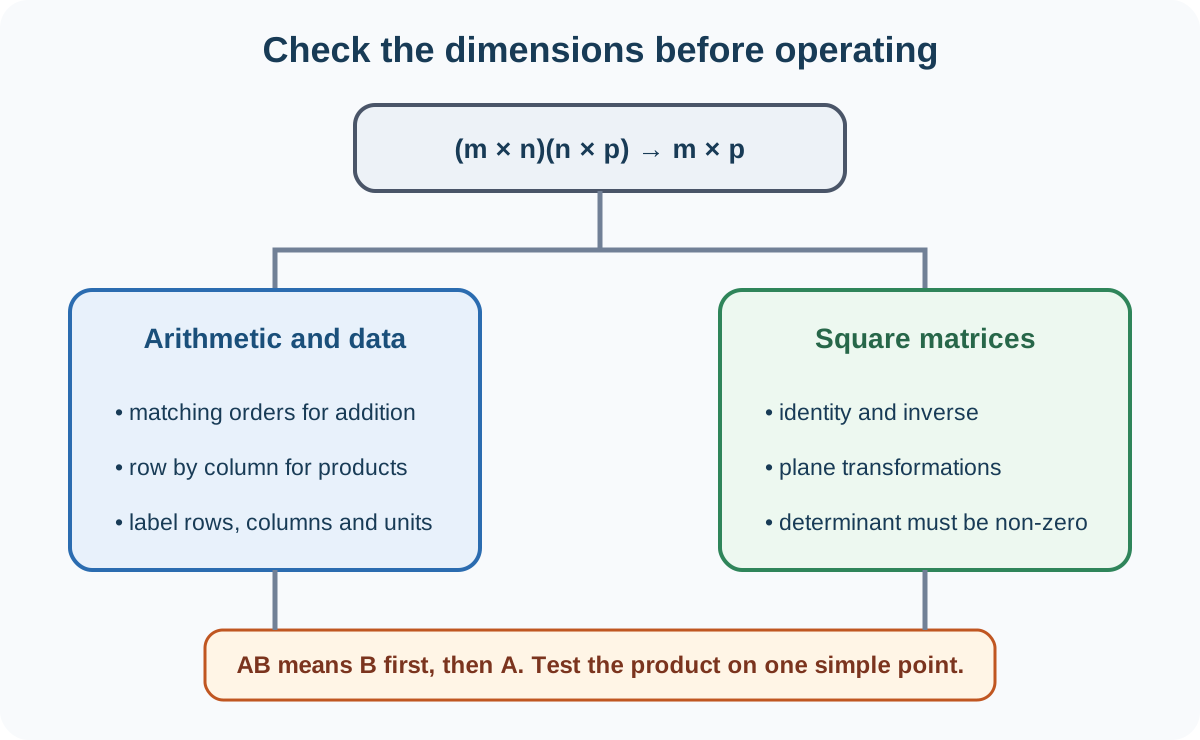
The product AB is defined when the number of columns of A equals the number of rows of B. If A is m × n and B is n × p, then AB is m × p. The inner dimensions must match; the outer dimensions give the result.
Each entry is a row-column dot calculation: multiply corresponding entries from one row of A and one column of B, then add. For a 2 by 2 example,
if A has rows (a, b) and
Check this topic from memory
Attempt the matching topic bank before reopening the notes. Use each missed idea to decide what to review next.
Start the topic quiz