

Pearson Edexcel International GCSE Mathematics B 6: Geometry
Pearson Edexcel International GCSE Mathematics B 4MB1 notes on geometry.
Geometry turns diagram features into justified conclusions. Pearson Edexcel International GCSE Mathematics B (4MB1) includes Euclidean reasoning, angles and polygons, quadrilateral properties, symmetry, two- and three-dimensional Pythagoras, similarity and congruence, circle theorems including intersecting chords and the alternate segment theorem, cyclic quadrilaterals, loci, and ruler-and-compass constructions. Formal proofs of theorems are not required, but applying them in a problem demands a clear reason at each step.
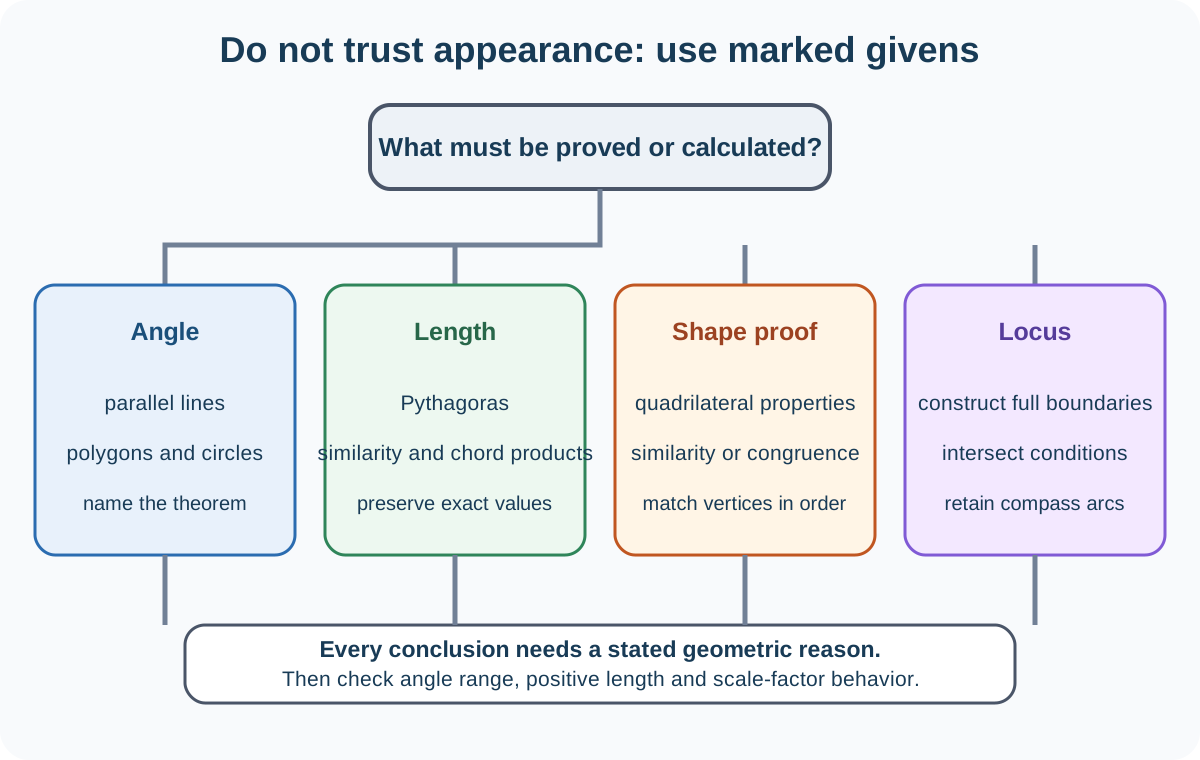
1. Geometrical reasoning
A diagram is evidence only when its markings or the question state a property. Do not assume lines are parallel, angles equal or a drawing to scale. Translate each given into a usable fact, select a theorem and state the conclusion.
Pearson allows traditional angle or congruence methods, vectors, transformations, or a mixture. Choose the shortest valid route. A good reason names the relevant relationship, such as “alternate angles in parallel lines” or “radii of the same circle”, rather than saying only “angles are equal”.
Directed angles are positive anticlockwise and negative clockwise under the specification convention. This matters when rotations or bearings are described algebraically.
2. Angles and polygons
Angles on a straight line total 180°, around a point total 360°, and vertically opposite angles are equal. When a transversal crosses parallel lines, corresponding and alternate angles are equal, while co-interior angles total 180°. Converse statements can prove lines parallel.
The interior angles of a triangle total 180°. An exterior angle equals the sum of the two remote interior angles. The interior-angle sum of an n-sided polygon is (n - 2)180°, found by splitting it into triangles. The exterior angles, one at each vertex in a consistent direction, total 360°.
For a regular polygon, each exterior angle is 360°/n and each interior angle is 180° - 360°/n. If a calculated side count is not a positive integer of at least three, the proposed regular polygon cannot exist.
3. Quadrilaterals
A parallelogram has opposite sides parallel and equal, opposite angles equal, adjacent angles supplementary and diagonals bisecting each other. A rectangle adds right angles and equal diagonals. A rhombus has four equal sides, perpendicular diagonals and diagonals that bisect opposite angles. A square has all rectangle and rhombus properties.
A trapezium has one pair of parallel sides under the convention used in many examination contexts; check any definition supplied. A kite has two pairs of adjacent equal sides, one pair of opposite equal angles, and perpendicular diagonals, with one diagonal bisecting the other.
Check this topic from memory
Attempt the matching topic bank before reopening the notes. Use each missed idea to decide what to review next.
Start the topic quiz