

Pearson Edexcel International GCSE Mathematics B 7: Mensuration
Pearson Edexcel International GCSE Mathematics B 4MB1 notes on mensuration.
Mensuration calculates lengths, areas and volumes from geometric dimensions. Pearson Edexcel International GCSE Mathematics B (4MB1) includes standard and compound two-dimensional shapes, standard and composite three-dimensional solids, and arc lengths and sector areas using degrees. Radian measure is explicitly excluded from this topic. Reliable solutions identify the required measure, select dimensions perpendicular to one another, preserve units and separate added material from removed material.
1. Dimensional meaning and units
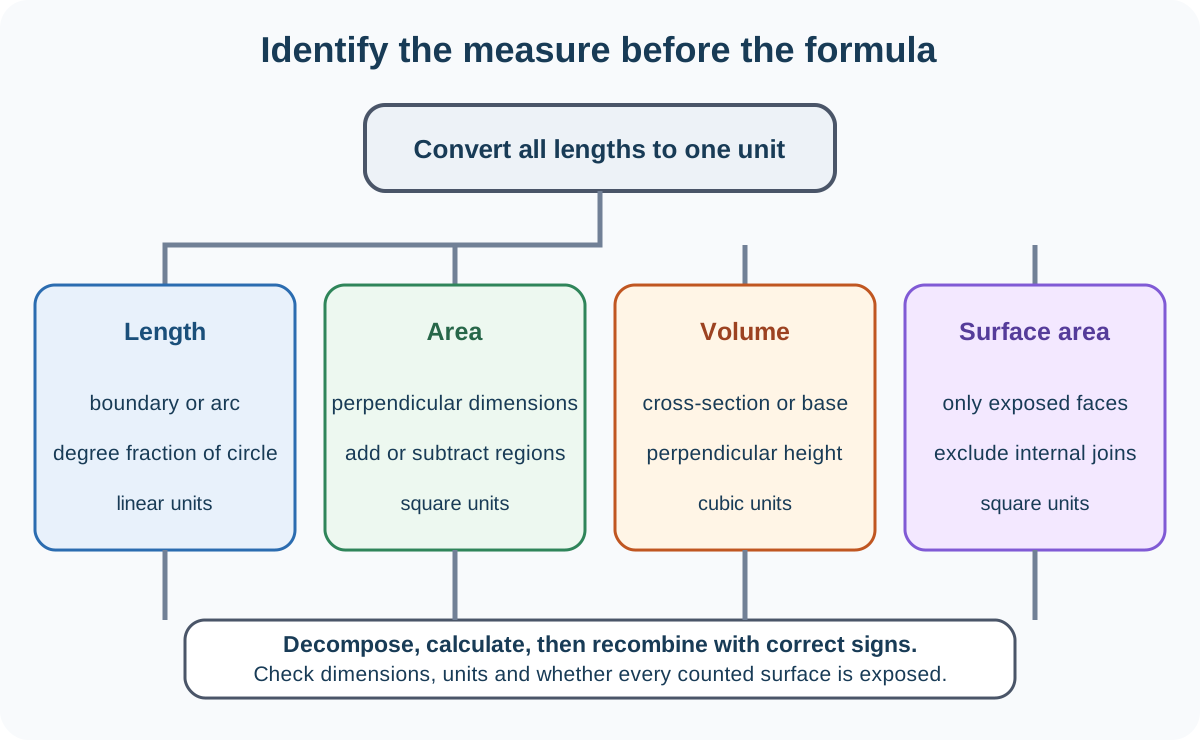
Length measures one dimension and uses units such as millimetres, centimetres or metres. Area measures a two-dimensional region and uses squared units. Volume measures three-dimensional space and uses cubed units. Capacity is related to volume, with 1 cm³ = 1 mL and 1000 cm³ = 1 L.
Convert every length to a common unit before applying a formula. A linear conversion factor is squared for area and cubed for volume. For example, 1 m² = 10,000 cm², not 100 cm².
A perimeter or circumference adds boundary lengths. Area covers a surface or region. Volume fills a solid. Surface area covers exposed faces. Identify which quantity the wording requests before calculating.
2. Rectangles, parallelograms and triangles
For a rectangle, area = length × width. For a parallelogram, area = base × perpendicular height. A sloping side is not the height unless it is perpendicular to the chosen base.
For a triangle, area = (1/2) × base × perpendicular height. The altitude may lie outside an obtuse triangle. Any side can be selected as the base if the corresponding perpendicular height is used.
The area of a trapezium is (1/2)(a + b)h, where a and b are parallel sides and h is their perpendicular separation. The non-parallel sloping sides do not replace h.
For an irregular polygon, divide it into known shapes or place it inside a larger shape and subtract unwanted regions. Mark dimensions introduced by subtraction or Pythagoras and ensure regions neither overlap nor leave gaps.
3. Circles, arcs and sectors
For radius r, circumference is 2πr and area is πr². Diameter is 2r. Leave answers in terms of π when exact form is requested; otherwise use the calculator's π value and round only at the end.
For a central angle θ measured in degrees,
arc length = (θ/360°) × 2πr,
and
sector area = (θ/360°) × πr²
Check this topic from memory
Attempt the matching topic bank before reopening the notes. Use each missed idea to decide what to review next.
Start the topic quiz