

Pearson Edexcel International GCSE Mathematics B 8: Vectors and transformation geometry
Pearson Edexcel International GCSE Mathematics B 4MB1 notes on vectors and transformation geometry.
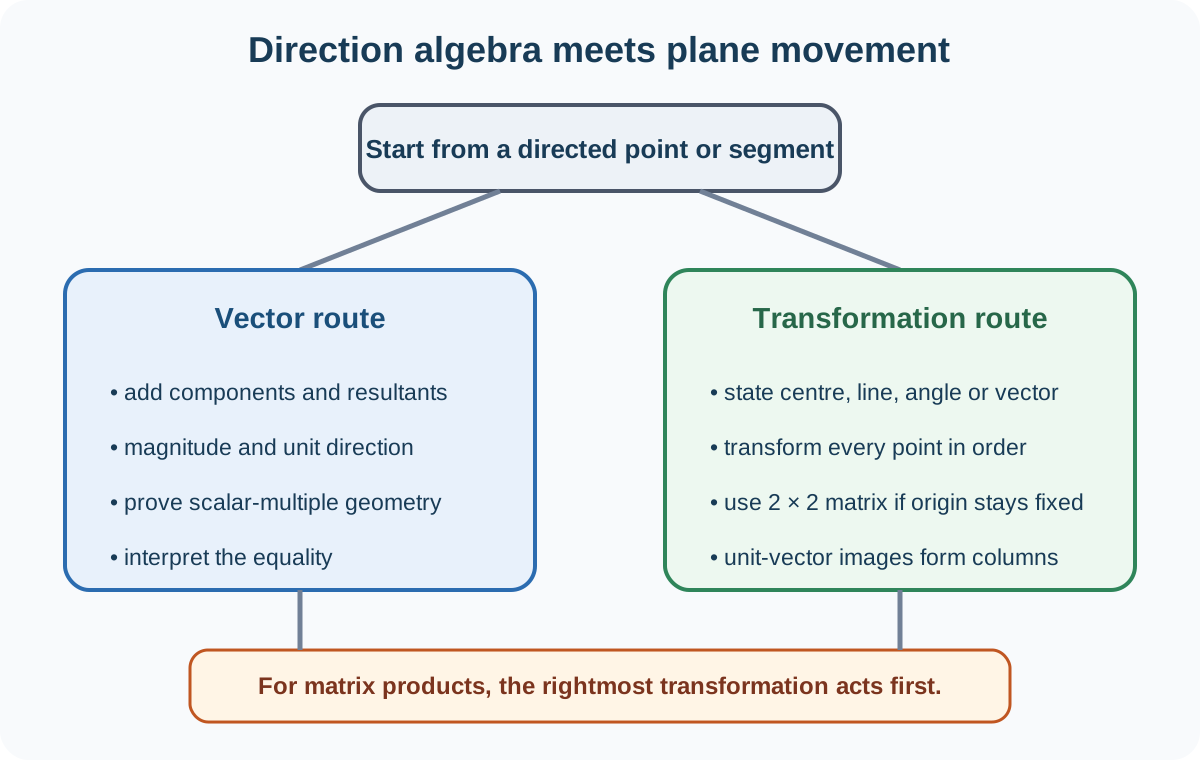
Vectors describe magnitude and direction, while transformations describe systematic movement of every point in the plane. Pearson Edexcel International GCSE Mathematics B (4MB1) restricts vectors here to two dimensions and includes notation, directed segments, position and unit vectors, arithmetic, resultants and geometry proofs. It also includes reflections in any line, rotations about any point, translations, enlargements, combinations, and matrix action for transformations that leave the origin fixed.
1. Scalar and vector quantities
A scalar has magnitude only, such as mass, time or temperature. A vector has magnitude and direction, such as displacement, velocity or force. A negative scalar multiple of a vector reverses its direction rather than making its magnitude negative.
Vectors may be written in bold, with an arrow, or as two-entry columns. A directed segment from A to B is AB. Reversing direction gives BA = -AB. Equal free vectors have the same magnitude and direction even if drawn in different locations.
The zero vector has magnitude zero and no unique direction. It acts as the additive identity but should not be used to infer a line direction.
2. Components, addition and resultants
A two-dimensional vector can be represented by horizontal and vertical components. Add or subtract corresponding components. Geometrically, addition follows a head-to-tail route: AB + BC = AC. Subtraction is addition of the opposite vector.
Multiplication by scalar k multiplies every component. If k > 0, direction is preserved; if k < 0, direction reverses. Parallel non-zero vectors are scalar multiples of one another.
The resultant of several vectors is their sum. A closed vector path has zero resultant. In a force or travel context, keep units and distinguish resultant displacement from total distance, which adds path lengths rather than directed components.
3. Magnitude and unit vectors
For vector a with components (p, q),
|a| = √(p² + q²).
Magnitude is a non-negative scalar. The unit vector in the direction of non-zero a is a divided by |a|. It retains the direction signs and has magnitude 1.
If a vector of specified magnitude M is required in the direction of a, multiply its unit vector by M. Check the resulting magnitude using Pythagoras.
Do not add vector magnitudes unless vectors point in the same direction. In general, find the resultant components first, then calculate their combined magnitude.
Check this topic from memory
Attempt the matching topic bank before reopening the notes. Use each missed idea to decide what to review next.
Start the topic quiz