

Pearson Edexcel International GCSE Mathematics B 9: Trigonometry
Pearson Edexcel International GCSE Mathematics B 4MB1 notes on trigonometry.
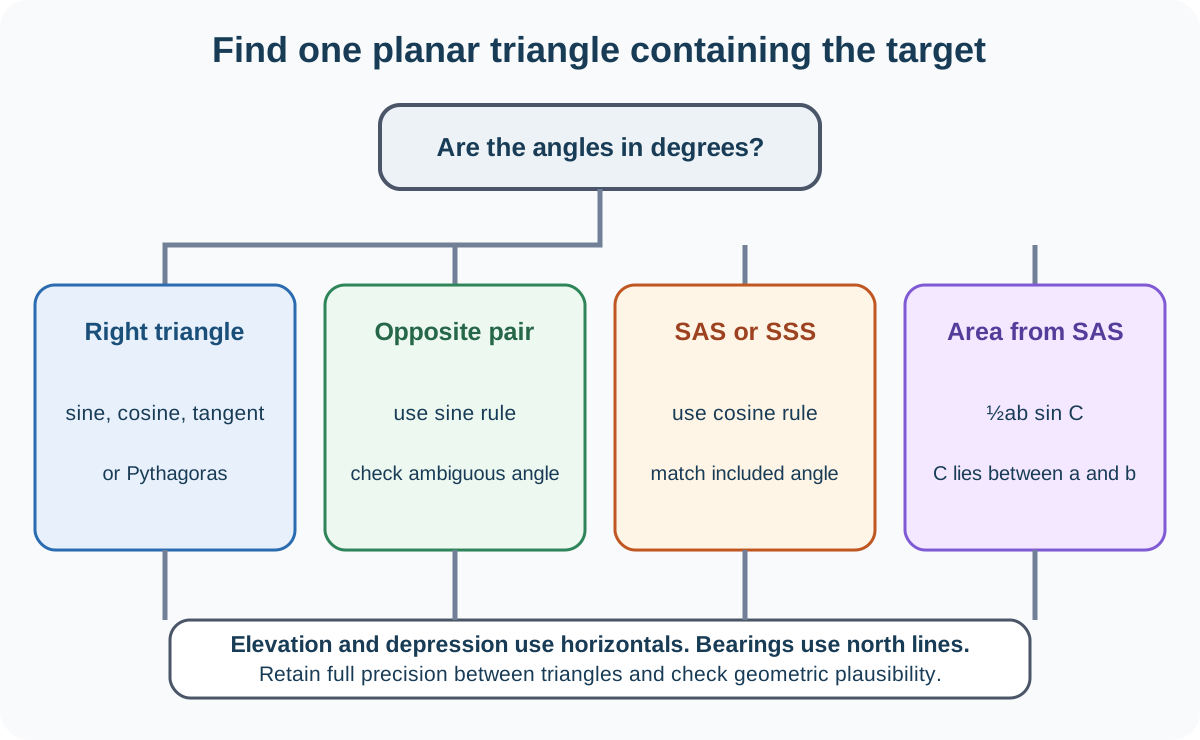
Trigonometry links angles and lengths in two and three dimensions. Pearson Edexcel International GCSE Mathematics B (4MB1) uses sine, cosine and tangent for angles up to 180°, measured in degrees and decimal degrees; sine and cosine rules; the triangle area formula; scale drawing; angles of elevation and depression; and clockwise three-figure bearings. Latitude and longitude, angles between two planes, and angles between a line and a plane are explicitly excluded.
1. Right-triangle ratios
In a right triangle relative to angle θ:
sin θ = opposite/hypotenuse,
cos θ = adjacent/hypotenuse,
and tan θ = opposite/adjacent.
The hypotenuse is opposite the right angle and is the longest side. “Opposite” and “adjacent” depend on the chosen angle. Label the triangle before selecting a ratio.
To find a side, rearrange the ratio algebraically. To find an angle, use the appropriate inverse trigonometric function. The calculator must be in degree mode. Preserve full precision during multi-stage problems and round only the final answer.
Pythagoras may be quicker when two sides of a right triangle are known and only the third side is needed. Trigonometry is necessary when angle information connects the dimensions.
2. Angles up to 180 degrees
For acute angles, sine, cosine and tangent have the familiar right-triangle signs. Between 90° and 180°, sine remains positive, while cosine and tangent are negative. A reference angle relates an obtuse angle to an acute one.
Inverse sine can produce an acute principal value even when a triangle's valid angle is obtuse. In non-right-triangle problems, test the supplementary angle 180° - θ where the sine rule creates an ambiguous case.
Answers in decimal degrees should not be converted into degrees and minutes unless requested. A value such as 37.6° means 37 degrees plus six-tenths of a degree, not 37 degrees 6 minutes.
3. Sine rule
For a triangle with sides a, b, c opposite angles A, B, C:
a/sin A = b/sin B = c/sin C.
Use the sine rule when there is a known opposite side-angle pair. Match each side with the angle directly opposite it. For an unknown side, a side-over-sine arrangement is convenient; for an unknown angle, the reciprocal form may reduce rearrangement.
The ambiguous case occurs when two sides and a non-included angle are given. If sin B = k, both
Check this topic from memory
Attempt the matching topic bank before reopening the notes. Use each missed idea to decide what to review next.
Start the topic quiz