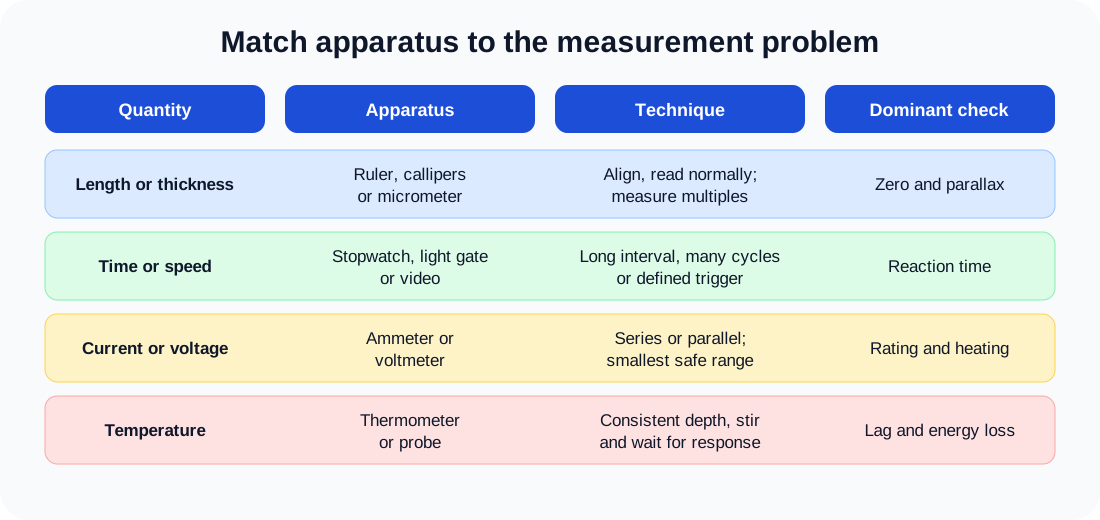
Reliable measurement begins with apparatus whose range and resolution suit the expected quantity.
In Pearson 4PH1 written practical questions, apparatus choice is part of the physics argument. A named instrument earns little if its connection, range, scale-reading method or limitation is wrong. The aim is to collect readings that can resolve the expected effect without overloading equipment or implying unsupported precision.
Measurement choices
Check and record zero error before measuring.
Read analogue scales perpendicular to the pointer or marker to reduce parallax.
Use light gates or video when human reaction time would dominate short intervals.
Measure multiple wavelengths, oscillations or thicknesses and divide to reduce percentage uncertainty.
Select ammeter and voltmeter ranges that protect instruments while giving useful resolution.
Repeat fluctuating readings and report a representative mean with sensible precision.
Range, resolution and uncertainty
The range is the span of values an instrument can measure. The resolution is the smallest scale division or display change it can distinguish. Neither term guarantees accuracy, which describes closeness to the accepted value. A high-resolution sensor can give consistently biased readings if it is badly calibrated.
Choose the smallest safe range that includes the expected reading. On a multirange ammeter, begin with a high range to protect the meter, then reduce the range for finer resolution if the current is safely below the limit. Never exceed a meter or sensor rating. A pilot measurement can establish the approximate value before the final range is selected.
For a single analogue reading, an uncertainty related to about half the smallest division is often a reasonable school-level estimate when the scale can be interpolated. For a change found from two readings, both endpoints contribute uncertainty. More important than memorising a rule is recognising when the uncertainty is large compared with the measured change. Measuring an extension of only 2mm
Check this topic from memory
Attempt the matching topic bank before reopening the notes. Use each missed idea to decide what to review next.
with a millimetre ruler gives weak relative precision; increasing the safe force range may produce a more resolvable extension.
Length, thickness and volume
Place a ruler close and parallel to the object, align a defined zero or record both endpoint readings, and view perpendicular to the scale. A set square or pointer can transfer an object's position to the scale. If the ruler has a damaged end, start at a different graduation and subtract the two readings rather than assuming the physical edge is zero.
For one thin sheet or wire, measure many identical layers or turns and divide. Twenty sheets producing a measurable total thickness reduce the percentage effect of the same absolute scale uncertainty. This method is valid only when the layers are tightly packed without gaps or compression that changes their thickness.
Measure liquid volume at eye level using the correct meniscus and a measuring cylinder of suitable capacity. Density work may require displacement for an irregular solid. Record the initial and final water levels, submerge the object fully, remove trapped air and calculate the difference. An object that floats needs a justified sinking method whose own displaced volume is accounted for.
Time, motion and repeated cycles
Human reaction time can dominate a short stopwatch interval. Increase the measured duration by timing a longer distance, several oscillations or many rotations, then divide where appropriate. Use the same clearly defined event to start and stop. For a pendulum, one complete oscillation returns to the same position moving in the same direction; counting half-cycles as full cycles doubles the calculated period incorrectly.
Light gates improve timing when a trolley or card interrupts a beam. A single gate can measure the time for a card of known length to pass, giving speed near the gate from card length divided by interruption time. Two gates can measure travel time between known positions. The card length, gate mode and distance definition must match the intended calculation. Video analysis can provide position at known frame intervals, but the camera should be fixed, perpendicular to the motion and calibrated with a scale in the same plane.
Electrical and thermal measurements
Connect an ammeter in series so the component current passes through it. Connect a voltmeter in parallel across the component. Check polarity for direct current and switch off before changing connections. The current can heat a filament or resistor and change its resistance, so take prompt readings, use low current where appropriate or allow cooling between trials when temperature should be controlled.
A thermometer or probe needs time to respond. Keep the sensing region immersed to a consistent depth without touching the container, stir gently when uniform temperature is required and wait for a stable reading. In calorimetry, insulation, a lid and prompt readings reduce energy transfer to the surroundings, but they do not eliminate it. State the likely direction of the resulting bias rather than claiming perfect insulation.
Zeroing, calibration and parallax
Check whether an unloaded balance, force meter or sensor reads zero. Reset it if possible; otherwise record the zero offset and correct every measurement consistently. A zero error is systematic, so taking more readings does not remove it. Calibration goes further by comparing output with known reference values across the working range. A sensor that reads zero correctly may still have an incorrect scale factor.
Parallax occurs when a pointer or marker is viewed from an angle relative to the scale. Read at eye level and perpendicular to the scale, or use a mirror scale and align the pointer with its reflection. Digital displays remove pointer parallax but can still fluctuate, round values or respond slowly. Record readings only after the stated stable condition is reached.
Precision in records and calculations
Record repeated direct measurements to consistent decimal places determined by the instrument. Do not delete trailing zeros that communicate measurement resolution. A calculation should not suddenly acquire many meaningful digits. Keep extra digits during working, then round the final value to a precision supported by the least precise input and the context. Include units and convert to a consistent unit system before substituting into an equation.
Worked application
Determine the period of a pendulum using a stopwatch. Measure the pendulum length from the pivot to the centre of the bob with a millimetre ruler, keeping the ruler beside the string and viewing perpendicular to it. Displace the bob by a small angle and release it without a push. After one settling pass, start timing as the bob crosses a fixed centre marker. Time 20 complete oscillations, stopping when it crosses the marker in the same direction after the twentieth cycle. Divide the total time by 20. Repeat the release and timing at least three times, reject an anomaly only with evidence, and calculate the mean period. Timing many cycles makes the fixed reaction-time uncertainty a smaller percentage of the measured interval. Keep length and release angle constant. Secure the clamp stand and keep the swing path clear. A light gate could reduce reaction-time uncertainty further, but its position and trigger event must still be defined.
Common mistakes
Treating resolution and accuracy as synonyms.
Connecting an ammeter in parallel.
Recording calculated values to greater precision than the measurements justify.
Choosing a very fine meter range before checking that the reading will not overload it.
Measuring pendulum length only to the top of the bob instead of its centre.
Repeating a reading while leaving the same systematic zero error uncorrected.
Claiming that a digital instrument has no uncertainty because it has no pointer.
Measuring one very short interval when the same process can be accumulated over many cycles.
Assessment guidance
When asked to choose or improve apparatus, identify the measurement problem first. Name the required range, resolution, response or connection and explain why the proposed instrument changes the evidence. Use a more accurate instrument is too vague unless the answer identifies, for example, a light gate that reduces reaction-time uncertainty or a smaller scale division that resolves a short extension. For scale diagrams, state the reading with a unit and appropriate precision, after checking zero and viewing direction. In uncertainty questions, distinguish random scatter from a systematic offset and compare uncertainty with the size of the effect. Preserve sensible significant figures in calculated answers and never infer precision that the raw readings do not support.
Check yourself
Explain why timing ten oscillations can be better than timing one, even with the same stopwatch.
Then decide: Which start and stop event will you use? How will you count complete cycles? Which uncertainty is reduced as a percentage, and which possible zero or length error remains? When would a light gate produce a material improvement?
Official specification boundary
This note develops measurement and apparatus skills embedded throughout Pearson Edexcel International GCSE Physics 4PH1. These skills are assessed through written questions and do not constitute a separate timetabled practical examination. Always check the specification issue used for the intended examination series.